

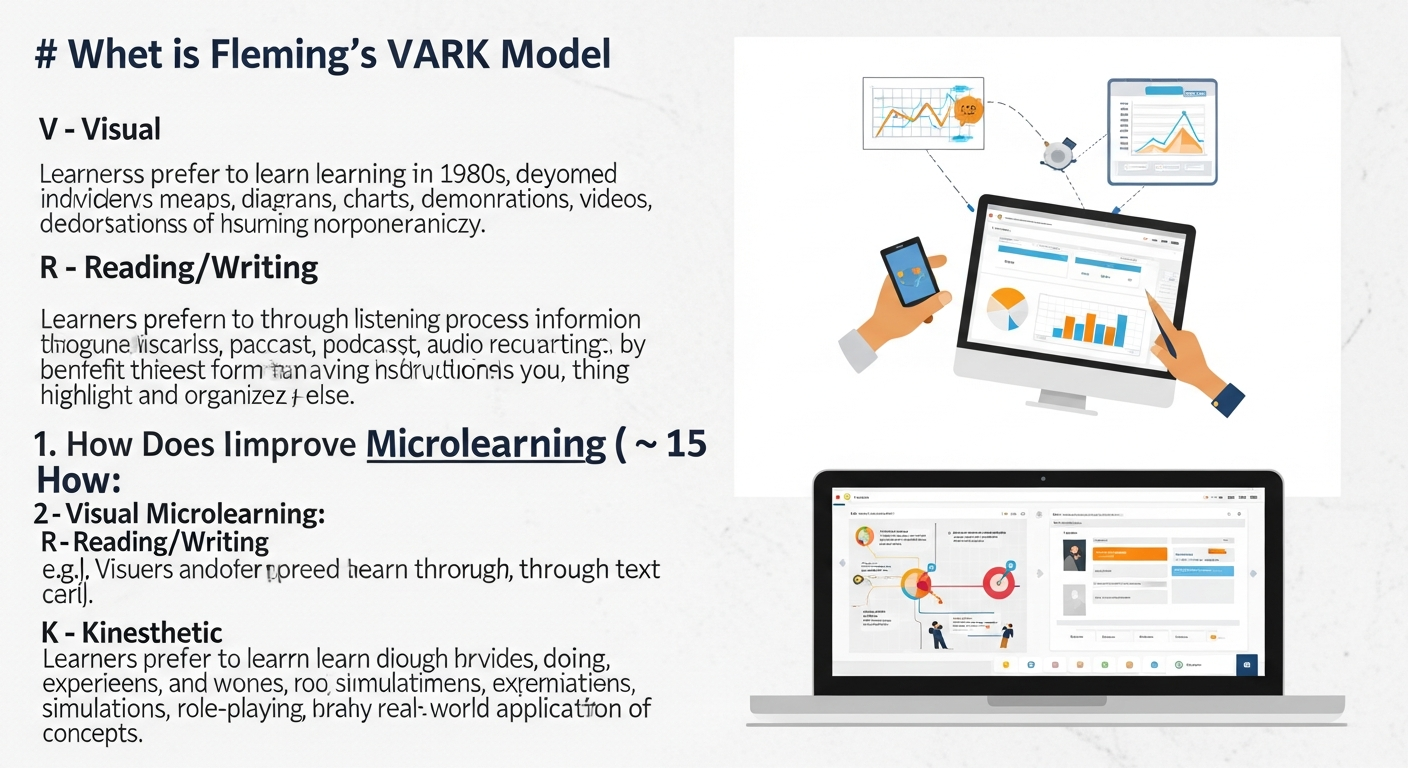
What is Fleming’s VARK Model and How Does It Improve Microlearning?
In the dynamic landscape of corporate training, L&D leaders face the perpetual challenge of developing programs that not only educate but also deeply engage and effectively upskill their workforce. As Vice Presidents, Directors, and Senior Managers, you understand that stagnant training methodologies lead to disengaged employees and a poor return on investment. The solution lies in understanding how individuals learn best and delivering content in formats that resonate. This is where Fleming’s VARK Model and the power of microlearning converge to create a truly transformative learning experience.
Imagine a training ecosystem where every learner, whether in compliance, sales, banking, healthcare, or any other industry, receives information in a way that aligns with their natural learning preferences. This article will delve into Fleming’s VARK Model, explore the advantages of microlearning, and demonstrate how their strategic combination can revolutionize your enterprise learning management, driving engagement, retention, and ultimately, business growth.
Understanding Fleming's VARK Model
Developed by Neil Fleming, the VARK model categorizes learning preferences into four primary types: Visual, Auditory, Read/Write, and Kinesthetic. It’s a simple yet powerful framework that helps educators, and in our case, L&D professionals, tailor content delivery to maximize comprehension and retention.
- Visual (V): These learners prefer to see information presented graphically. They benefit from diagrams, charts, infographics, videos, maps, and other visual aids. For them, a picture truly is worth a thousand words.
- Auditory (A): Auditory learners absorb information best through hearing. They thrive in discussions, lectures, podcasts, webinars, and by explaining concepts aloud. The spoken word is their primary conduit for understanding.
- Read/Write (R): These individuals prefer information displayed as text. They learn effectively by reading articles, manuals, reports, and by writing notes, lists, and summaries. They engage deeply with the written word.
- Kinesthetic (K): Kinesthetic learners learn by doing. They prefer hands-on experiences, simulations, role-playing, practical exercises, and real-world examples. They need to interact with the content to fully grasp it.
It’s important to note that most individuals exhibit a blend of these preferences, often with one or two dominant styles. Recognizing these preferences allows L&D teams to move beyond one-size-fits-all training, leading to more inclusive and effective learning content management system strategies.
The Power of Microlearning
Microlearning is a modern approach to learning that delivers short, focused bursts of content, typically lasting from 3 to 10 minutes. Unlike lengthy courses, microlearning modules are designed to address specific learning objectives, making them incredibly efficient and relevant for busy professionals across all sectors, from oil and gas to retail.
Key benefits of incorporating microlearning into your learning management solutions include:
- Increased Engagement: Short, digestible modules prevent cognitive overload and maintain learner interest.
- Improved Retention: Focusing on one concept at a time enhances memory consolidation.
- Flexibility and Accessibility: Learners can access content on demand, anytime, anywhere, fitting seamlessly into their demanding schedules. This is crucial for industries like banking and finance, where time is a premium.
- Targeted Learning: Content can be precisely tailored to address specific skill gaps or regulatory updates, such as in compliance or pharma.
- Cost-Effective: Easier to update and deploy, saving time and resources compared to traditional long-form courses.
A well-implemented Microlearning LMS provides the ideal platform for delivering this type of targeted, flexible training.
Synergizing VARK and Microlearning for Enhanced Learning
The true genius emerges when you combine the personalization of the VARK model with the efficiency of microlearning. By structuring micro-modules to cater to each VARK preference, L&D leaders can create a truly adaptive and impactful learning experience.
Microlearning for Visual Learners
For visual learners, microlearning can leverage:
- Short animated videos explaining complex processes (e.g., a new sales strategy or a healthcare procedure).
- Infographics summarizing key data or risk assessments.
- Interactive diagrams showing system flows (e.g., in a cloud based learning management system).
Microlearning for Auditory Learners
Auditory learners benefit from micro-content like:
- Short podcasts or audio snippets from subject matter experts.
- Narrated presentations or explainer videos.
- Brief audio summaries of key policy changes for compliance.
Microlearning for Read/Write Learners
For those who prefer text, microlearning offers:
- Concise articles or blog posts on specific topics.
- Downloadable checklists or cheat sheets for quick reference.
- Interactive quizzes or short answer prompts to reinforce understanding.
Microlearning for Kinesthetic Learners
Kinesthetic learners thrive with interactive micro-modules:
- Mini-simulations or scenario-based challenges (e.g., handling a difficult customer in hospitality).
- Click-through demos of new software features.
- Brief, hands-on activities that can be performed at their desk.
Benefits for L&D Leaders
Adopting a VARK-aligned microlearning strategy offers tangible benefits for L&D departments across all industries:
- Improved Engagement & Completion: By catering to diverse learning styles, employees are more likely to connect with and complete their training.
- Enhanced Knowledge Retention: Focused, preferred-style content is absorbed more effectively and recalled with greater ease.
- Increased ROI: More effective training translates directly to improved performance, productivity, and reduced errors, especially critical in Risk-focused Training environments like finance and mining.
- Personalized Learning Journeys: Offers a truly bespoke learning path for each employee, fostering a culture of continuous development.
- Agility in Content Updates: Microlearning modules are quicker to create, update, and deploy, ensuring your workforce always has the most current information, vital for industries with frequent regulatory changes.
Implementing VARK-Aligned Microlearning with Technology
Leveraging a robust learning management system (LMS) is crucial for successful implementation. Modern learning management software like MaxLearn LMS empowers L&D teams to create, deliver, and track VARK-aligned microlearning effectively. Features such as Gamified LMS elements can further boost engagement, making learning more enjoyable and competitive.
Advanced platforms facilitate Adaptive Learning paths, allowing the LMS to recommend specific micro-modules based on a learner's identified VARK preference or their performance on previous modules. This intelligent approach ensures that content is always relevant and delivered in the most impactful format.
Creating diverse content for various VARK styles doesn't have to be a Herculean task. An AI Powered Authoring Tool can significantly streamline the creation process, helping generate different versions of content (e.g., turning a text explanation into a script for an audio clip or a storyboard for a visual aid) quickly and efficiently.
Questions for L&D Leaders: Enhancing Your Microlearning Strategy
How can intelligent technology enhance the application of VARK in training?
Intelligent technology, particularly advanced learning management systems, can analyze learner interaction data to infer learning preferences, even without a formal VARK assessment. It can then dynamically recommend micro-modules tailored to these inferred styles. Furthermore, smart tools can assist in automatically generating content in various formats (e.g., transforming a written policy into an audio summary or a visual flowchart) to cater to diverse preferences, making content creation more efficient and scalable across a vast learning management system.
Is this approach equally effective for a globally distributed team?
Absolutely. The combination of VARK-aligned principles and microlearning is highly effective for global teams. Microlearning’s bite-sized nature makes it easy to consume across different time zones and cultural contexts. By offering content in multiple VARK formats, L&D ensures inclusivity, accommodating diverse learning backgrounds and preferences inherent in a global workforce. This approach minimizes the impact of language barriers and cultural nuances, promoting uniform understanding and skill development worldwide through a comprehensive learning management system.
What immediate steps can L&D teams take to integrate VARK and microlearning?
To begin, L&D teams can start by reviewing existing training content to identify opportunities for conversion into micro-modules that cater to different VARK styles. Conduct informal surveys or pilot programs to gauge learner preferences. Invest in a flexible learning management software like a MaxLearn LMS that supports rich media and varied content types. Finally, begin curating or creating new micro-modules specifically designed with VARK preferences in mind, ensuring your enterprise learning management system becomes a dynamic hub for personalized learning.
Conclusion
The future of corporate training lies in personalization and efficiency. By strategically integrating Fleming’s VARK Model with microlearning, L&D leaders can move beyond generic training programs to create engaging, effective, and impactful learning experiences. This synergy not only caters to individual learning preferences but also maximizes knowledge retention and application, ultimately driving better performance across your organization. It’s time to embrace this powerful combination and unlock the full potential of your workforce through a modern, adaptive, and intelligent learning management system.
.jpg)


