

How Can L&D Teams Use the VARK Model for Microlearning Design?
In today's fast-paced corporate environment, learning and development (L&D) teams face the constant challenge of delivering effective, engaging, and relevant training. Employees, from front-line staff to senior management, require knowledge that is easy to digest, immediately applicable, and flexible enough to fit into their demanding schedules. This is where the synergy between the VARK model of learning styles and microlearning design offers a powerful solution, transforming how organizations approach talent development across diverse industries like Banking, Finance, Insurance, Retail, Pharma, Healthcare, Hospitality, Oil and Gas, Mining, Sales, and Compliance.
For Vice Presidents, Directors, Senior Managers, and Managers of L&D, optimizing training efficiency and impact is paramount. Understanding how individual learners prefer to absorb information – be it through visual aids, auditory explanations, reading and writing, or hands-on experience – can dramatically enhance the effectiveness of training programs. When combined with the bite-sized, focused approach of microlearning, this personalized strategy leads to higher engagement, better knowledge retention, and ultimately, improved organizational performance.
Understanding the VARK Model
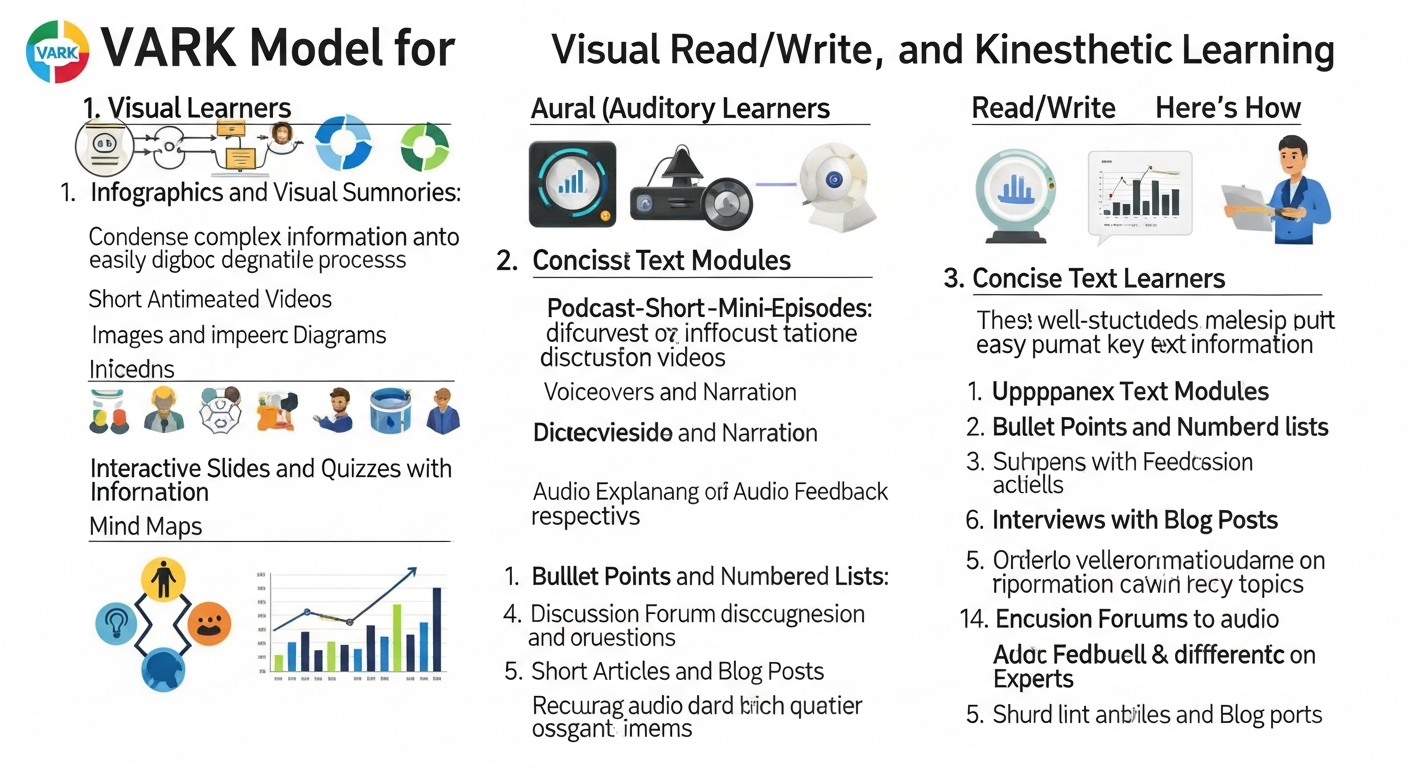
The VARK model, developed by Neil Fleming, categorizes learning preferences into four distinct styles: Visual, Auditory, Read/Write, and Kinesthetic. While individuals often have a dominant preference, many are multimodal, meaning they learn effectively through a combination of styles. Recognizing these preferences allows L&D professionals to craft more inclusive and impactful learning experiences.
- Visual (V): Learners who prefer seeing information through charts, graphs, diagrams, videos, and demonstrations. They often think in pictures.
- Auditory (A): These learners prefer to hear information. They benefit from lectures, discussions, podcasts, and verbal instructions.
- Read/Write (R): Individuals who learn best by reading text and writing notes. They thrive with manuals, articles, lists, and written assignments.
- Kinesthetic (K): These learners prefer a hands-on approach. They learn by doing, experimenting, role-playing, and practical exercises.
The Power of Microlearning for Corporate Training
Microlearning delivers short, focused bursts of content designed to meet a specific learning objective. Typically lasting anywhere from 2 to 10 minutes, these modules are ideal for busy professionals. The benefits are numerous:
- Increased Engagement: Shorter modules prevent cognitive overload and maintain learner attention.
- Better Retention: Focusing on one concept at a time facilitates deeper processing and recall.
- Flexibility: Learners can access content anytime, anywhere, fitting learning into their workflow.
- Cost-Effectiveness: Easier to produce and update than lengthy traditional courses.
- Immediate Application: Knowledge can be applied almost instantly, closing skill gaps rapidly.
Many organizations are adopting a Microlearning LMS to manage and deliver this type of content effectively. These systems are often part of a broader learning management system that supports comprehensive talent development.
Integrating VARK into Microlearning Design
Combining VARK with microlearning means designing diverse content formats that cater to each learning style within a concise timeframe. An effective learning content management system (LCMS) or lms learning management system can help manage this variety.
Designing for Visual Learners
For visual learners, microlearning can include short animated videos, infographics explaining complex processes (e.g., a new compliance procedure), interactive charts demonstrating sales performance trends, or short "how-to" clips showcasing software functionalities in Banking or Pharma. A robust enterprise learning management solution can host these rich media types.
Designing for Auditory Learners
Auditory learners benefit from concise podcasts, audio summaries of key concepts, expert interviews, or narrated explanations of procedures (e.g., patient care protocols in Healthcare, safety guidelines in Oil and Gas). These can be brief audio snippets integrated into a module or standalone micro-podcasts accessible via a learning management software.
Designing for Read/Write Learners
Microlearning for read/write learners can involve short articles, checklists, quick guides, bullet-point summaries of regulations (crucial for Compliance), or concise FAQs. Interactive quizzes with immediate written feedback also serve this style well. A flexible learning management solutions platform facilitates the deployment of such text-heavy content.
Designing for Kinesthetic Learners
Kinesthetic learners thrive with interactive simulations, drag-and-drop activities, quick scenario-based exercises (e.g., customer service interactions in Retail or Hospitality), short gamified challenges, or brief practical demonstrations followed by an immediate task. Gamified LMS features can be particularly effective here, encouraging active participation and application of knowledge.
Leveraging Technology for Personalized Microlearning
Modern L&D relies heavily on technology to personalize and deliver learning experiences at scale. A cloud based learning management system provides the infrastructure needed to cater to diverse learning styles within a microlearning framework.
Query: How can advanced algorithms help tailor microlearning paths based on individual learner preferences?
Response: Intelligent systems can analyze a learner's past performance, engagement data, and even self-reported VARK preferences to dynamically recommend the most effective microlearning modules. This ensures that a visual learner primarily receives video content, while a read/write learner gets more text-based summaries, creating a truly Adaptive Learning experience.
Query: What considerations should L&D teams make when deploying microlearning content to a globally dispersed workforce, ensuring cultural and linguistic relevance?
Response: Platforms with robust localization features and content tagging capabilities are essential. Content should be designed for easy adaptation to different regional contexts and translated accurately, often leveraging machine translation with human oversight. This ensures consistent, yet culturally sensitive, training delivery regardless of geography, from a Banking branch in London to an Oil Rig in the Gulf.
Query: In what ways can machine learning optimize the creation and curation of microlearning content?
Response: Machine learning can identify content gaps by analyzing learner feedback and performance data, suggest relevant topics, and even assist in generating initial drafts for various microlearning formats (e.g., summarizing a long document into a micro-article or script for a short video). This significantly boosts the efficiency of content development, especially when utilizing an AI Powered Authoring Tool.
Practical Applications Across Industries
The VARK-microlearning approach is versatile:
- Compliance & Finance: Short animated videos explaining new regulations (Visual), audio summaries of policy changes (Auditory), quick reference guides for reporting (Read/Write), and interactive scenarios for fraud detection (Kinesthetic). This is critical for Risk-focused Training.
- Sales & Retail: Micro-videos demonstrating product features (Visual), role-play scenarios for objection handling (Kinesthetic), short podcasts on sales techniques (Auditory), and quick tips for customer engagement (Read/Write).
- Healthcare & Pharma: Visual aids for medical procedures, quick audio guides for medication administration, written protocols for patient care, and simulated patient interactions.
- Hospitality & Mining: Visual safety infographics, audio instructions for equipment, written emergency procedures, and hands-on simulation training for equipment operation or customer service.
Implementing a comprehensive MaxLearn LMS allows L&D teams to manage and deliver this diverse content effectively, providing an integrated platform for all learning needs.
Conclusion
For L&D leaders looking to build a highly skilled and adaptable workforce, integrating the VARK model with microlearning design is a strategic imperative. By understanding and catering to individual learning preferences through concise, targeted content, organizations can create a more engaging, effective, and efficient learning ecosystem. Leveraging advanced LMS platforms and authoring tools, L&D teams can deliver truly personalized learning experiences that drive measurable business outcomes, foster continuous development, and ensure their workforce remains competitive in an ever-evolving global landscape.
.jpg)


