

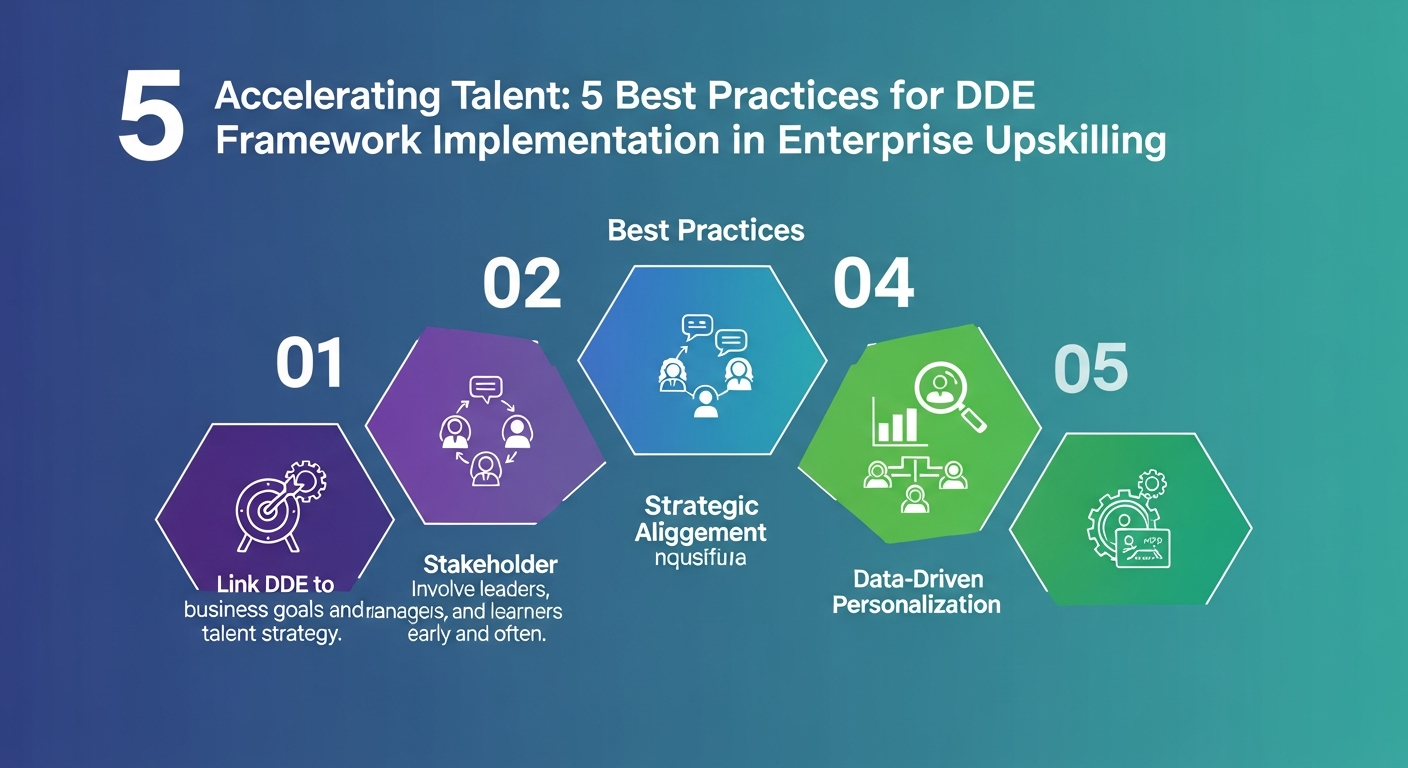
5 Best Practices for Implementing the DDE Framework in Enterprise Upskilling
In today's rapidly evolving corporate landscape, marked by technological disruption and shifting market demands, enterprise upskilling is no longer a luxury but a strategic imperative. Organizations across diverse sectors—from Compliance, Sales, Banking, Finance, and Insurance to Retail, Pharma, Healthcare, Hospitality, Oil and Gas, and Mining—are grappling with the urgent need to equip their workforces with future-ready skills. This is where the Discover, Design, Execute (DDE) Framework emerges as a powerful, structured approach to talent development.
The DDE Framework provides a systematic blueprint for L&D leaders, VPs, Directors, and Senior Managers to navigate the complexities of enterprise upskilling. It ensures that learning initiatives are not only relevant and engaging but also strategically aligned with business objectives. Implementing DDE effectively can transform your organization's learning culture, boost productivity, and secure a competitive edge. Let's explore five best practices to unlock the full potential of this framework.
1. Strategic Discovery: Unearthing True Skill Gaps and Future Needs
The "Discover" phase is foundational. It’s about deeply understanding the current capabilities of your workforce and proactively identifying the skills that will be critical for future success. This goes beyond simple surveys; it requires a data-driven, holistic approach to pinpoint actual gaps and anticipate emerging requirements.
Best Practice in Action: Leveraging Data Analytics and Predictive Modeling
- Comprehensive Needs Assessment: Utilize performance data, market trends, strategic business goals, and employee feedback to paint a clear picture of current and future skill demands. This includes evaluating roles impacted by automation, new regulations, or evolving customer expectations.
- Skill Inventory and Mapping: Develop a detailed inventory of existing skills within your organization. Map these against future requirements to highlight precise gaps at both individual and team levels. This data informs targeted upskilling initiatives rather than a one-size-fits-all approach.
- Proactive Trend Analysis: Stay abreast of industry shifts and technological advancements. What new tools are emerging in finance? How will AI impact healthcare diagnostics? Understanding these trends allows you to prepare your workforce before skills become obsolete.
A common question arises: "How can smart algorithms help my organization predict future skill requirements?" Leveraging advanced analytics on HR data, performance metrics, and external market trends can provide valuable foresight, allowing L&D teams to identify potential skill gaps long before they impact productivity. A robust LMS or learning content management system can integrate with these data sources to provide a centralized view.
2. Adaptive Design: Crafting Engaging and Personalized Learning Journeys
Once needs are discovered, the "Design" phase focuses on creating compelling learning experiences that resonate with diverse learners and effectively close identified skill gaps. This calls for innovation in content delivery and a commitment to learner-centric methodologies.
Best Practice in Action: Personalization and Experiential Learning
- Personalized Learning Paths: Design learning journeys that adapt to individual needs, roles, and learning styles. Not all employees learn at the same pace or respond to the same content. An Adaptive Learning approach ensures relevance and maximizes engagement.
- Microlearning Integration: Break down complex topics into bite-sized, easily digestible modules. Microlearning LMS platforms are ideal for delivering just-in-time training that fits into busy schedules, enhancing knowledge retention and application.
- Experiential and Gamified Content: Incorporate simulations, role-playing, and real-world case studies to provide practical application. A Gamified LMS can further boost motivation and completion rates through challenges, points, and leaderboards.
You might wonder: "What kind of digital platforms are most effective for delivering tailored training experiences to a large workforce?" The answer lies in sophisticated learning management software that can handle personalized content delivery, track progress, and offer diverse learning formats. Modern enterprise learning management systems are built to address this need.
3. Seamless Execution: Delivering Scalable and Integrated Solutions
The "Execute" phase is where designed learning interventions come to life. This requires robust technology, efficient deployment, and continuous support to ensure widespread adoption and effective knowledge transfer.
Best Practice in Action: Leveraging Technology for Efficient Delivery
- Centralized Learning Ecosystem: Implement a powerful learning management system that acts as the central hub for all learning activities. This system should be scalable, user-friendly, and integrate with other HR and business systems. A cloud based learning management system offers flexibility and accessibility.
- Content Authoring and Curation: Utilize tools that empower L&D teams and even subject matter experts to create and curate high-quality content efficiently. An AI Powered Authoring Tool can significantly accelerate content development, ensuring it’s relevant and engaging.
- Multi-channel Delivery: Provide learning content through various channels – desktop, mobile, in-person workshops – to accommodate different work environments and preferences. This ensures accessibility for all employees, from a sales representative on the go to a compliance officer in the office.
A common executive query is: "How can my company ensure consistent training delivery across all global locations?" A unified MaxLearn LMS or similar learning management solutions with multi-language support and regional customization capabilities is key to standardizing and delivering quality upskilling programs consistently worldwide.
4. Continuous Measurement and Iterative Improvement
The DDE framework isn't a one-off process; it’s cyclical. Effective implementation demands ongoing evaluation and refinement of your upskilling programs to ensure they remain relevant and impactful.
Best Practice in Action: Data-Driven Feedback Loops
- Robust Analytics and Reporting: Implement strong analytics within your LMS to track learner progress, engagement rates, completion rates, and assessment scores. Look beyond superficial metrics to understand true knowledge acquisition and application.
- Impact Assessment: Measure the business impact of upskilling programs. Are sales teams closing more deals after training? Has compliance adherence improved? Are operational errors reduced? Connect learning outcomes directly to key performance indicators (KPIs).
- Feedback Mechanisms: Establish regular channels for learner and manager feedback. Use surveys, focus groups, and one-on-one discussions to gather qualitative insights into the effectiveness and relevance of the training content.
- Iterative Refinement: Use all gathered data and feedback to continuously refine and update learning content, delivery methods, and overall program design. This ensures your learning initiatives remain agile and responsive to changing needs. For instance, Risk-focused Training might need constant updates based on evolving regulatory landscapes.
5. Fostering a Culture of Continuous Learning
Ultimately, the success of the DDE framework for upskilling hinges on cultivating an organizational culture that values and promotes continuous learning at every level. Technology is an enabler, but culture is the engine.
Best Practice in Action: Leadership Buy-in and Empowerment
- Lead by Example: Senior leadership and managers must actively participate in learning and champion upskilling initiatives. When leaders demonstrate a commitment to growth, it encourages employees to do the same.
- Time and Resources: Allocate dedicated time and resources for employees to engage in learning. This might involve protected learning hours, access to premium learning management software content, or budgets for external courses.
- Recognition and Reward: Acknowledge and reward employees who actively pursue upskilling and apply new knowledge. This can be through promotions, special projects, or public recognition, reinforcing the value of continuous development.
- Mentorship and Peer Learning: Encourage knowledge sharing through mentorship programs, communities of practice, and peer-to-peer learning initiatives. An effective LCMS can facilitate the creation and sharing of user-generated content, fostering a collaborative learning environment.
Conclusion
Implementing the DDE Framework in enterprise upskilling is a strategic investment that yields significant returns in employee capability, organizational agility, and competitive advantage. By meticulously discovering needs, designing adaptive experiences, executing with scalable solutions, measuring impact, and fostering a robust learning culture, L&D leaders can build a future-ready workforce. Embracing these best practices ensures that your upskilling initiatives are not just effective but transformative, preparing your organization to thrive in the face of ongoing change. Consider leveraging advanced learning management system solutions, like a MaxLearn LMS, to streamline and enhance your DDE implementation journey.
.jpg)


