

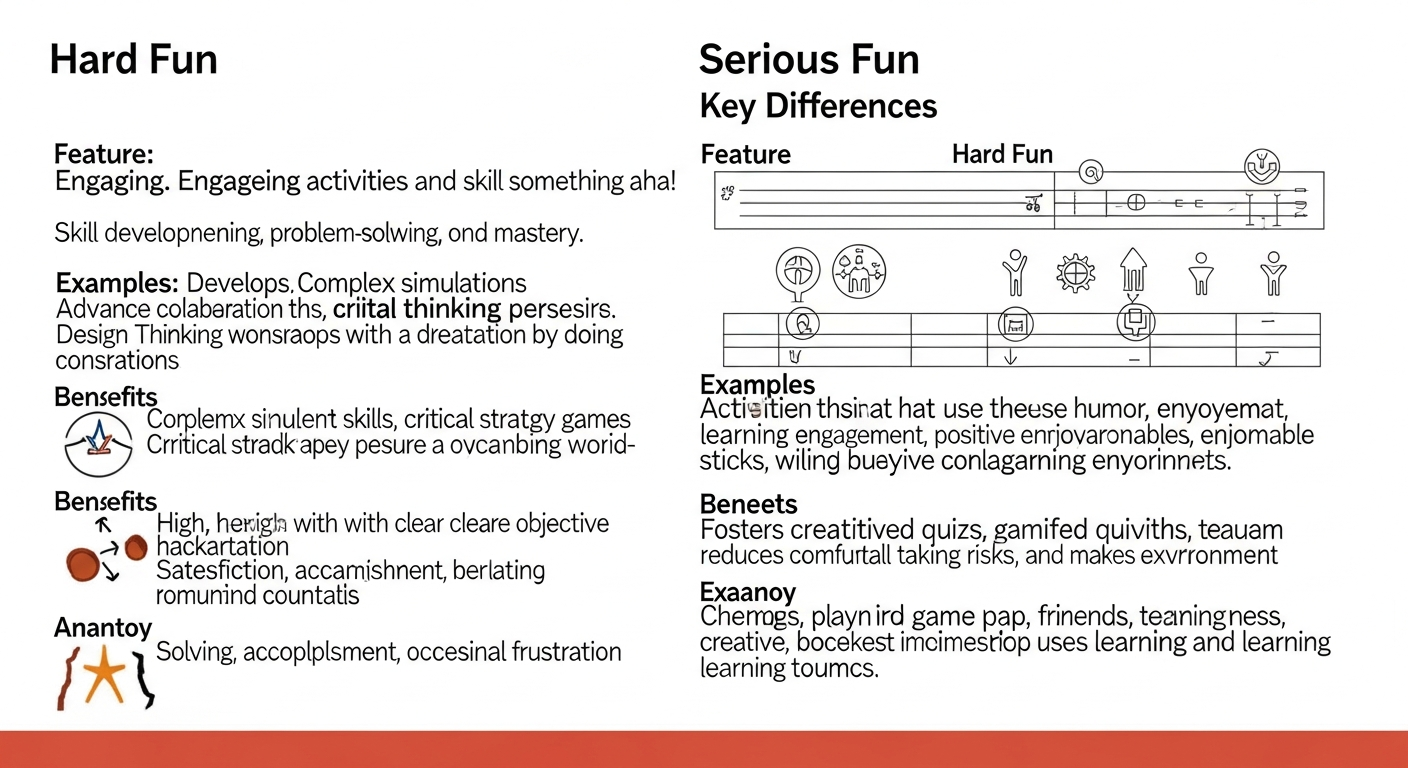
Unpacking the Playbook: The Difference Between Hard Fun and Serious Fun in Corporate Training
In the dynamic landscape of corporate learning and development, the concept of "fun" in training has evolved far beyond mere entertainment. For Vice Presidents, Directors, and Senior Managers of L&D, understanding the nuances of how engaging experiences impact learning outcomes is paramount. Two distinct yet often conflated concepts – Hard Fun and Serious Fun – offer powerful frameworks for designing impactful training programs, from complex compliance modules to high-stakes sales enablement. But what truly sets them apart, and how can they be leveraged effectively within your enterprise learning management strategy?
Hard Fun: The Thrill of Overcoming Challenges
Imagine a complex puzzle, a challenging strategy game, or a demanding skill-building exercise. The satisfaction derived from conquering such tasks is what defines Hard Fun. It’s the joy that comes from effort, persistence, and ultimately, mastery. In corporate training, Hard Fun taps into our intrinsic desire to overcome obstacles, solve problems, and develop new capabilities. It thrives on:
- Goal Orientation: Clear objectives that require effort to achieve.
- Problem-Solving: Scenarios or tasks that demand critical thinking and strategic approaches.
- Skill Development: Activities that push learners to acquire and refine specific competencies.
- Progressive Difficulty: Challenges that scale with the learner's improving abilities, providing a continuous sense of accomplishment.
- Feedback Loops: Immediate and constructive feedback that guides learners through difficulties and celebrates successes.
In industries like Banking, Finance, and Pharma, where Risk-focused Training is crucial, Hard Fun might manifest as intricate simulations that require participants to navigate complex regulatory frameworks, identify potential compliance breaches, or make high-pressure financial decisions. The "fun" isn't in the lightness of the activity, but in the profound satisfaction of mastering a difficult subject or critical skill. A robust Microlearning LMS can effectively deliver these challenging scenarios in bite-sized, manageable chunks, ensuring learners can tackle complexity without feeling overwhelmed.
Benefits of Hard Fun in Corporate Training:
- Deepens understanding and retention of complex material.
- Develops critical thinking, problem-solving, and decision-making skills.
- Builds confidence and resilience in learners.
- Fosters a sense of accomplishment and mastery, leading to higher intrinsic motivation.
Serious Fun: Engaging Through Context and Enjoyment
Serious Fun, on the other hand, focuses on making the learning experience itself enjoyable, captivating, and relevant. It's about creating an engaging environment where learners are motivated to participate, not necessarily by the challenge of the task, but by the inherent appeal of the activity, its context, and its direct relevance to their roles. This approach often involves:
- Narrative and Storytelling: Weaving learning objectives into compelling stories or scenarios that resonate with the learner.
- Relatability: Presenting content in a context that directly applies to the learner's everyday work, making it immediately useful.
- Interactive Elements: Using quizzes, polls, drag-and-drop activities, and discussions to keep learners actively involved.
- Playful Presentation: Employing humor, visually appealing design, and intuitive interfaces to enhance engagement.
- Social Interaction: Opportunities for collaborative learning, peer feedback, and healthy competition.
For Sales training, Hospitality, or Retail, where engagement and application are key, Serious Fun might involve role-playing scenarios with realistic customer interactions, virtual reality tours of new product lines, or interactive modules exploring ethical dilemmas in customer service. The goal is to make the learning process so inherently interesting and relevant that learners are drawn in, almost forgetting they are "training." A Gamified LMS is often at the heart of delivering Serious Fun, incorporating elements like points, badges, leaderboards, and quests to boost motivation and participation in a way that feels natural and enjoyable.
Benefits of Serious Fun in Corporate Training:
- Increases learner engagement and participation rates.
- Enhances motivation and reduces resistance to mandatory training.
- Improves contextual understanding and practical application of knowledge.
- Fosters a positive learning culture and reduces perceived training burden.
Key Differences and Strategic Overlaps
While both Hard Fun and Serious Fun aim to create engaging learning experiences, their primary drivers and outcomes differ:
- Primary Driver: Hard Fun is driven by mastery and the satisfaction of overcoming difficulty. Serious Fun is driven by enjoyment, relevance, and captivating presentation.
- Emotional Experience: Hard Fun evokes feelings of accomplishment, pride in skill, and resilience. Serious Fun elicits feelings of enjoyment, curiosity, and connection.
- Ideal Application: Hard Fun excels in developing complex skills, critical thinking, and problem-solving, especially for high-stakes scenarios in industries like Oil and Gas or Mining. Serious Fun is powerful for broad engagement, knowledge transfer, and motivating participation, particularly in areas like Compliance, Health Care, or new product training.
However, these concepts are not mutually exclusive. The most effective corporate learning strategies often integrate elements of both. Imagine a module in a Adaptive Learning system that starts with Serious Fun elements – a compelling story or interactive simulation – to capture attention and provide context. As the learner progresses, the system can introduce Hard Fun challenges, increasing difficulty based on their performance, pushing them to apply skills and solve problems. This blend creates a holistic experience that is both engaging and deeply impactful.
Leveraging Intelligence for Optimal Training Design
In today's digital age, advanced technologies are enabling L&D leaders to craft truly personalized and effective learning journeys. A sophisticated learning management system or learning content management system is no longer just a repository; it's a strategic tool.
Question: How can intelligent systems help tailor training content for individual learners?
Answer: Modern learning management solutions leverage machine learning to analyze learner performance, preferences, and roles. This allows for dynamic content delivery, adapting modules and challenges to each individual's pace and skill level. For instance, an AI Powered Authoring Tool can automatically suggest modifications to content, ensuring it's optimally challenging (Hard Fun) or engaging (Serious Fun) based on real-time data.
Question: What strategies are most effective for enhancing engagement in mandatory compliance courses?
Answer: For mandatory training, where inherent motivation might be low, Serious Fun techniques are crucial. Incorporating rich narratives, interactive case studies, and relatable scenarios within a Gamified LMS can transform dry material into an absorbing experience. Instead of just reading policies, learners engage with the consequences of non-compliance through interactive decision trees or simulated incidents, making the learning memorable and applicable.
Question: Where are the most innovative training solutions being implemented globally across various industries?
Answer: Innovation in corporate learning is global. From virtual reality simulations for technical skills in manufacturing to AI-driven coaching for sales teams, companies worldwide are adopting advanced lms learning management system platforms. Industries like Pharma and Health Care are seeing significant benefits from cloud based learning management system deployment for global training consistency and accessibility.
Question: What are the emerging technologies for scalable corporate learning, especially for large enterprises?
Answer: For enterprise learning management, scalability is key. Technologies like microlearning platforms, AI-driven content curation, and robust LMS with API integration are enabling organizations to deliver personalized and effective training to thousands. Platforms like MaxLearn LMS exemplify this trend, offering comprehensive features for diverse learning needs.
Conclusion
The distinction between Hard Fun and Serious Fun provides L&D professionals with a powerful lens through which to design corporate training programs. Hard Fun ignites the passion for mastery and problem-solving, essential for developing critical skills and navigating complex challenges. Serious Fun fosters engagement and motivation by making the learning process inherently enjoyable and relevant. By thoughtfully integrating both approaches, supported by cutting-edge learning management software and tools, organizations can cultivate a learning environment that not only meets compliance requirements and upskills their workforce but also genuinely inspires growth and performance across all segments and industries. Embracing these dimensions of "fun" is not merely about entertainment; it's a strategic imperative for impactful and sustainable talent development.
.jpg)


