

Unlocking Engagement: How Nicole Lazzaro’s 4 Fun Types Framework Elevates L&D
In today's dynamic business environment, where talent retention and skill development are paramount, Learning & Development (L&D) professionals face an ongoing challenge: how to genuinely engage learners. Traditional training methods often fall short, leading to disinterest, low completion rates, and ultimately, a limited impact on performance. Enter Nicole Lazzaro, a leading expert in player experience and emotional design, whose groundbreaking "4 Fun Types" framework offers a powerful lens through which L&D can transform passive learning into an active, enjoyable, and effective experience.
For Vice Presidents, Directors, and Senior Managers of L&D across industries like Compliance, Sales, Banking, Finance, Insurance, Retail, Pharma, Healthcare, Hospitality, Oil and Gas, and Mining, understanding and applying Lazzaro's framework isn't just about making learning "fun"; it's about strategically designing experiences that tap into intrinsic human motivations, driving deeper understanding, better retention, and measurable business outcomes. This approach moves beyond superficial gamification to create truly engaging and impactful learning solutions.
Nicole Lazzaro's 4 Fun Types: A Quick Overview
Lazzaro's research identifies four fundamental categories of fun that drive player engagement. These aren't mutually exclusive but often blend to create rich experiences. Understanding each type is the first step towards intentionally designing them into your LMS-powered learning initiatives.
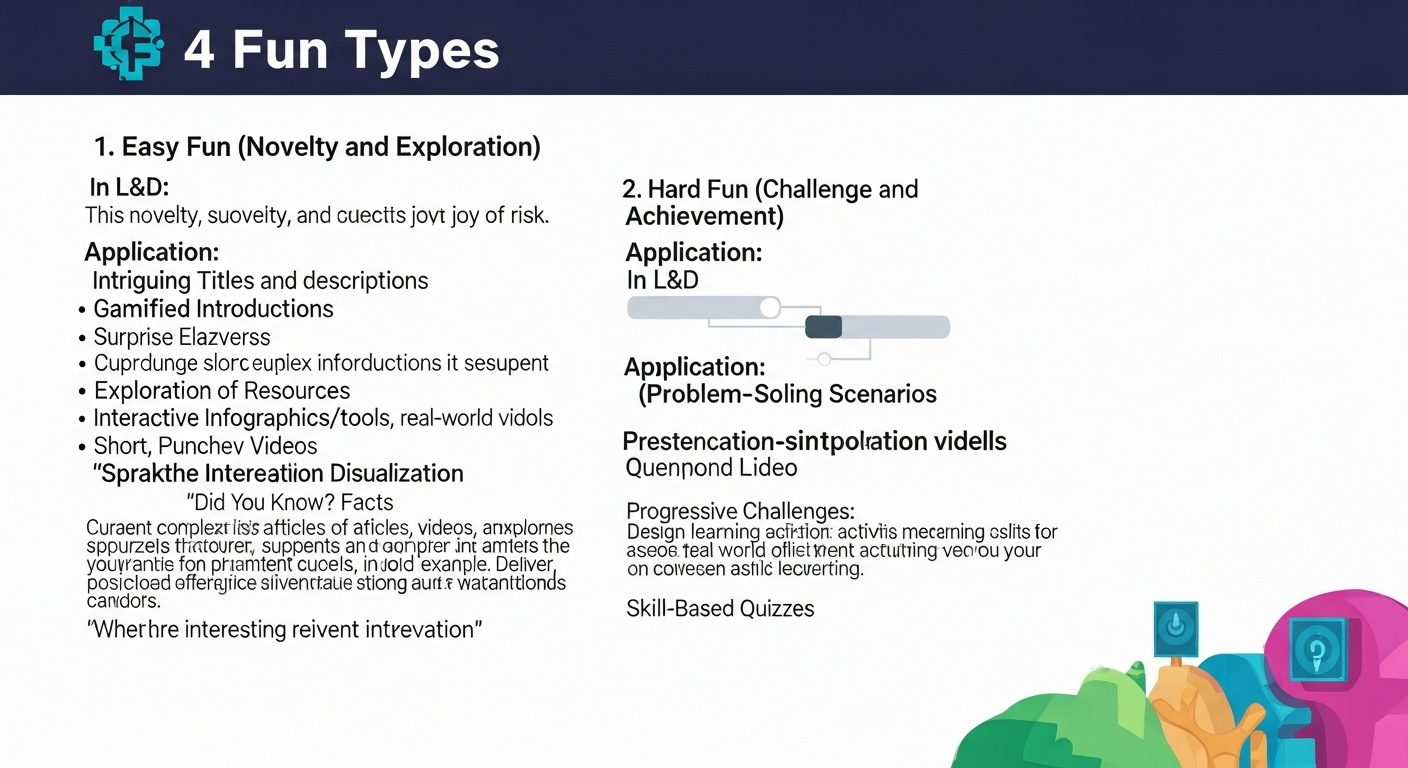
- Hard Fun (Fiero): The satisfaction of overcoming a difficult challenge. This is the "aha!" moment, the triumph over adversity, often accompanied by a sense of accomplishment and pride.
- Easy Fun (Novelty): The joy of exploration, curiosity, and surprise. This type of fun is about discovery, experimentation, and experiencing new things without significant pressure or risk.
- People Fun (Fellowship): The pleasure derived from social interaction, collaboration, and competition. It's about connecting with others, whether through teamwork, rivalry, or shared experiences.
- Serious Fun (Exploration/Meaning): The enjoyment found in activities that provide meaning, purpose, or a sense of personal growth and mastery. This often involves deep engagement with complex systems or ideas, leading to a profound understanding and impact.
Applying the 4 Fun Types to Learning & Development
Hard Fun: Mastering Complex Skills and Compliance
For L&D, Hard Fun translates into the satisfaction of mastering a difficult concept, achieving a challenging certification, or successfully navigating a complex simulation. In sectors like Finance and Healthcare, where Risk-focused Training is critical, Hard Fun can be cultivated by presenting realistic scenarios that demand critical thinking and problem-solving, leading to a clear sense of achievement upon successful completion.
- Examples: Complex compliance simulations, advanced sales negotiation role-playing with multiple variables, coding challenges for IT professionals, diagnostic puzzles for healthcare staff, or rigorous certification pathways.
- How to Design: Structure learning paths with clear objectives, increasing difficulty, and immediate feedback. Leverage a Gamified LMS to introduce leaderboards, badges for skill mastery, and multi-level challenges. Design scenarios where learners must apply critical knowledge to prevent failures or achieve optimal outcomes. This type of learning management system is ideal for fostering resilience and a deep understanding of challenging material.
- Impact: Builds confidence, deepens understanding of complex topics, and fosters a growth mindset crucial for continuous professional development.
Easy Fun: Sparking Curiosity and Discovery in Everyday Learning
Easy Fun is about making learning inherently enjoyable through novelty, surprise, and low-stakes exploration. This is particularly effective for introducing new topics, refreshing knowledge, or making routine compliance updates more palatable. In industries like Retail and Hospitality, where new product knowledge or service protocols are frequent, Easy Fun keeps learners engaged without burnout.
- Examples: Interactive quizzes with unexpected facts, exploratory modules on emerging industry trends, short video explainers with animation, discovery-based scavenger hunts within a Microlearning LMS platform, or quick, engaging modules on soft skills.
- How to Design: Incorporate visually appealing content, short, digestible modules, and opportunities for learners to explore at their own pace. An Adaptive Learning system can provide personalized discovery paths based on learner interests or previous interactions, keeping the content fresh and relevant. Utilize an AI Powered Authoring Tool to quickly generate diverse content formats and interactive elements that keep the novelty high.
- Impact: Increases initial engagement, encourages exploration, and makes learning feel less like a chore and more like an enjoyable pastime, leading to higher completion rates for essential updates and new information.
People Fun: Building Collaboration and Community
People Fun taps into our innate desire for social connection, collaboration, and healthy competition. For L&D, this means designing learning experiences that foster teamwork, peer-to-peer learning, and a sense of belonging. In a globalized workforce across Oil and Gas or Pharma, facilitating social connection through a learning content management system can break down silos.
- Examples: Collaborative project-based learning, peer feedback systems, discussion forums for case studies, team-based competitions within an LMS, or virtual study groups for certification exams.
- How to Design: Integrate social learning features within your `learning management software`, such as forums, chat functionalities, and group assignments. Design activities that require collaboration to succeed, like shared problem-solving scenarios or peer review modules. Encourage friendly competition through leaderboards for team performance rather than just individual scores. This strengthens team bonds and facilitates knowledge sharing.
- Impact: Enhances communication skills, builds community, and leverages collective intelligence, leading to richer learning outcomes and stronger organizational culture.
Serious Fun: Driving Meaning and Personal Growth
Serious Fun is perhaps the most profound for L&D, as it connects learning to a deeper purpose, personal growth, and mastery. It's about empowering learners to understand the 'why' behind their training and to see the tangible impact of their efforts. In every industry, from Banking to Mining, linking learning to impact on career progression, company goals, or even societal benefit elevates engagement.
- Examples: Long-term development programs, mentorship initiatives, projects that contribute directly to business objectives, ethical dilemma training, leadership development journeys, or mastery paths for highly specialized skills.
- How to Design: Frame learning within a broader context of career progression, personal mastery, or organizational impact. Provide real-world case studies and opportunities for learners to apply their knowledge to tangible problems. An `enterprise learning management` solution that tracks progression through skills and competencies can help visualize growth. Offer opportunities for specialization and thought leadership.
- Impact: Fosters a sense of purpose, drives intrinsic motivation for continuous learning, and cultivates high-performing individuals who are deeply invested in their roles and the organization's mission.
The Role of a Modern Learning Management System in Fostering Fun
Implementing Nicole Lazzaro's 4 Fun Types framework is significantly streamlined by leveraging a robust `learning management system` (LMS). A state-of-the-art `cloud based learning management system` provides the infrastructure to design, deliver, and track these diverse learning experiences. From a comprehensive `learning content management system` that supports varied multimedia for Easy Fun, to advanced `lms learning management system` functionalities that enable gamification for Hard Fun and social modules for People Fun, technology is the enabler.
An integrated `LCMS` (Learning Content Management System) allows L&D teams to create and manage content that inherently supports these fun types, ensuring consistency and quality across all learning initiatives. When considering `learning management solutions`, prioritize platforms that offer flexibility in content delivery and robust analytical capabilities to measure the impact of these engaging strategies.
Addressing Common Questions with Smart L&D Solutions
How can L&D content be structured to provide immediate, precise answers to learners' most pressing questions?
By adopting a `Microlearning LMS` approach, content can be broken down into short, focused modules that directly address specific learning objectives or common queries. Implementing robust search functionalities within the `learning management system` allows learners to quickly find exact information, much like using a knowledge base. AI-powered chatbots integrated into the platform can also provide instant answers by scanning existing content, guiding learners to the most relevant bite-sized resources, thus maximizing efficiency and learner satisfaction.
Is it possible to apply these 'fun types' effectively across diverse global teams and varying cultural contexts?
Absolutely. While the core human motivations for fun are universal, their expression can vary culturally. An effective `enterprise learning management` strategy for global teams involves cultural localization of content, ensuring examples and scenarios resonate with regional audiences. Utilizing an `AI Powered Authoring Tool` can assist in quickly translating and adapting content, while an `LMS` with multi-language support is essential. Additionally, fostering "People Fun" through global collaboration projects or culturally sensitive competitions can bridge geographical divides, creating a cohesive yet diverse learning experience.
How does a comprehensive learning platform support the integration of these diverse fun elements for a holistic L&D strategy?
A unified `learning management software` like `MaxLearn LMS` acts as a central hub. It enables L&D leaders to integrate all four fun types into a cohesive strategy. For Hard Fun, it offers robust assessment and Gamified LMS features. For Easy Fun, its `learning content management system` supports rich multimedia and exploratory paths, often enhanced by `Adaptive Learning` capabilities. For People Fun, it provides social learning tools and collaborative spaces. And for Serious Fun, it links learning paths to career development and strategic objectives, tracking progress towards mastery. This holistic approach ensures every aspect of learning contributes to engagement and organizational growth.
The Business Imperative for L&D Leaders
For L&D VPs, Directors, and Managers, integrating Nicole Lazzaro's 4 Fun Types isn't merely about improving learner satisfaction; it's a strategic imperative. Highly engaged learners are more likely to retain information, apply new skills, and contribute directly to business objectives. This translates into tangible benefits:
- Improved compliance rates in regulated industries.
- Faster time-to-competency for sales teams and new hires.
- Enhanced innovation and problem-solving across all departments.
- Stronger employee retention and reduced turnover.
- A demonstrable return on investment (ROI) for L&D initiatives.
Conclusion
The future of L&D lies in moving beyond didactic instruction to intentional experience design. By thoughtfully applying Nicole Lazzaro's 4 Fun Types – Hard Fun, Easy Fun, People Fun, and Serious Fun – L&D leaders can craft learning journeys that resonate deeply with adult learners. Leveraging a modern `learning management system` as the backbone, organizations can cultivate a culture where learning is not just a requirement, but a source of genuine enjoyment, personal growth, and collective success. Investing in these engaging strategies ensures that L&D doesn't just deliver content, but truly empowers and transforms its workforce for the challenges of tomorrow.
.jpg)


