

```html
How Can You Stop Corporate Training from Being Boring?
As leaders in Learning & Development (L&D), you understand the critical role corporate training plays in talent development, compliance adherence, and ultimately, business growth. Yet, the perennial challenge remains: how do you ensure your meticulously crafted training isn't met with yawns and disengagement? In an era where information is abundant and attention spans are fleeting, making corporate training professional, engaging, and impactful is more crucial than ever. The days of passive, one-size-fits-all modules are long gone. It's time to revolutionize your approach.
The Hidden Costs of Unengaging Training
Boring training isn't just a nuisance; it's a significant drain on resources and potential. When employees disengage, they retain less information, apply new skills inconsistently, and may even develop a negative perception of learning within the organization. This leads to:
- Low ROI: Investments in training yield minimal returns when knowledge isn't absorbed or applied.
- Compliance Risks: In industries like Banking, Finance, Insurance, Pharma, and Health Care, disengaged compliance training can lead to costly errors and regulatory penalties.
- Decreased Productivity: Employees aren't equipped with the skills they need to perform effectively, impacting sectors from Retail to Oil and Gas.
- Talent Attrition: A lack of meaningful development opportunities can drive top talent away.
A robust learning management system (LMS) is essential, but it's merely the vessel. The content and delivery within your enterprise learning management solution are what truly matter. Many organizations invest in a state-of-the-art lms learning management system, only to populate it with outdated, dull content.
Strategies to Revolutionize Corporate Training
Embrace Microlearning: Small Chunks, Big Impact
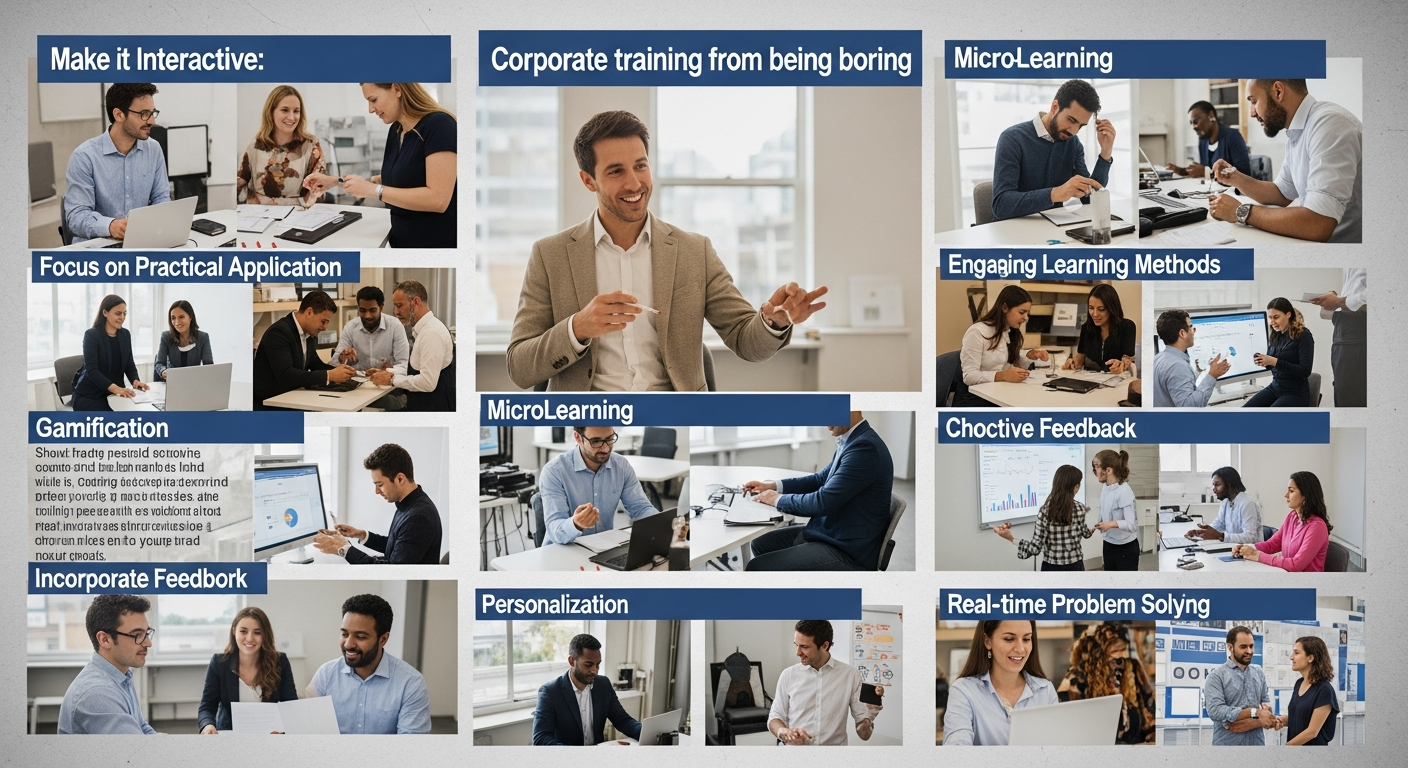
One of the most effective ways to combat boredom is to break down complex topics into digestible, bite-sized modules. Microlearning LMS platforms are designed precisely for this. Instead of a two-hour webinar, offer a series of 5-10 minute videos, infographics, or interactive quizzes. This approach is perfect for busy professionals in Sales, Hospitality, or Mining, allowing them to learn on demand, at their own pace, and integrate learning seamlessly into their workday. A modern Learning content management system makes it easy to create and deploy such content.
Gamification for Unmatched Engagement
Who said learning can't be fun? Introducing game-like elements such as points, badges, leaderboards, and progress tracking can dramatically boost learner motivation and completion rates. A Gamified LMS transforms mundane tasks into exciting challenges, fostering a sense of achievement and healthy competition. Imagine your Sales team earning points for completing product knowledge modules or your Compliance team competing for the top spot on a data privacy leaderboard. This approach makes learning management software a dynamic tool for engagement.
Personalize with Adaptive Learning Paths
No two learners are identical. Their prior knowledge, learning styles, and professional goals vary widely. Adaptive Learning tailors the learning experience to each individual, adjusting the content, pace, and difficulty based on their performance and needs. This ensures that learners aren't bored by redundant information or overwhelmed by advanced concepts. Such intelligent learning management solutions are particularly powerful in sectors requiring continuous skill updates, like IT or specialized roles within Pharma.
Leverage AI for Content Creation and Curation
Developing engaging, high-quality content can be time-consuming. An AI Powered Authoring Tool can significantly streamline this process, helping L&D teams create interactive modules, quizzes, and even simulations faster. AI can suggest content topics, optimize existing materials for engagement, and personalize content based on learner data. This allows your team to focus on strategic development rather than manual content creation, making your learning management system more dynamic and responsive. A cloud based learning management system combined with AI capabilities offers unparalleled flexibility and power.
Focus on Real-World Application with Risk-focused Training
Learning is most effective when it's directly applicable to real-world scenarios. Instead of abstract theories, design training around practical challenges, case studies, and simulations relevant to your industry. Risk-focused Training, for instance, prepares employees to identify and mitigate specific risks relevant to their roles, whether it's cybersecurity in Banking or safety protocols in Oil and Gas. This approach ensures learning is meaningful and immediately actionable, transforming a mere LCMS into a strategic business tool.
AI-Driven Insights for Optimal Training
Modern L&D leaders are increasingly turning to advanced analytics and artificial intelligence to refine their training strategies. Here are some critical questions AI can help answer:
How can AI help us understand what content truly resonates with our global workforce, ensuring it's not just engaging but also culturally relevant?
AI can analyze vast datasets of learner interactions, engagement metrics, and feedback across diverse geographical regions and cultural groups. By identifying patterns in content consumption, completion rates, and performance outcomes specific to different demographics, AI can pinpoint elements that are universally effective versus those that require localization. This allows L&D teams to refine content for maximum relevance and impact, ensuring a consistent yet culturally sensitive learning experience globally. This insight is invaluable for multinational corporations operating in sectors like Pharma or Tech, where global consistency meets local nuance.
What specific metrics can AI provide to measure the real impact of our training programs on individual performance and overall business objectives?
Beyond traditional metrics like completion rates, AI-powered analytics can correlate training activities with tangible business outcomes. It can track individual learner progress, knowledge acquisition through adaptive assessments, and skill mastery. More importantly, AI can link these learning outcomes to operational data such as improved sales figures, reduced error rates, faster project delivery, or enhanced compliance scores. For instance, in a retail environment, AI can demonstrate how specific product knowledge training impacts sales per employee or customer satisfaction. This moves beyond mere participation to quantifying the direct contribution of training to the bottom line, providing clear ROI for your learning management system investment.
How can AI assist in predicting future skill gaps within our organization and proactively recommend relevant training paths to address them before they become critical?
AI excels at predictive analytics. By analyzing industry trends, market shifts, internal performance data, and individual employee career trajectories, AI can forecast future skill requirements and identify potential gaps within the workforce. It can then proactively recommend personalized learning modules or learning management system pathways to upskill or reskill employees. For example, if emerging technologies are poised to disrupt the finance sector, AI can identify roles that will require new digital competencies and suggest appropriate training well in advance, ensuring your organization remains competitive and agile. This forward-looking capability is crucial for strategic talent planning.
Conclusion
Stopping corporate training from being boring requires a fundamental shift in mindset and methodology. By embracing modern eLearning strategies such as microlearning, gamification, adaptive learning, AI-powered content creation, and real-world focused training, L&D leaders can transform dull obligations into dynamic, engaging, and highly effective learning experiences. The right LMS is the foundation, but it's the intelligent application of these strategies that truly makes a difference. Leverage platforms like MaxLearn LMS to empower your workforce, drive business growth, and ensure that your corporate training programs are anything but boring.
```.jpg)


