

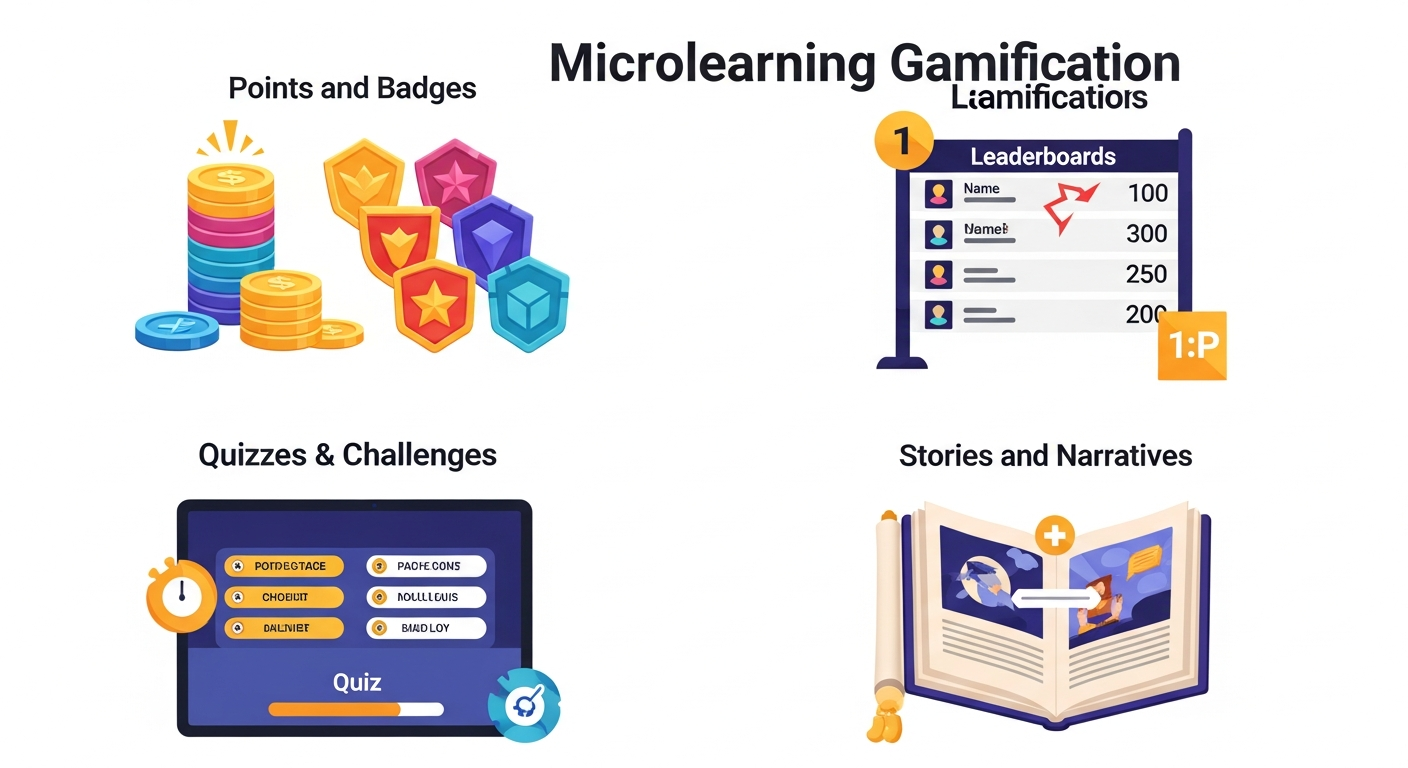
The 4 Types of Microlearning Gamification: A Strategic Guide for L&D Leaders
In today's fast-paced corporate environment, where attention spans are shrinking and the demand for continuous skill development is ever-growing, Learning & Development (L&D) leaders face a critical challenge: how to deliver engaging, effective, and efficient training that truly impacts performance. The answer increasingly lies at the intersection of microlearning and gamification – two powerful methodologies that, when combined, create an unparalleled learning experience. But what does "gamified microlearning" truly entail, and what are its various forms? For Vice Presidents, Directors, and Senior Managers in L&D across industries like Compliance, Sales, Banking, Finance, Insurance, Retail, Pharma, Healthcare, Hospitality, Oil and Gas, and Mining, understanding the nuances of these approaches is key to building a resilient, high-performing workforce.
The Power of Microlearning Gamification in Modern L&D
Microlearning delivers bite-sized content, making learning accessible and digestible, especially for busy professionals. Gamification, on the other hand, applies game-like elements and mechanics to non-game contexts to boost engagement, motivation, and retention. When these two concepts merge, they create a dynamic learning environment that resonates deeply with adult learners. You might ask, "What strategic advantage does gamified microlearning offer L&D leaders?" It provides a measurable uplift in learner engagement, significantly improves knowledge retention, and accelerates skill acquisition, all while reducing the time and cost associated with traditional training.
Let's explore the four distinct types of microlearning gamification that L&D professionals can leverage to revolutionize their training programs.
Type 1: Points, Badges, and Leaderboards (PBL)
What is it?
The Points, Badges, and Leaderboards (PBL) system is the most recognizable form of gamification. It involves awarding points for completing learning modules, quizzes, or activities; granting digital badges as recognition for achieving milestones or mastering skills; and displaying leaderboards to foster healthy competition among learners. This straightforward approach taps into intrinsic human desires for achievement and recognition.
How it Works in Microlearning:
- Learners earn points for each micro-module completed, correct answers in quizzes, or participation in discussions.
- Badges are awarded for completing a series of related micro-modules, demonstrating proficiency in a specific skill, or reaching certain performance thresholds.
- Leaderboards showcase top performers, encouraging others to improve and engage more deeply with the content.
Benefits and Examples:
PBL systems are incredibly effective for driving continuous engagement and celebrating progress. "How do PBL systems drive engagement in corporate training?" By providing instant feedback and public recognition, they motivate learners to not just complete tasks but to excel. In Sales, micro-modules on product knowledge can award points and badges, with top performers appearing on a leaderboard. For Compliance training in Banking or Pharma, completing short modules on new regulations or ethical guidelines can earn points and compliance badges, fostering a culture of continuous adherence. A robust Microlearning LMS often includes built-in PBL features, making implementation straightforward.
Type 2: Narrative and Story-Driven Gamification
What is it?
This type immerses learners in a compelling story or narrative, where their learning journey is framed as an adventure, a mystery, or a quest. The content is woven into the plot, and learner actions often influence the story's progression or outcome. This taps into our innate love for stories and provides context and purpose to the learning.
How it Works in Microlearning:
- Each micro-module represents a chapter, a clue, or a challenge within the overarching narrative.
- Learners make choices that affect their character's path or the story's resolution.
- The narrative creates a memorable context, making dry or complex information more engaging and easier to recall.
Benefits and Examples:
Narrative gamification excels at making abstract or dense topics relatable and memorable. "Can storytelling improve knowledge retention in complex topics like finance or healthcare?" Absolutely. By embedding learning within a story, it creates emotional connections and anchors information more effectively. For Financial Services, training on fraud detection could be framed as solving a financial crime, with each micro-module uncovering a piece of evidence. In Healthcare, new patient safety protocols could be part of a "healing quest." This approach, often facilitated by a powerful Gamified LMS, can significantly boost engagement in subjects that might otherwise be perceived as tedious.
Type 3: Simulation and Scenario-Based Gamification
What is it?
This type involves creating realistic, interactive scenarios or simulations where learners can practice applying knowledge and skills in a safe, controlled environment. These scenarios often present real-world challenges, requiring learners to make decisions and experience the consequences without actual risk.
How it Works in Microlearning:
- Micro-scenarios present specific dilemmas or situations relevant to the job role.
- Learners interact with virtual characters, equipment, or systems, making choices that lead to different outcomes.
- Immediate feedback is provided on decisions, helping learners understand the impact of their actions.
Benefits and Examples:
Simulation gamification is invaluable for developing critical thinking, problem-solving, and decision-making skills, especially in high-stakes environments. "What is the most effective way to provide practical experience for high-stakes roles?" By providing hands-on, experiential learning, it bridges the gap between theory and practice. For Oil and Gas, micro-simulations can train technicians on emergency shutdown procedures or equipment maintenance. In Hospitality, employees can practice handling difficult customer complaints in a virtual setting. Risk-focused Training benefits immensely from this type, allowing learners to make mistakes and learn from them without real-world repercussions, crucial for industries like Insurance or Mining.
Type 4: Personalized and Adaptive Challenges
What is it?
This advanced form of gamification tailors the learning experience to each individual learner's needs, performance, and preferences. It uses data to present challenges that are neither too easy nor too difficult, ensuring optimal engagement and learning efficiency. This often leverages sophisticated algorithms to adapt content dynamically.
How it Works in Microlearning:
- Based on pre-assessments or ongoing performance, the learning management system identifies knowledge gaps or areas for development.
- Micro-challenges are dynamically generated or selected to target these specific areas.
- As learners progress, the system adapts, providing more difficult challenges or reinforcing weaker areas until mastery is achieved.
Benefits and Examples:
Personalized and adaptive challenges ensure that every learner receives the most relevant and impactful training. "How can training be customized to individual learner needs across a large enterprise?" By leveraging Adaptive Learning principles, this type addresses individual learning styles and paces, maximizing efficiency and impact. For onboarding in Retail or any large organization, new hires can receive micro-challenges tailored to their role and prior knowledge, accelerating their readiness. An AI Powered Authoring Tool within a robust LCMS can help L&D teams rapidly create and deploy such adaptive content.
Unleashing Potential with the Right Platform
Implementing these types of microlearning gamification effectively requires a powerful and flexible LMS. For organizations aiming to deploy engaging and scalable training solutions, investing in a comprehensive Microlearning LMS is paramount. Consider a cloud based learning management system to ensure accessibility and scalability across your global workforce. "How does a cloud based learning management system support global L&D initiatives?" It provides 24/7 access, ensures consistency of content, and streamlines administration for distributed teams, making it an ideal learning management software solution for any enterprise learning management strategy.
A modern learning management system like MaxLearn LMS offers the functionalities needed to integrate these gamification types seamlessly. From tracking points and badges to supporting complex simulation scenarios and adaptive learning paths, the right learning management solutions empower L&D teams to create impactful experiences. "What features should an L&D professional look for in a modern learning management system?" Look for strong content management, analytics, mobile responsiveness, and robust gamification tools that integrate microlearning principles.
Strategic Advantages for L&D Leaders
By strategically implementing these four types of microlearning gamification, L&D leaders can achieve several key objectives:
- Increased Engagement: Transform mundane training into an enjoyable and motivational experience.
- Improved Retention: Gamified elements and bite-sized content significantly boost memory and recall.
- Accelerated Skill Development: Learners practice and apply skills more frequently and effectively.
- Measurable Impact: Robust analytics within an lms learning management system provide clear insights into learner progress and performance, proving ROI.
- Scalability: Deliver consistent, high-quality training to a diverse and geographically dispersed workforce.
Conclusion: Elevate Your L&D Strategy
The future of corporate learning is dynamic, engaging, and personalized. For L&D Vice Presidents, Directors, and Managers, understanding and applying the four types of microlearning gamification – PBL, Narrative, Simulation, and Personalized Challenges – is not just an option, but a strategic imperative. By leveraging these powerful methodologies within a cutting-edge enterprise learning management system, you can cultivate a culture of continuous learning, drive employee performance, and secure your organization's competitive edge in an ever-evolving market. It's time to transform your training from a requirement into an exciting journey of growth and achievement.
.jpg)


