

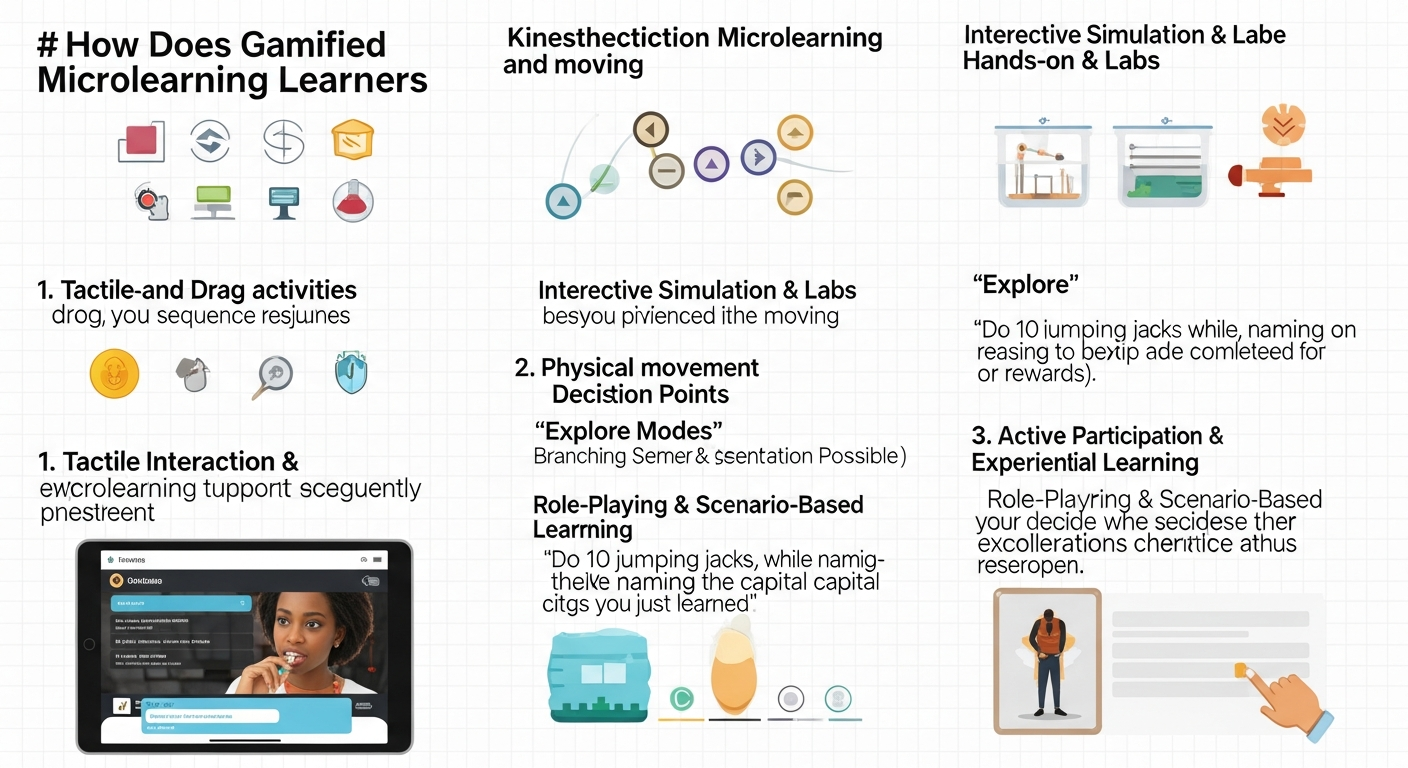
Unlocking Potential: How Gamified Microlearning Supports Kinesthetic Learners in the Enterprise
As leaders in Learning & Development, you understand the critical challenge of engaging a diverse workforce with training that truly sticks. Traditional long-form courses often fall short for a significant segment of your employees: kinesthetic learners. These are the individuals who learn best by doing, experiencing, and interacting. In today's fast-paced corporate environment, where time is a luxury and practical application is paramount, how can L&D professionals effectively cater to this dynamic learning style across industries like compliance, sales, banking, healthcare, and manufacturing? The answer lies in the powerful synergy of gamified microlearning.
The 'Doers' in Your Workforce: Understanding Kinesthetic Learners
Kinesthetic learners, often referred to as tactile or hands-on learners, thrive when actively involved in the learning process. They prefer movement, action, and physical interaction rather than passively listening or reading. For them, understanding comes from direct experience and experimentation. In a professional context, this translates to:
- Preferring simulations and role-playing over lectures.
- Excelling in practical tasks and problem-solving scenarios.
- Remembering information better when they can physically manipulate objects or perform actions related to the content.
- Becoming restless or disengaged with long periods of static instruction.
Recognizing and accommodating this learning style is not just about inclusivity; it's about maximizing training effectiveness, boosting knowledge retention, and ultimately enhancing performance across your organization, from a frontline sales team to a highly technical operations crew.
The Power of Microlearning: Bite-Sized Learning for Big Impact
Microlearning breaks down complex topics into short, focused, and easily digestible modules, typically lasting 3-10 minutes. This approach is inherently appealing due to its convenience and immediate relevance. It perfectly aligns with the modern professional's need for "just-in-time" learning, allowing employees to access specific information precisely when they need it, whether they are preparing for a client meeting in banking or reviewing a safety protocol in oil and gas. A robust Microlearning LMS is essential for delivering these concise, impactful learning experiences.
Beyond its convenience, microlearning's inherent structure helps prevent cognitive overload, making it easier for learners to process and retain information. When combined with a sophisticated learning content management system, L&D teams can efficiently create, deploy, and update relevant content across various departments, ensuring that the entire workforce has access to up-to-date and targeted training.
Gamification: Transforming Training into Engaging Experiences
Gamification is the application of game-design elements and game principles in non-game contexts, such as corporate training. It's much more than just playing games; it's about leveraging intrinsic human motivators like achievement, competition, collaboration, and immediate feedback to drive engagement and learning. Points, badges, leaderboards, levels, and narrative elements can transform mundane training into an exciting and rewarding journey. Organizations looking for powerful learning management solutions often seek a Gamified LMS to inject this vitality into their programs.
When strategically applied, gamification can significantly boost learner motivation, participation rates, and overall satisfaction. It fosters a growth mindset, encouraging learners to embrace challenges and learn from 'failures' in a low-stakes environment, a crucial factor for skill development in areas like customer service in retail or complex financial product knowledge.
The Synergy: How Gamified Microlearning Powers Kinesthetic Learners
The combination of gamification and microlearning creates an exceptionally potent learning environment for kinesthetic learners. Here's how this dynamic duo specifically supports their hands-on learning style:
Interactive Simulations and Role-Playing
Gamified microlearning modules can simulate real-world scenarios, allowing kinesthetic learners to 'practice' skills in a safe, controlled environment. For instance, a healthcare professional can interact with a virtual patient, a retail employee can navigate a customer complaint, or a compliance officer can tackle a regulatory challenge. This active engagement directly caters to their need to do and experience.
Immersive Quizzes and Challenges
Beyond multiple-choice, gamified quizzes can involve drag-and-drop activities, click-to-explore scenarios, or even mini-puzzles that require physical interaction with the device. These 'active recall' methods solidify learning through action, making the learning management software an interactive playground rather than a static textbook.
Immediate and Actionable Feedback
Kinesthetic learners benefit greatly from instant feedback on their actions. Gamified elements provide this by indicating correct answers, awarding points, or explaining consequences of choices in simulations. This iterative process of 'do, get feedback, adjust, do again' is a cornerstone of effective kinesthetic learning.
Skill-Based Progression and Levels
The structured progression often found in gamified learning, where learners unlock new levels or challenges as they master skills, resonates deeply with kinesthetic learners who appreciate tangible milestones. This applies whether they are learning new protocols in pharma or understanding complex market dynamics in finance. A robust enterprise learning management platform can track this progression seamlessly.
Virtual Labs and Exploratory Environments
For industries like manufacturing, oil & gas, or even IT, gamified microlearning can offer virtual labs where kinesthetic learners can experiment with equipment, troubleshoot systems, or perform maintenance tasks without physical risk or cost. This provides invaluable experiential learning.
The seamless integration within an lms learning management system ensures that these interactive and engaging experiences are easily accessible and trackable, providing L&D managers with valuable insights into learner progress and engagement.
Key Benefits Across Industries
The advantages of gamified microlearning for kinesthetic learners span virtually every industry:
- Compliance: Interactive scenarios for policy adherence, enabling employees to 'act out' correct procedures and understand consequences. This is crucial for Risk-focused Training.
- Sales: Role-playing simulations for objection handling, product pitches, and customer interaction, allowing sales professionals to practice and refine their approach.
- Banking & Finance: Interactive case studies for financial analysis, fraud detection, or customer service situations, giving employees hands-on experience with complex scenarios.
- Healthcare: Procedural simulations for medical techniques, patient communication, and emergency response, improving practical readiness.
- Retail & Hospitality: Immersive customer service scenarios, point-of-sale system training, or service recovery practice, building practical skills.
- Pharma, Oil & Gas, Mining: Critical safety protocol drills, equipment operation simulations, and hazard recognition exercises to reinforce essential behaviors and minimize incidents.
Leveraging Advanced Tools for Enhanced Engagement
To truly maximize the impact of gamified microlearning for kinesthetic learners, L&D leaders should consider platforms that offer advanced capabilities. Adaptive Learning technologies, for instance, can dynamically adjust the learning path based on a learner's performance and preferences, providing more challenges where needed or reinforcing concepts that require extra practice. This personalization ensures that kinesthetic learners are always engaged at their optimal level.
Furthermore, an AI Powered Authoring Tool can significantly streamline the creation of these interactive and gamified microlearning modules, allowing L&D teams to rapidly develop and deploy high-quality, engaging content tailored to kinesthetic learners without extensive programming knowledge. Platforms like MaxLearn LMS, a cloud based learning management system, offer comprehensive tools to manage and deliver such dynamic training programs.
Common Inquiries from L&D Leaders
Question: How can organizations deploy this solution effectively across diverse geographic regions and multiple languages?
Answer: A modern, enterprise-grade learning management system (LMS) hosted in the cloud is crucial. Such a platform supports multi-language content, global access, and scalable infrastructure, ensuring consistent delivery and tracking of gamified microlearning modules worldwide, regardless of where your teams are located.
Question: How can we create highly personalized learning experiences that adapt to each employee's pace and style?
Answer: Implementing an LMS with adaptive learning capabilities is key. These systems utilize data from learner interactions to tailor content, difficulty levels, and instructional methods. For kinesthetic learners, this means more hands-on practice or simulations are presented if they excel in those areas or struggle with theoretical concepts.
Question: What are the immediate practical steps to implement gamified microlearning for our kinesthetic workforce?
Answer: Start with a pilot program in a specific department or for a particular skill set. Identify a core training need that would benefit from hands-on practice. Choose a learning management software (LCMS) that offers robust microlearning and gamification features, allowing you to easily create and deploy interactive content. Gather feedback from participants to iterate and scale the program based on success.
Conclusion
For L&D leaders striving to elevate their training programs, embracing gamified microlearning offers a powerful solution, particularly for engaging kinesthetic learners. This approach moves beyond passive instruction, transforming learning into an active, engaging, and highly effective experience. By leveraging the right learning management system and advanced tools, you can cultivate a more skilled, motivated, and productive workforce across all sectors. It’s time to empower your 'doers' with training that truly resonates and drives measurable business growth.
.jpg)


