

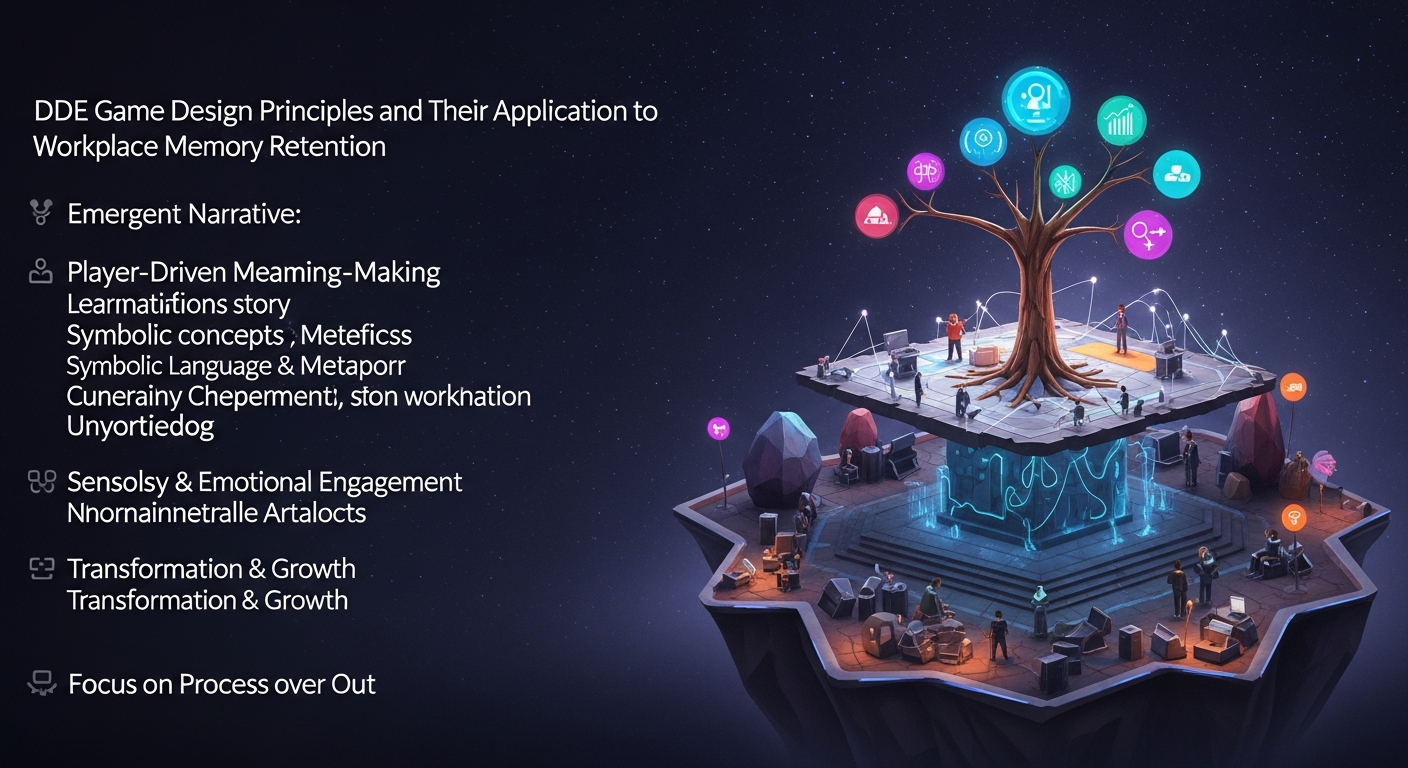
How Does DDE Game Design Enhance Workplace Memory Retention?
In today's fast-paced corporate environment, effective learning and knowledge retention are paramount. For Vice Presidents, Directors, and Senior Managers in Learning & Development, the challenge isn't just delivering information, but ensuring that critical skills and data stick. Traditional training methods often fall short, leading to forgotten policies, inefficient processes, and compliance gaps. This is where DDE Game Design, an innovative pedagogical approach, steps in to revolutionize how your employees learn and retain information.
DDE – Discovery, Deliberation, and Elaboration – represents a powerful framework for creating truly immersive and sticky learning experiences. By embedding these principles into Gamified LMS platforms, organizations across industries like Compliance, Sales, Banking, Finance, Insurance, Retail, Pharma, Healthcare, Hospitality, Oil and Gas, and Mining can dramatically improve long-term memory retention and practical application of knowledge. Let's delve into how DDE game design transforms workplace learning.
Understanding the DDE Framework in eLearning
DDE Game Design is not merely about adding points and badges to a course; it's a deeply researched methodology focused on how the human brain acquires, processes, and stores information. Each component plays a crucial role:
Discovery: Igniting Curiosity Through Exploration
Active Engagement: Instead of passively receiving information, learners are prompted to explore scenarios, discover hidden information, and solve problems independently. This mirrors real-world challenges, making the learning experience more relevant and impactful. Think of a compliance training module where employees "discover" the implications of a policy violation through a simulated case study, rather than just reading a rulebook.
Contextual Learning: Discovery-based activities place information within a meaningful context, aiding the brain in forming stronger associations. This is particularly effective when delivered via a Microlearning LMS, where concise, focused content facilitates targeted exploration.
Deliberation: Fostering Critical Thinking and Decision-Making
Reflection and Analysis: After discovery, learners are encouraged to pause, reflect, and deliberate on the information they've uncovered. This involves asking 'why,' 'what if,' and 'how does this apply?' This phase often involves choices, dilemmas, and critical analysis of outcomes.
Problem-Solving Practice: In a gamified environment, deliberation can take the form of choosing between different courses of action in a simulated scenario, weighing pros and cons, and understanding the consequences of their decisions. This is vital for complex fields requiring Risk-focused Training, such as banking or healthcare.
Elaboration: Solidifying Knowledge Through Application and Connection
Application of Knowledge: This is where learners actively apply what they've discovered and deliberated upon. It could involve developing a strategy, performing a task, or explaining a concept in their own words.
Connecting New Information: Elaboration encourages learners to integrate new knowledge with existing understanding, creating a richer, more interconnected mental model. An Adaptive Learning approach can then tailor subsequent elaboration exercises based on the learner's demonstrated mastery, optimizing retention.
The Cognitive Science Behind DDE's Memory Boost
DDE game design is inherently aligned with established principles of cognitive psychology that underpin long-term memory formation:
Active Recall: By requiring learners to actively retrieve information (Discovery, Deliberation), DDE strengthens memory traces far more effectively than passive review.
Spaced Repetition: Effective DDE game design on a robust learning management system can integrate spaced repetition, re-exposing learners to concepts at optimal intervals to prevent forgetting.
Context-Dependent Memory: Learning within a relevant, simulated context (as fostered by Discovery) improves recall when learners encounter similar situations in their real jobs.
Elaborative Rehearsal: The Elaboration phase encourages deep processing of information, linking it to prior knowledge and personal experiences, which is crucial for moving data from short-term to long-term memory.
DDE in Action: Enhancing Retention Across Industries
Consider the practical applications of DDE game design within various corporate training scenarios:
Sales Training: Instead of memorizing product features, a sales professional might engage in a DDE game where they discover customer pain points through simulated conversations, deliberate on the best product solutions, and then elaborate by pitching to a virtual client. An AI Powered Authoring Tool can help L&D teams rapidly develop such dynamic scenarios.
Compliance & Ethics: Employees can navigate simulated ethical dilemmas, discovering policy nuances, deliberating on the correct course of action, and elaborating on their rationale. This proactive engagement reduces risks and ensures consistent adherence. A comprehensive LCMS is key to managing such sensitive materials.
Healthcare & Pharma: Medical professionals can practice complex procedures or drug administration in a safe, simulated DDE environment, reducing errors and improving patient outcomes. A robust enterprise learning management system needs to support high-fidelity simulations.
Finance & Banking: Training on new financial regulations can involve discovering market trends, deliberating on their impact on client portfolios, and elaborating on new advisory strategies. A robust cloud based learning management system ensures secure and scalable delivery.
Addressing Common Questions About Memory Retention in eLearning
What are the best methods to improve employee recall in corporate training?
The most effective methods move beyond passive learning. Strategies incorporating active recall, spaced repetition, and experiential learning are crucial. DDE game design directly leverages these by requiring learners to actively explore, make decisions, and apply knowledge, fundamentally shifting from passive reception to active construction of understanding. Utilizing a modern learning management software that supports these interactive formats is essential.
How can digital learning platforms support long-term knowledge retention?
Digital learning platforms, particularly sophisticated lms learning management system solutions, achieve this by offering features that facilitate DDE principles. This includes interactive simulations, scenario-based learning, intelligent feedback mechanisms, and personalized learning paths. Platforms like MaxLearn LMS are designed to maximize engagement and ensure that learning translates into lasting knowledge by integrating these powerful methodologies.
What impact does interactive course design have on workplace performance?
Interactive course design, particularly when structured around DDE principles, has a profound impact. It fosters deeper understanding, improves decision-making skills, enhances problem-solving capabilities, and builds confidence. This leads to reduced errors, increased efficiency, and a more agile workforce better equipped to adapt to new challenges. The ability to practice and apply skills in a safe environment before real-world execution is invaluable.
Where can L&D professionals find effective tools for experiential learning?
L&D professionals should seek out comprehensive learning management solutions that prioritize experiential and gamified learning. Look for platforms that offer robust content creation tools, support for diverse media, and analytics to track engagement and progress. A modern LMS is the backbone of delivering such innovative training, enabling the creation and deployment of highly effective DDE-powered courses.
Implementing DDE Game Design in Your Organization
For L&D leaders looking to elevate their training programs, integrating DDE game design requires a strategic approach:
Invest in the Right Platform: Choose a learning management system that is built to support gamification, simulations, and adaptive learning paths.
Prioritize Content Design: Work with instructional designers who understand DDE principles to craft engaging, scenario-driven content. An AI Powered Authoring Tool can significantly streamline this process.
Measure and Iterate: Utilize the analytics features of your LMS to track learner performance, identify areas for improvement, and continuously refine your DDE-based training modules.
Conclusion
The imperative for L&D leaders is clear: move beyond rote memorization and embrace methodologies that foster true understanding and lasting retention. DDE Game Design offers a scientifically-backed, highly engaging framework to achieve this. By transforming passive learning into an active journey of Discovery, Deliberation, and Elaboration, organizations can cultivate a workforce that not only knows but truly understands and applies critical information. Invest in these advanced methodologies and robust learning solutions to unlock unparalleled memory retention and drive tangible business outcomes.
.jpg)


