

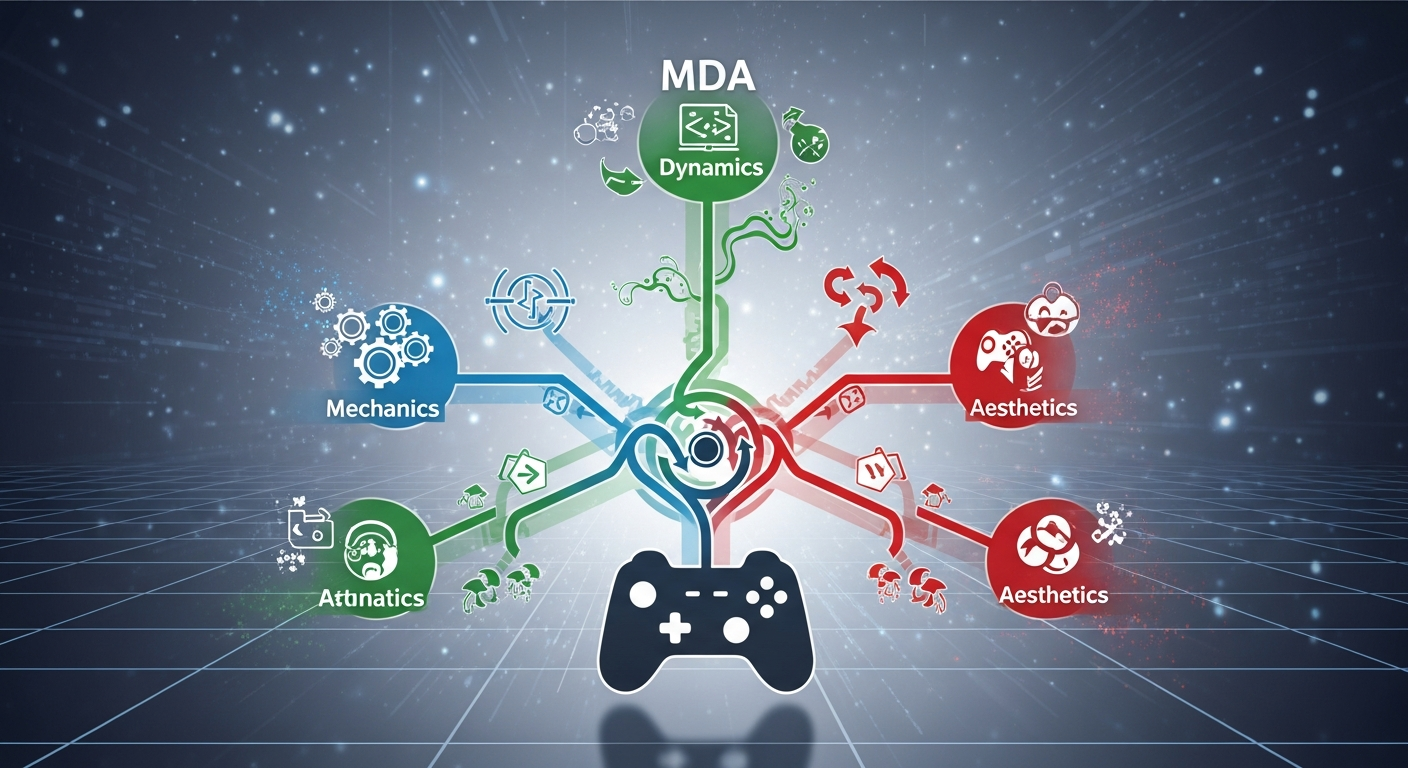
MDA in Game Design: The Secret Sauce for Player Engagement
In the intricate world of game development, creating an experience that truly resonates with players is a monumental challenge. It's not enough to simply have good graphics or an interesting story; the game needs to feel right, to compel interaction, and to leave a lasting impression. This is where the MDA framework comes – a powerful lens for understanding and designing games. MDA, standing for Mechanics, Dynamics, and Aesthetics, provides a structured approach to analyzing and building interactive experiences, transforming abstract ideas into concrete design decisions. For anyone serious about creating compelling digital worlds, understanding MDA in Game Design is absolutely fundamental.
Originally introduced by Robin Hunicke, Marc LeBlanc, and Robert Zubek, the MDA framework helps designers articulate the different facets of a game experience. It breaks down the complex act of playing into three distinct, yet interconnected, layers that move from the concrete rules of the game to the player's subjective emotional response. Let’s dive deep into each component and discover how their synergy crafts unforgettable interactive journeys.
Understanding the Pillars: Mechanics, Dynamics, and Aesthetics
Mechanics: The Foundation of Play
At its core, a game is a system of rules. These rules, along with the various actions players can take, the data structures used, and the algorithms that govern the game world, constitute the "Mechanics." Think of Mechanics as the building blocks – the verbs and nouns of the game. They are the concrete elements that define how the game operates. Examples include:
- Player Actions: Jumping, shooting, moving, interacting, crafting, trading.
- Game Rules: How points are scored, win/loss conditions, resource management constraints, turn-based systems.
- Game State: Player health, inventory items, map layout, enemy positions, currency.
- Underlying Algorithms: Physics engines, AI behaviors, procedural generation rules.
Mechanics are the most tangible aspect of a game. They are what the designer directly implements and what the player directly manipulates. Without robust and well-defined mechanics, the game lacks structure and purpose. They provide the raw material from which all other aspects of the game emerge.
Dynamics: The Emergent Gameplay
While Mechanics are the static rules, Dynamics are what emerge when players interact with those Mechanics, and when Mechanics interact with each other, over time. Dynamics represent the actual runtime behavior of the game system, driven by player input and the interplay of various game elements. This is where the 'game' truly happens. Dynamics are not explicitly programmed; they are the emergent behaviors and strategies that players discover and employ. Consider these examples:
- Player Strategies: How players choose to approach a challenge, the tactics they develop, resource allocation decisions under pressure.
- Emergent Narrative: The stories that unfold uniquely during a playthrough, created by player choices and the system's reactions.
- Player-to-Player Interaction: Cooperation, competition, betrayal in multiplayer settings, arising from the game's mechanics that allow such interactions.
- System Feedback: How the game world responds to player actions, creating loops of cause and effect.
Dynamics are often unpredictable and can lead to vastly different experiences even within the same game. A well-designed set of Mechanics will foster a rich and interesting set of Dynamics, encouraging players to experiment, learn, and adapt.
Aesthetics: The Player's Experience and Emotions
Aesthetics represent the emotional responses and experiences evoked in the player as a result of interacting with the game's Dynamics, which are themselves shaped by its Mechanics. This is the ultimate goal of game design – to create a specific feeling or experience. The MDA framework identifies eight common types of aesthetic pleasure in games:
- Sensation (Sense-Pleasure): Game as a sensory experience (graphics, sound, haptics).
- Fantasy (Make-Believe): Game as a portal to another world.
- Narrative (Drama): Game as a framework for a story.
- Challenge (Obstacle Course): Game as a test of skill or intellect.
- Fellowship (Social Framework): Game as a platform for social interaction.
- Discovery (Uncharted Territory): Game as an act of exploration and revelation.
- Expression (Self-Discovery): Game as a means for self-expression.
- Submission (Pastime): Game as a form of casual entertainment or mindless engagement.
Aesthetics are subjective and deeply personal. A designer might aim to evoke feelings of triumph through overcoming a challenge (Challenge aesthetic), or wonder through exploring a vast open world (Discovery aesthetic). The visual style, sound design, story, and even the pace of play all contribute to the overall aesthetic experience.
The Iterative Dance: Designing with MDA
While the framework is presented as M-D-A, professional game designers often work backward, or rather, in an iterative loop. They might start by identifying the desired Aesthetics – what emotions or experiences they want players to have. From there, they consider what Dynamics would naturally lead to those Aesthetics. Finally, they design the Mechanics necessary to enable those Dynamics.
For example, if the desired Aesthetic is 'Challenge,' the designer might think about Dynamics where players are constantly tested, need to make strategic decisions, and learn from failures. This then leads to Mechanics like complex enemy AI, intricate puzzle systems, or limited resources. This "designing from Aesthetics to Mechanics" approach ensures that all design decisions are geared towards creating a specific, intentional player experience.
The Benefits of Embracing MDA in Game Design
Adopting the MDA framework offers numerous advantages for game developers:
- Clear Communication: Provides a common language for teams to discuss and critique game design.
- Targeted Design: Helps designers focus on specific player experiences from the outset, rather than just piling on features.
- Problem Solving: When a game isn't "fun," MDA helps pinpoint whether the issue lies in broken mechanics, uninteresting dynamics, or failing aesthetics.
- Structured Iteration: Facilitates systematic testing and refinement, as changes to mechanics can be analyzed for their impact on dynamics and aesthetics.
- Player-Centric Focus: By emphasizing aesthetics, it ensures that the player's subjective experience remains at the heart of the design process.
MDA Beyond Entertainment: Its Relevance in Modern Learning and Training
The principles of MDA are not confined to traditional video games. They are increasingly vital in any field that seeks to engage users through interactive systems, particularly in education and corporate training. Consider how MDA principles enhance various learning solutions:
- A well-designed MaxLearn Microlearning Platform uses precise Mechanics (short, focused lessons, interactive quizzes) to create engaging Dynamics (quick mastery, immediate feedback) that evoke Aesthetics of achievement and confidence.
- Gamified LMS platforms leverage MDA by implementing game Mechanics like points, badges, and leaderboards. These mechanics generate Dynamics of friendly competition and progression, leading to Aesthetics of challenge and accomplishment, which significantly boost learner motivation and retention.
- In the realm of Adaptive Learning, Mechanics are dynamically altered based on learner performance. This creates personalized Dynamics, where the challenge level adjusts to the individual, ensuring an Aesthetic of optimal challenge – neither too easy nor too difficult, keeping engagement high.
- Tools like an AI Powered Authoring Tool enable designers to rapidly create diverse Mechanics and content, allowing for a broader range of Dynamics and the ability to target multiple Aesthetics for different learning objectives.
- For specialized areas such as Risk-focused Training, MDA is crucial. Mechanics simulating real-world scenarios and consequences generate Dynamics of critical decision-making under pressure, ultimately fostering Aesthetics of mastery, preparedness, and confidence in handling high-stakes situations.
Conclusion
The MDA framework is more than just an academic concept; it's an indispensable tool for anyone involved in game design or the creation of interactive experiences. By consciously separating and then connecting Mechanics, Dynamics, and Aesthetics, designers gain unparalleled clarity on how their creations function, how players engage with them, and what emotions they ultimately evoke. Embracing MDA means moving beyond guesswork, allowing for more intentional, effective, and ultimately, more enjoyable game design, forging powerful connections between the game and its players.
.jpg)


