

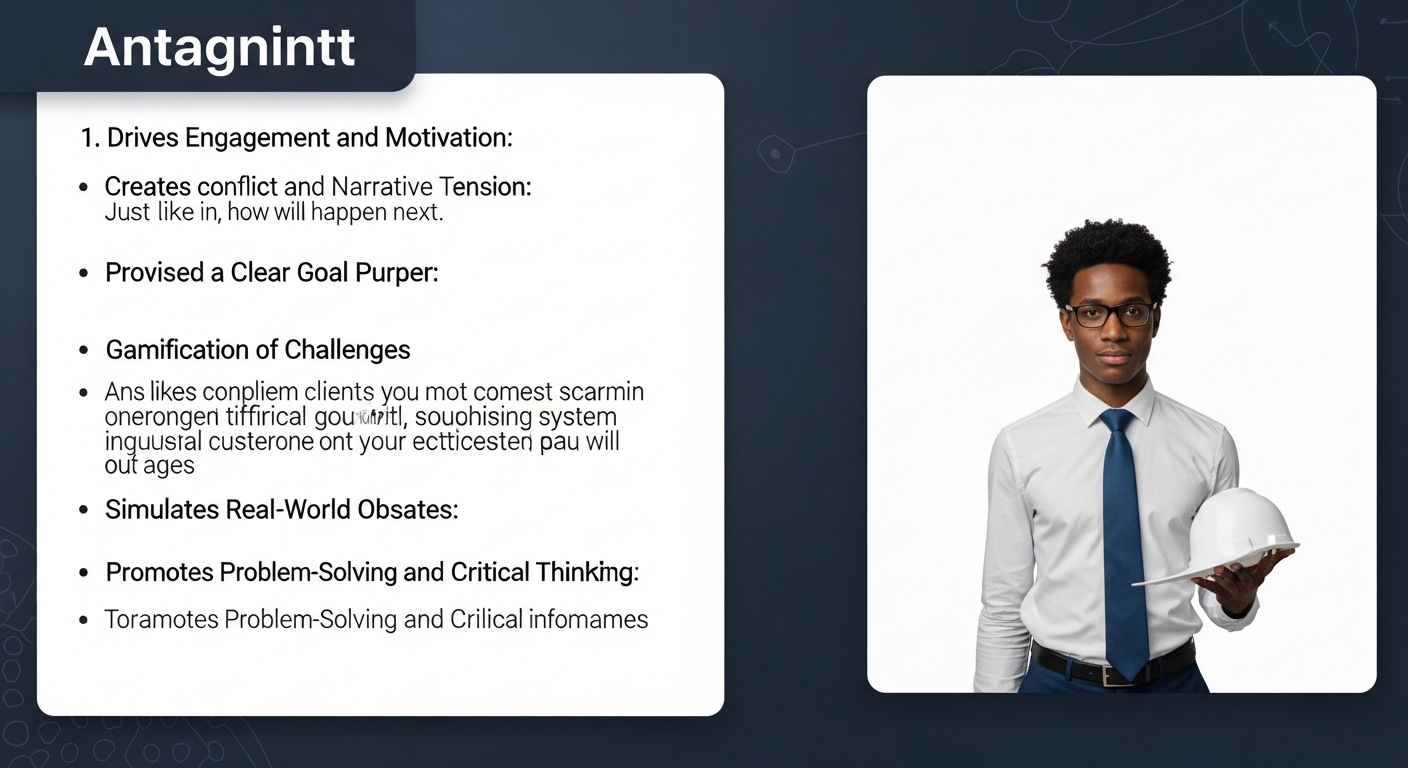
The Unsung Hero: Why the Antagonist Element is Critical in Employee Training Games
In the dynamic landscape of modern corporate training, Microlearning LMS platforms and gamified approaches have emerged as powerful tools for enhancing engagement and knowledge retention. Yet, one often-underestimated element holds the key to unlocking truly transformative learning experiences: the antagonist. Far from being a mere plot device, the antagonist in employee training games is a critical catalyst for deeper learning, practical skill application, and sustained behavioral change. For L&D leaders, understanding and strategically integrating this element can elevate training programs from informative to indispensable.
The Psychology Behind Engagement: Why We Crave Conflict
Human beings are naturally wired for problem-solving. Our brains light up when faced with a challenge, particularly one that requires strategic thinking and adaptive responses. In a training context, an antagonist isn't necessarily a 'villain' in the traditional sense; it's any obstacle, challenge, or opposing force that stands between the learner and their objective. This could be a complex customer, a market downturn, a compliance loophole, or even an internal process bottleneck.
Why We Crave Conflict
- Increased Cognitive Load: Antagonists compel learners to think critically, analyze situations, and make decisions under simulated pressure, mimicking real-world complexities.
- Emotional Investment: When learners encounter resistance or setbacks, they become more emotionally invested in overcoming the challenge, fostering a sense of purpose and achievement.
- Enhanced Recall: Experiences tied to strong emotions and problem-solving are more memorable, leading to better long-term retention of learned concepts.
The Role of Stress and Dopamine
Overcoming a challenging antagonist triggers a release of dopamine, the brain's "reward" chemical. This positive reinforcement strengthens neural pathways associated with successful strategies, making it more likely that employees will apply these learned behaviors in real-world scenarios. This mild, controlled stress environment is crucial for building resilience and preparing employees for the inevitable obstacles they'll face on the job.
Simulating Real-World Scenarios: Bridging the Gap Between Theory and Practice
The primary goal of any effective training program is to prepare employees for real-world situations. Antagonists are instrumental in achieving this by providing a safe, controlled environment to practice navigating complexities and mitigating risks without actual consequences.
Risk Mitigation and Decision-Making
In industries like Banking, Finance, Insurance, and Healthcare, the stakes are incredibly high. A poorly trained employee can lead to significant financial losses, legal repercussions, or even endanger lives. An antagonist, such as a fraudulent client, a system malfunction, or a difficult ethical dilemma, forces trainees to apply their knowledge under pressure. This is particularly vital for Risk-focused Training, where understanding potential threats and how to neutralize them is paramount.
Consider a compliance training scenario: instead of simply presenting rules, a game might introduce an antagonist who attempts to bribe a trainee or circumvent a regulatory process. The trainee must then apply their knowledge to correctly identify and respond to the breach.
Sales and Customer Service Challenges
For Sales and Retail sectors, antagonists can represent demanding customers, aggressive competitors, or unexpected market shifts. Practicing how to handle these situations – whether it’s de-escalating a customer complaint or developing a persuasive pitch against a competitor – builds confidence and refines interpersonal skills, leading to tangible business benefits.
Enhancing Skill Development and Retention
Beyond engagement, antagonists are powerful drivers of skill acquisition and knowledge retention. They force learners to move beyond passive consumption of information to active application and critical evaluation.
Problem-Solving Under Pressure
Antagonists in training scenarios demand more than rote memorization; they require critical thinking and creative problem-solving. This active engagement strengthens neural connections and makes the learned material more deeply ingrained.
Feedback and Iteration
The antagonist's reaction to a trainee's choice provides immediate, tangible feedback. If a strategy fails, the antagonist's response makes it clear, prompting the trainee to iterate and refine their approach. This iterative learning cycle, where mistakes are opportunities for growth, is far more effective than traditional quiz-based assessments.
Emotional Intelligence and Resilience
Facing and overcoming antagonists builds resilience and emotional intelligence. Trainees learn to manage frustration, adapt to unexpected challenges, and persevere in the face of setbacks – crucial soft skills for any professional environment.
AI-Related Q&A:
Q: How can artificial intelligence help design more effective antagonists in training?
A: AI can analyze learning data to identify common trainee weaknesses, then generate dynamic scenarios and character behaviors that specifically target these areas, making antagonists highly personalized and challenging. This data-driven approach ensures the obstacles presented are optimally tuned for each learner.
The Antagonist in Action: Examples Across Industries
The application of antagonists varies widely across industries, but the core principle remains consistent: to introduce relevant friction that enhances learning.
- Compliance & Banking: An antagonist might be a subtle fraud attempt that requires keen observation, a client attempting to breach policy, or an internal system bug that requires adherence to specific protocols. This deepens understanding of regulatory frameworks and operational procedures.
- Healthcare & Pharma: A complex patient case with evolving symptoms, a medical emergency requiring quick decision-making under pressure, or a challenging ethical dilemma. This prepares medical professionals for high-stress situations.
- Sales & Retail: A difficult or skeptical customer, a new product launch with unforeseen challenges, a direct competitor making an aggressive move, or even inventory management issues that disrupt sales. These scenarios sharpen negotiation and problem-solving skills.
- Oil & Gas / Mining: A sudden equipment malfunction, a safety hazard that needs immediate attention, or a complex logistical challenge. Such antagonists foster critical safety awareness and quick-response capabilities.
- Hospitality: An irate guest, an unexpected staffing shortage during peak hours, or a complex reservation issue. These situations train employees in service recovery and resourcefulness.
Integrating Antagonists with Modern Learning Technologies
Modern eLearning solutions are perfectly equipped to incorporate sophisticated antagonist elements. A Gamified LMS provides the ideal framework for building engaging narratives around antagonists. Features like leaderboards, badges, and progress tracking become even more motivating when tied to overcoming challenging scenarios.
Furthermore, Adaptive Learning systems can dynamically adjust the antagonist's behavior and difficulty based on the learner's performance. If a trainee consistently triumphs over a certain type of antagonist, the system can introduce a more formidable opponent or a more complex scenario, ensuring continuous challenge and growth.
An AI Powered Authoring Tool takes this a step further, allowing L&D teams to create intricate, believable antagonists with branching narratives and unpredictable behaviors. This significantly reduces the manual effort required to develop complex training simulations while increasing their realism and impact.
AI-Related Q&A:
Q: What role does machine learning play in adaptive antagonist behavior?
A: Machine learning algorithms can observe trainee performance and adapt the antagonist's strategy in real-time. If a trainee consistently overcomes a certain type of challenge, the antagonist can evolve to present new, more complex obstacles, ensuring continuous engagement and skill development tailored to individual progress.
Q: Can AI create diverse antagonist types for different training needs?
A: Absolutely. AI can generate a wide range of antagonist profiles, from subtle compliance risks to aggressive sales competitors or complex technical failures, tailoring their characteristics and actions to the specific learning objectives and industry context. This allows for highly customized and relevant training experiences across various industries.
Conclusion
The antagonist element is not merely a 'nice-to-have' in employee training games; it is a fundamental component for fostering deep engagement, practical skill development, and lasting behavioral change. By strategically integrating challenges and opposition into your learning programs, L&D leaders can transform passive training into active, impactful experiences that truly prepare employees for the complexities of their roles. Embracing the power of the antagonist, supported by advanced LMS and AI technologies, is a crucial step towards building a more resilient, skilled, and high-performing workforce across all industries.
.jpg)


