

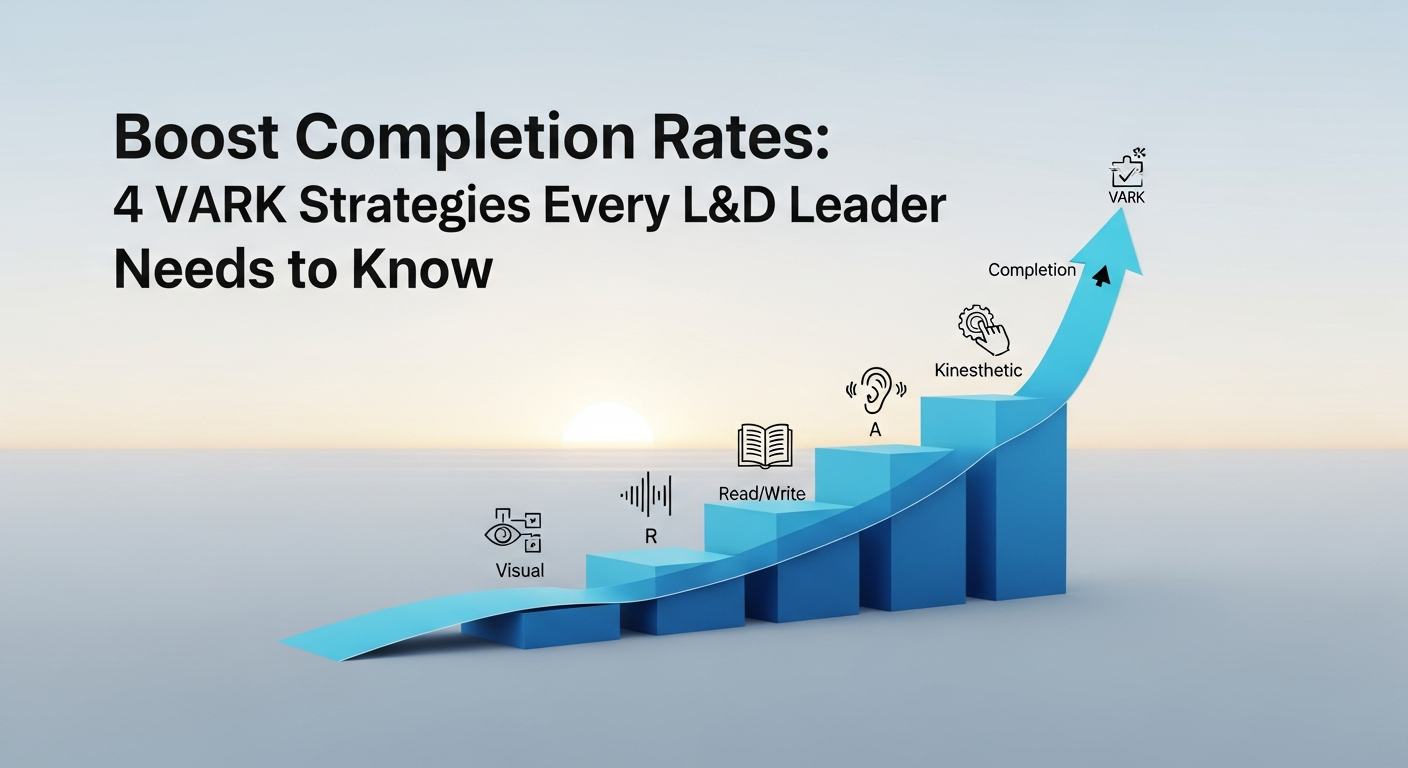
Boost Completion Rates: 4 VARK Strategies Every L&D Leader Needs to Know
As an L&D leader, you understand the critical importance of effective training. From onboarding new hires in a fast-paced retail environment to ensuring compliance in banking or healthcare, high course completion rates are a key indicator of success. Yet, far too often, learners disengage, abandon courses, and fail to retain vital information, leading to wasted resources and skill gaps. The challenge isn't just about delivering content; it's about delivering it in a way that resonates with every individual, fostering engagement and driving true knowledge acquisition.
Enter VARK – a powerful framework that helps us understand diverse learning preferences. By strategically integrating Visual, Auditory, Read/Write, and Kinesthetic approaches into your training design, L&D departments can dramatically improve engagement and boost completion rates across the board. This isn't just about ticking boxes; it's about creating a dynamic, inclusive learning environment that truly empowers employees, whether they're refining sales techniques, mastering new pharma regulations, or navigating complex financial products.
In this article, we’ll dive deep into four VARK-aligned strategies that every L&D leader needs to master. We’ll explore how leveraging these insights, often supported by a robust Microlearning LMS or comprehensive learning management system, can transform your training programs from mere obligations into impactful developmental journeys. Let's unlock the full potential of your workforce and ensure every learning experience counts.
Understanding VARK: A Quick Refresher
Before we delve into the strategies, let’s quickly revisit what VARK represents:
- Visual (V): Learners who prefer to see information presented graphically – through charts, diagrams, infographics, videos, and demonstrations.
- Auditory (A): Learners who best absorb information by hearing it – through lectures, discussions, podcasts, and verbal instructions.
- Read/Write (R): Learners who thrive on text-based information – reading manuals, taking notes, creating lists, and reviewing written materials.
- Kinesthetic (K): Learners who learn best by doing – through hands-on activities, simulations, role-playing, and practical application.
While individuals often have a dominant preference, most learners are multimodal, benefiting from a blend of these approaches. The key is to provide diverse options within your LMS or learning management software to cater to everyone.
Strategy 1: Visual (V) Learners – See It to Believe It
Visual learners are captivated by what they can see. For these individuals, abstract concepts come alive when presented through images, videos, and dynamic graphics. In industries like hospitality, where service procedures are crucial, or manufacturing, where intricate processes must be understood, visual aids are indispensable.
How to Engage Visual Learners:
- Infographics and Charts: Distill complex data (e.g., market trends in finance, safety protocols in oil and gas) into easily digestible visual summaries.
- Video Tutorials and Demonstrations: Show, don't just tell. High-quality video content is perfect for demonstrating software usage, equipment operation, or customer service scenarios.
- Visual Storytelling: Use compelling visuals to illustrate case studies or real-world application, making the learning more memorable.
- Interactive Diagrams and Simulations: Allow learners to explore systems visually, such as the flow of funds in banking or the supply chain in retail.
An effective Microlearning LMS that supports rich media formats and offers a seamless viewing experience is crucial here. Integrating visual elements keeps these learners engaged, leading to higher retention rates and a deeper understanding of the subject matter.
Strategy 2: Auditory (A) Learners – Hear the Message Clearly
Auditory learners process information best when they hear it. They excel in environments where discussions are encouraged, and spoken words carry significant weight. This is particularly relevant for training that involves communication skills, customer interaction, or complex explanations, common in sales, insurance, and healthcare.
How to Engage Auditory Learners:
- Podcasts and Audio Summaries: Offer short, digestible audio modules that learners can listen to on the go, reinforcing key concepts.
- Narrated Presentations: Ensure all visual presentations are accompanied by clear, concise narration.
- Virtual Discussions and Q&A Sessions: Facilitate live or recorded virtual meetings where learners can ask questions and discuss topics.
- Interactive Audio Scenarios: Present audio-based role-playing exercises, especially useful for sales and customer service training.
A Gamified LMS can incorporate auditory challenges or discussion forums that appeal to these learners, making the learning experience interactive and rewarding. By providing audio alternatives, you ensure that vital information, such as ethical guidelines in pharma or compliance details in mining, is heard and absorbed effectively.
Strategy 3: Read/Write (R) Learners – Dive into the Details
Read/Write learners thrive on text. They prefer to consume information through written words, whether it's detailed manuals, comprehensive articles, or structured notes. They often consolidate their learning by writing summaries or outlines themselves. This preference is often strong in professions requiring deep analytical skills, such as finance, legal compliance, and engineering within oil and gas.
How to Engage Read/Write Learners:
- Detailed Guides and Manuals: Provide comprehensive written documentation that learners can refer to.
- Annotated Resources: Offer articles, whitepapers, and reports with embedded notes or explanations.
- Written Quizzes and Assessments: Design assessments that require written answers or detailed explanations, not just multiple-choice.
- Note-Taking Prompts: Encourage learners to take notes and provide templates or structured prompts.
- Glossaries and FAQs: Offer easily searchable text-based resources for quick reference.
Adaptive Learning paths within your learning management solutions can be tailored to provide additional written content or deeper dives for those who prefer reading. This ensures that meticulous details, crucial for compliance or complex technical training, are thoroughly understood and documented.
Strategy 4: Kinesthetic (K) Learners – Learn by Doing
Kinesthetic learners are hands-on. They learn best through direct experience, practical application, and physical activity. Sitting through long lectures or reading extensive texts can be frustrating for them. This learning style is paramount in fields requiring practical skills, such as healthcare (procedures), retail (product handling), or mining (equipment operation).
How to Engage Kinesthetic Learners:
- Interactive Simulations: Create realistic simulations for practicing complex tasks, like operating machinery or managing a customer complaint.
- Role-Playing Scenarios: Enable learners to act out real-world situations, refining their interpersonal and practical skills.
- Case Studies with Actionable Tasks: Present real-world problems and require learners to develop and implement solutions.
- Gamification: Incorporate game-based elements that require active participation and problem-solving, like quizzes with physical actions or interactive challenges.
- Virtual Labs or Practical Exercises: Allow learners to perform tasks virtually, such as setting up a network or performing a diagnostic.
An AI Powered Authoring Tool can be invaluable for creating highly interactive and immersive content for kinesthetic learners. Additionally, integrating Risk-focused Training through simulations can allow employees to practice critical procedures in a safe environment, vital for industries like pharma and oil & gas.
The Multimodal Advantage: Blending for Broader Reach
While understanding individual VARK preferences is beneficial, the reality is that most learners are multimodal. This means the most effective strategy isn't to pick just one VARK type, but to incorporate elements from all four into your comprehensive enterprise learning management system. A blended learning approach that offers a variety of content formats caters to the broadest possible audience, ensuring higher engagement and better outcomes.
For instance, a module on new compliance regulations could include a video explanation (Visual), a narrated podcast summary (Auditory), a downloadable PDF with legal texts (Read/Write), and an interactive scenario where learners decide how to act in a tricky situation (Kinesthetic). This holistic approach reduces friction for learners, making the training more accessible and enjoyable.
Leveraging Technology for VARK-Aligned Training
Modern learning management system platforms are essential enablers for implementing VARK strategies. A robust cloud based learning management system, such as MaxLearn LMS, provides the flexibility to host diverse content types, from high-definition videos to interactive simulations and detailed documentation. An integrated Learning content management system (LCMS) further streamlines the creation, organization, and delivery of this varied content.
By investing in the right learning management software, L&D leaders can:
- Easily upload and manage multimedia content.
- Track learner progress across different activity types.
- Offer personalized learning paths based on learner preferences or performance.
- Gather feedback to continuously refine content for all VARK styles.
AI-Related Questions & Answers for Enhanced Learning Experience:
Question: What impact does personalized learning have on employee engagement across diverse industries?
Answer: Personalization significantly boosts engagement by catering to individual preferences, making learning more relevant and reducing cognitive load. This is especially critical in highly regulated sectors like banking and healthcare, where precise knowledge acquisition is paramount for compliance and Risk-focused Training. When content aligns with a learner's natural processing style, they feel understood and valued, leading to increased motivation and higher completion rates.
Question: How can advanced learning management software help global teams achieve consistent training outcomes, regardless of their location?
Answer: A robust cloud based learning management system provides centralized content delivery, multi-language support, and flexible access from anywhere. Features like performance analytics and standardized assessment tools ensure uniform skill development and adherence to corporate standards across all regional offices, from oil and gas to retail. This consistency is vital for maintaining brand integrity and operational efficiency globally.
Question: In what ways can a modern LCMS optimize the development and deployment of interactive content for various learning styles?
Answer: A cutting-edge learning content management system empowers L&D teams with powerful authoring tools and content versioning. It allows for rapid creation of rich media, interactive simulations, and adaptive pathways, ensuring content resonates with visual, auditory, read/write, and kinesthetic learners. This streamlined development process, coupled with targeted deployment, directly contributes to higher engagement and significantly improved course completion rates.
Conclusion
In the dynamic world of corporate training, simply offering courses is no longer enough. To truly elevate your L&D impact and boost completion rates, understanding and applying VARK learning strategies is fundamental. By providing a diverse range of learning experiences – visual, auditory, read/write, and kinesthetic – you create a more inclusive, engaging, and effective training environment for every employee, regardless of their industry segment, from sales to pharma.
As an L&D leader, your mission is to empower your workforce. Embrace these VARK strategies, leverage the power of a modern LMS learning management system and its capabilities, and watch your completion rates soar. Your organization will benefit from a more skilled, engaged, and knowledgeable workforce, ready to tackle any challenge and drive business growth. It's time to transform your training and unlock unparalleled potential.
.jpg)


