

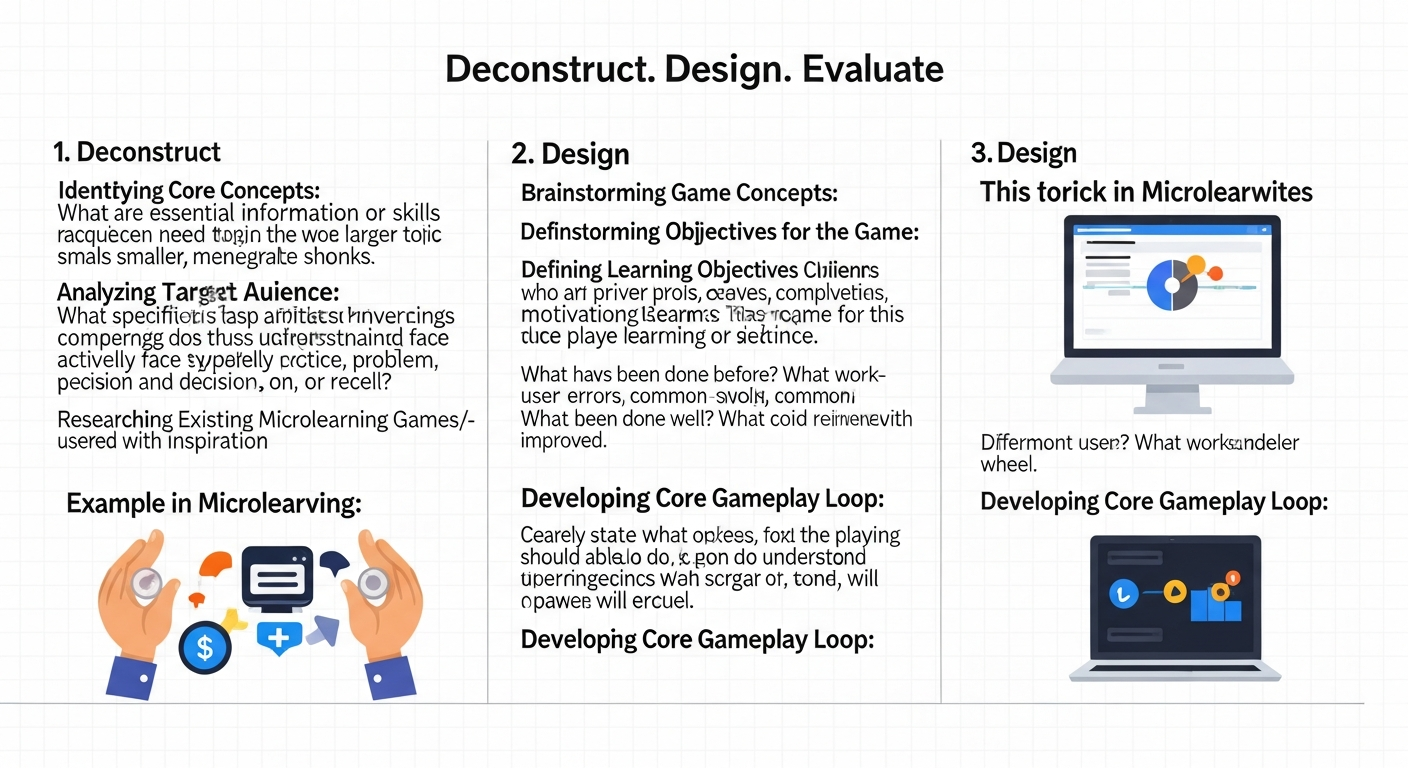
What is the DDE Framework for Game Design in Microlearning?
In today's fast-paced corporate environment, the traditional training paradigms often fall short. Vice Presidents, Directors, and Managers of Learning & Development (L&D) are constantly seeking innovative strategies to enhance employee engagement, knowledge retention, and ultimately, performance. Microlearning, with its bite-sized, focused approach, has emerged as a powerful solution. But how do you ensure these compact learning modules are not just informative, but truly captivating and effective? The answer lies in robust instructional design, particularly through the lens of game design. This is where the DDE Framework for Game Design in Microlearning offers a transformative approach.
The DDE Framework – Define, Design, Engage – provides a systematic and strategic blueprint for integrating game-thinking into microlearning, creating experiences that resonate deeply with adult learners across diverse industries, from Compliance and Sales to Banking, Finance, Insurance, Retail, Pharma, Health care, Hospitality, Oil and Gas, and Mining.
Understanding the DDE Framework: Define, Design, Engage
At its core, DDE is a methodical framework developed to guide the creation of impactful, gamified microlearning content. It recognizes that effective learning isn't just about delivering information; it's about creating an experience that encourages participation, problem-solving, and sustained interest. Let's break down each crucial phase:
Phase 1: Define - Laying the Strategic Foundation
The "Define" phase is the bedrock of any successful learning initiative. Before a single game mechanic is considered, L&D leaders must clearly articulate the 'why' and 'what' of the training. This involves a deep dive into organizational needs, performance gaps, and specific learning objectives.
- Identify Learning Objectives: What specific skills or knowledge should learners acquire? What behavioral changes are desired? These must be measurable and aligned with business goals.
- Understand the Audience: Who are the learners? What are their prior knowledge levels, roles, motivations, and preferred learning styles? Understanding the target demographic, whether it's sales representatives needing to master new product features or compliance officers understanding intricate regulations, is paramount.
- Determine Context and Constraints: What are the real-world scenarios where these skills will be applied? What technological, budgetary, or time constraints exist? A robust Microlearning LMS, for instance, can significantly impact the scope and delivery of content within these constraints.
- Success Metrics: How will success be measured? This could involve quiz scores, completion rates, behavioral changes, or impact on business KPIs. This initial definition is crucial for the entire LMS and learning content management system strategy.
Phase 2: Design - Crafting the Immersive Experience
With a clear definition in place, the "Design" phase brings creativity and instructional expertise to the forefront. This is where game design principles are interwoven with microlearning content to create engaging, memorable experiences.
- Game Mechanics Selection: What game elements will best support the learning objectives? This could include points, badges, leaderboards, levels, challenges, quests, progress bars, or virtual rewards. The key is to choose mechanics that motivate, provide immediate feedback, and align with the learning goals. A sophisticated Gamified LMS will offer robust tools to implement these.
- Narrative and Storytelling: How can a compelling story or scenario contextualize the learning? A relatable narrative makes abstract concepts more concrete and emotionally engaging, whether it's navigating a simulated customer interaction for sales training or mitigating a financial risk in a banking scenario.
- Challenge and Progression: Design challenges that are appropriately difficult, providing a sense of achievement without overwhelming the learner. Each microlearning module should build progressively, fostering a sense of mastery. This ties into the concept of a powerful learning management software.
- Feedback Loops: Implement immediate, constructive feedback that guides learners, reinforces correct answers, and explains mistakes. This constant interaction is vital for active learning.
Phase 3: Engage - Sustaining Momentum and Impact
The "Engage" phase focuses on maintaining learner motivation, facilitating skill transfer, and ensuring the learning has a lasting impact. It extends beyond the initial completion of the module.
- Motivation and Replayability: How can the design encourage continued interaction? This might involve spaced repetition, new challenges, competitive elements on a leaderboard, or collaborative tasks. An effective learning management system makes this ongoing engagement seamless.
- Social Interaction: Can learners collaborate, compete, or share insights? Peer learning and social recognition can significantly boost engagement and knowledge sharing within an enterprise learning management system.
- Analytics and Iteration: Continuously monitor learner progress, engagement levels, and performance data within the LMS. Use this data to refine and improve the microlearning experience, ensuring it remains relevant and effective. This data-driven approach is a hallmark of cutting-edge learning management solutions.
- Application and Transfer: Design opportunities for learners to apply their new knowledge and skills in real-world contexts, bridging the gap between learning and performance.
Why DDE is Crucial for Modern L&D Leaders
For L&D VPs, Directors, and Managers, the DDE Framework isn't just an academic exercise; it's a strategic imperative. It addresses several critical challenges:
- Enhanced Engagement & Retention: Gamified microlearning, built with DDE, inherently captures attention and improves knowledge recall, combating the common issue of passive learning.
- Measurable ROI: By defining clear objectives and success metrics upfront, DDE enables L&D teams to demonstrate the tangible impact of training on business outcomes, justifying investment in a cloud based learning management system.
- Rapid Skill Acquisition: The focused, iterative nature of microlearning, coupled with engaging game design, accelerates skill development, crucial for industries like Sales or Pharma that require constant updating of product knowledge.
- Consistent Application: Through realistic scenarios and immediate feedback, DDE helps learners practice and apply skills, reducing the gap between knowing and doing, vital for Risk-focused Training in Banking or Insurance.
- Scalability and Personalization: A well-designed DDE framework, especially when implemented within a robust lms learning management system like MaxLearn LMS or an LCMS, can be scaled across large organizations while offering personalized learning paths.
Leveraging Technology for DDE Success
The DDE Framework truly shines when supported by modern learning technologies. Platforms capable of Adaptive Learning can dynamically adjust content and challenges based on learner performance, personalizing the game experience. An AI Powered Authoring Tool can dramatically speed up the 'Design' phase, helping create engaging game scenarios and interactive content with unprecedented efficiency. These tools are indispensable for any organization serious about modernizing their learning management solutions.
Strategic Questions for L&D Leaders
As L&D leaders consider integrating the DDE Framework, critical questions often arise regarding optimization and strategic impact:
- How can advanced analytics and machine learning precisely identify the most critical skill gaps within an organization, ensuring that microlearning modules target the right competencies? By leveraging data from an enterprise learning management system, L&D can define learning objectives with unparalleled accuracy.
- Beyond mere engagement, how does the structured application of DDE translate into measurable improvements in employee performance, retention, and ultimately, the organization's bottom line? The focus on defining success metrics in Phase 1 directly links DDE implementation to tangible business results, providing clear ROI for L&D investments.
- What strategies can L&D teams employ to ensure microlearning content is culturally relevant and applicable across diverse global teams, taking into account regional regulations and operational nuances? The 'Define' phase, with its emphasis on audience and context, is crucial here. Partnering with local teams and using flexible content management within a cloud based learning management system allows for tailored content delivery.
- In what ways can intelligent systems and data analysis craft highly individualized learning journeys, adapting content and challenges to each employee's unique progress and preferences? This aligns perfectly with Adaptive Learning capabilities, allowing the 'Design' and 'Engage' phases to become deeply personalized, responding in real-time to learner needs and performance data.
- What practical steps can L&D departments take to integrate the DDE framework seamlessly into their existing content development workflows, maximizing adoption and impact without extensive overhaul? Starting with a pilot program for a critical training area, leveraging existing content adapted for microlearning, and utilizing intuitive AI Powered Authoring Tools can ensure a smooth transition and demonstrate quick wins.
DDE in Action: Industry-Specific Impact
The DDE Framework's versatility makes it applicable across a multitude of industries:
- Compliance: Transforming dry regulatory content into engaging scenarios where learners navigate ethical dilemmas or identify security risks, ensuring higher understanding and adherence. This is particularly effective for Risk-focused Training.
- Sales: Creating interactive simulations for product knowledge, objection handling, or negotiation tactics, allowing sales professionals to practice in a risk-free environment.
- Banking & Finance: Designing modules for financial product knowledge, fraud prevention, or customer service best practices, using game mechanics to reinforce complex information.
- Healthcare: Developing micro-simulations for medical procedure refreshers, patient communication skills, or new equipment training.
- Retail & Hospitality: Training staff on customer service excellence, new POS systems, or inventory management through interactive challenges and role-play scenarios.
Conclusion: Redefining Learning Engagement
The DDE Framework for Game Design in Microlearning is more than just a methodology; it's a strategic pathway for L&D leaders to revolutionize corporate training. By systematically defining objectives, thoughtfully designing engaging experiences, and continuously striving to sustain learner involvement, organizations can move beyond mere information dissemination to truly transformative learning. In an era where continuous learning is paramount, DDE offers a powerful approach to create impactful, memorable, and measurable training that drives business success and cultivates a highly skilled, engaged workforce. Embracing DDE is embracing the future of learning.
.jpg)


