

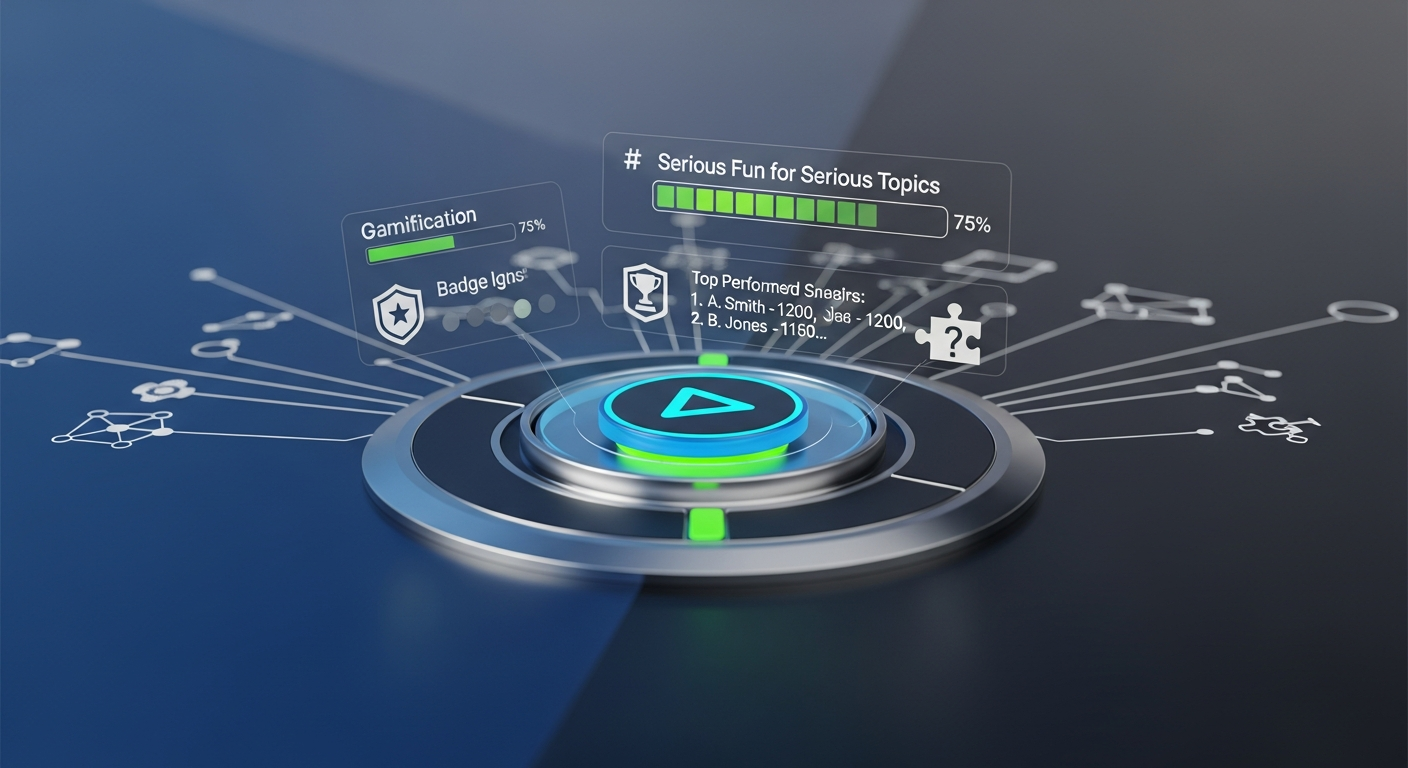
Serious Fun for Serious Topics: Gamifying Safety and Compliance
For Vice Presidents, Directors, and Managers in Learning & Development across industries like finance, healthcare, retail, and manufacturing, the phrase "safety and compliance training" often conjures images of uninspired presentations, endless policies, and glazed-over employee eyes. It's a critical function, no doubt, but one historically plagued by low engagement and questionable retention. Yet, in an era where regulatory landscapes are more complex than ever, and the cost of non-compliance can be catastrophic, effective training isn't just a recommendation—it's an imperative. What if we told you that the secret to transforming this dry, often dreaded necessity into an engaging, impactful, and even enjoyable experience lies in something as simple as play?
Welcome to the world of gamification in safety and compliance: a strategic approach that applies game-design elements and game principles in non-game contexts. This isn't about trivializing serious subjects; it's about harnessing intrinsic human motivations to drive better learning outcomes, foster safer behaviors, and build a culture of compliance from the ground up. Imagine a world where employees actively seek out compliance modules, not because they have to, but because they want to.
The Engagement Gap: Why Traditional Methods Fall Short
The traditional model of safety and compliance training—think lengthy manuals, annual webinars, and rote memorization tests—suffers from several critical flaws. It's often passive, one-size-fits-all, and fails to connect with learners on an emotional or practical level. The result? Low knowledge retention, minimal behavioral change, and a workforce that views compliance as a chore rather than a core responsibility. For organizations operating in high-risk sectors like oil and gas, mining, or pharmaceuticals, this engagement gap isn't just an inconvenience; it's a significant business risk. It impacts productivity, increases the likelihood of incidents, and leaves companies vulnerable to fines and reputational damage.
The solution isn't to make compliance easier or less stringent, but to make the learning process more effective and resonant. This is where Risk-focused Training, infused with gamification, shines. It shifts the paradigm from passive consumption to active participation, transforming mandatory training into a dynamic learning journey.
Beyond Badges: The Core Principles of Gamified Learning
Gamification is far more than just adding badges and leaderboards to existing content. It's about strategically applying core game mechanics to drive engagement, motivation, and measurable learning outcomes. Key elements include:
- Clear Objectives & Rules: Defining what needs to be learned and how success is measured.
- Challenges & Quests: Presenting information as problems to solve, often in real-world scenarios.
- Instant Feedback: Providing immediate results on actions, allowing learners to adjust and improve.
- Progression & Rewards: Showing progress through levels, points, and virtual incentives.
- Narrative & Storytelling: Embedding learning within a compelling storyline to make it relatable and memorable.
- Social Interaction: Enabling peer-to-peer competition or collaboration.
By integrating these elements into a robust LMS, organizations can craft experiences that intrinsically motivate employees to engage with complex safety protocols, ethical guidelines, and regulatory requirements. This approach ensures that vital information is not just reviewed but truly understood and internalized, leading to sustained behavioral change.
How Artificial Intelligence Amplifies Gamified Compliance
The synergy between gamification and artificial intelligence is unlocking new frontiers in learning and development. AI can personalize the learning journey, making gamified experiences even more potent and relevant. For enterprise learning management, this is a game-changer.
Can artificial intelligence tailor gamified safety training for diverse global workforces?
Absolutely. Modern learning management software, especially a sophisticated learning content management system, leverages AI to analyze individual learner performance, preferences, and progress. It can then adapt the game mechanics, challenges, and content difficulty in real-time. For global teams, this means AI can serve up scenarios specific to regional regulations, cultural nuances, and even language, ensuring that a compliance module on data privacy, for example, is highly relevant whether an employee is in Berlin, Boston, or Bengaluru. This individualized approach through Adaptive Learning maximizes engagement and knowledge transfer, regardless of geographical location or prior expertise.
What actionable insights can intelligent systems provide regarding compliance gaps and training effectiveness?
AI's analytical capabilities are invaluable for L&D leaders. Beyond basic completion rates, an advanced learning management system powered by AI can identify patterns in learner behavior, pinpoint common areas of confusion or difficulty, and even predict potential compliance risks. For instance, if a significant portion of employees repeatedly struggle with a specific module on anti-money laundering regulations within a gamified scenario, AI can flag this as a systemic weakness. This allows L&D teams to refine their content, offer targeted interventions, or adjust their overall learning management solutions strategy. It transforms data from a mere record into predictive intelligence for proactive risk mitigation.
How does AI assist in rapidly creating dynamic and engaging gamified content for critical regulations?
Creating highly interactive and scenario-based gamified content can be resource-intensive. This is where an AI Powered Authoring Tool becomes a significant asset. These tools can help L&D professionals rapidly generate diverse scenarios, interactive quizzes, and decision-tree challenges based on existing compliance documentation. AI can also suggest game mechanics that are most suitable for specific learning objectives, ensuring the content is both engaging and effective. This capability dramatically reduces development time and costs, allowing organizations to keep their compliance training up-to-date with evolving regulations without significant delays or budget overruns.
Tangible Benefits for Your Organization
Adopting gamified safety and compliance training through an effective lms learning management system delivers quantifiable benefits:
- Enhanced Engagement & Retention: Employees are more motivated to learn and remember critical information, reducing the need for costly retraining.
- Improved Safety Culture: Proactive engagement with safety protocols translates into fewer incidents, injuries, and operational disruptions.
- Reduced Compliance Risk: A well-informed workforce is less likely to make errors that lead to fines, lawsuits, or reputational damage.
- Measurable ROI: Demonstrable improvements in safety metrics, compliance rates, and employee productivity directly impact the bottom line.
- Scalability: A cloud based learning management system can effortlessly scale gamified content to thousands of employees across diverse locations.
Choosing the Right Partner for Your Gamified Journey
Implementing a successful gamified safety and compliance program requires more than just good intentions; it demands the right technology and strategic expertise. Look for a comprehensive learning management system (LCMS) that offers specialized features designed for engagement and effectiveness.
A leading platform like MaxLearn LMS exemplifies what an ideal Gamified LMS should be. It provides robust tools for creating interactive scenarios, tracking progress with detailed analytics, and delivering content in bite-sized, digestible modules consistent with a Microlearning LMS approach. When evaluating learning management software, consider its ability to integrate with existing HR systems, its user-friendliness for both administrators and learners, and its commitment to continuous innovation in the realm of AI and adaptive learning. The goal is to find learning management solutions that are not just functional, but transformative for your enterprise learning management strategy.
Conclusion: Play Your Way to Peak Performance and Compliance
The days of monotonous, ineffective compliance training are over. For L&D leaders tasked with safeguarding their organizations and empowering their workforces, gamification presents a compelling and proven pathway to success. By embracing game principles and leveraging the power of artificial intelligence, you can transform safety and compliance from a dreaded obligation into an engaging, impactful, and continuous learning journey.
Invest in an LMS that understands the critical balance between serious topics and serious fun. Empower your employees to not just comply, but to excel, fostering a culture where safety and ethics are embedded in every action. The game is on, and the stakes—and rewards—have never been higher.
.jpg)


