

Skinner And Operant Conditioning: A Blueprint for Modern eLearning Success
For decades, L&D professionals have sought effective strategies to not just impart knowledge, but to genuinely change behavior. In fields ranging from compliance and sales to healthcare and finance, the goal is often to instill specific actions, reinforce desired practices, and eliminate detrimental habits. While modern eLearning boasts sophisticated technologies, the foundational principles for achieving these outcomes often trace back to the revolutionary work of B.F. Skinner and his theory of operant conditioning.
As leaders in learning and development, understanding Skinner’s insights isn't merely an academic exercise; it's a strategic imperative. It provides a scientific framework for designing training programs that consistently produce measurable behavioral shifts, driving performance and mitigating risk across your enterprise. By leveraging these timeless principles, L&D teams can move beyond merely delivering content to actively shaping a more skilled, compliant, and productive workforce.
The Enduring Power of Operant Conditioning
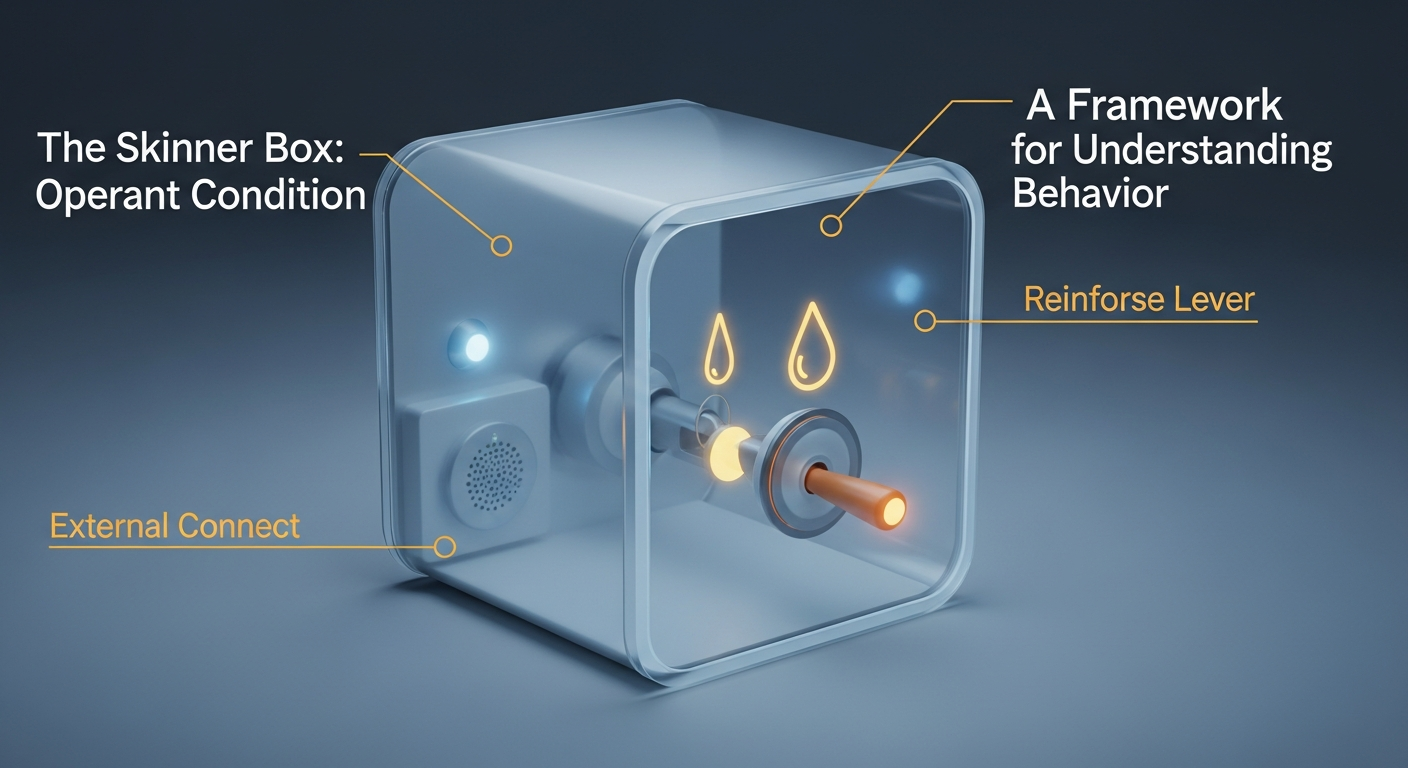
At its core, operant conditioning is a method of learning that occurs through rewards and punishments for behavior. An association is made between a behavior and a consequence for that behavior. Skinner's extensive research, often involving controlled experiments with animals in "Skinner boxes," meticulously demonstrated how specific actions could be deliberately shaped by controlling the environmental stimuli and the outcomes of those actions. This scientific rigor provides a powerful lens through which to view human learning and behavioral modification in the workplace.
Key Concepts for L&D Leaders:
- Reinforcement: The cornerstone of operant conditioning, reinforcement is any consequence that strengthens the likelihood of a behavior being repeated.
- Positive Reinforcement: This involves adding a desirable stimulus after a behavior to increase its frequency. Examples in L&D include immediate praise, awarding points or badges in a course, granting a certificate of completion, or providing access to advanced modules after mastering foundational ones.
- Negative Reinforcement: This entails removing an undesirable stimulus after a behavior to increase its likelihood. In a training context, it could mean a learner completing a module quickly to avoid a looming deadline, or a manager completing necessary compliance training to remove the stress of potential audit failures.
- Punishment: The application of a stimulus to decrease the likelihood of a behavior being repeated. It's crucial to differentiate punishment from negative reinforcement, as punishment aims to suppress a behavior, while negative reinforcement aims to increase one.
- Positive Punishment: Adding an undesirable stimulus after a behavior. For instance, a critical feedback session for an incorrect procedure, or a deduction of points in a simulation for a critical error.
- Negative Punishment: Removing a desirable stimulus after a behavior. This could be losing access to advanced training resources due to non-completion of prerequisites, or a reduction in performance bonuses for failing to adhere to sales protocols.
- Extinction: The gradual weakening and disappearance of a conditioned behavior when the reinforcement that maintained it is no longer provided. For L&D, if desired behaviors (e.g., following a new safety protocol) are no longer acknowledged or rewarded, they are likely to cease over time.
- Shaping: A powerful technique for teaching complex skills by reinforcing successive approximations of a target behavior. Instead of waiting for the perfect execution, smaller, incremental steps towards the desired outcome are rewarded. This is invaluable for breaking down intricate processes in fields like manufacturing or advanced financial modeling into manageable, learnable segments.
- Schedules of Reinforcement: The specific patterns that determine when and how often a behavior will be reinforced. These can be continuous (reinforcing every correct response, good for initial learning) or partial (fixed ratio, variable ratio, fixed interval, variable interval), which significantly impact the persistence and rate of learning, especially for long-term retention and motivation.
Translating Theory into Modern eLearning Practice
The principles of operant conditioning are remarkably adaptable to the digital learning landscape, offering a blueprint for high-impact training across diverse sectors. Consider the specific needs of various industries and how these principles apply:
- Compliance: In heavily regulated industries like banking, finance, insurance, pharma, and healthcare, precise adherence to regulations and protocols is paramount. Training must reinforce correct procedures and discourage non-compliance. Immediate feedback on quizzes, interactive scenarios simulating real-world consequences, and digital badges or certifications for successful completion act as powerful positive reinforcers, shaping compliant behavior.
- Sales: For sales teams across retail and other sectors, training aims to refine selling techniques, improve product knowledge, and increase conversions. Gamified LMS environments with points, leaderboards showcasing top performers, and instant feedback on pitch delivery or objection handling directly leverage positive reinforcement and variable ratio schedules to shape high-performance sales behaviors.
- Safety & Operations: In high-risk environments such as oil and gas, mining, and heavy manufacturing, even minor deviations can have severe consequences. Training modules designed with a focus on Risk-focused Training emphasize immediate feedback on safety protocols, simulated hazard responses, and clear consequences (even simulated negative punishment) for errors, effectively applying operant conditioning to prevent accidents and reinforce safe practices.
- Customer Service: In hospitality and retail, training focuses on specific interaction protocols, empathy, and problem-solving skills. Role-playing scenarios with constructive feedback, points for positive customer interactions, and recognition for service excellence drive desired customer service behaviors through consistent reinforcement.
Elevating Learning with Strategic Reinforcement
Modern eLearning platforms and methodologies offer sophisticated tools to apply Skinner's principles dynamically:
- Microlearning LMS: Short, focused modules inherently provide immediate opportunities for reinforcement. Learners complete a small task, get instant feedback on their performance, and quickly move to the next step, creating a continuous, efficient cycle of conditioned learning. This rapid feedback loop is a direct application of Skinner's principle of immediate reinforcement, optimizing retention and engagement.
- Gamified LMS: The very essence of gamification — points, badges, levels, leaderboards, and challenges — is built on the strategic application of reinforcement schedules. These elements provide consistent positive reinforcement, often on variable ratio schedules, motivating learners to engage more deeply and frequently with the content, thereby shaping desired learning behaviors and sustained engagement.
- Adaptive Learning: These intelligent systems personalize the learning path based on a learner's individual performance and progress. By dynamically adjusting content difficulty, providing targeted remediation, or presenting more challenging material, adaptive learning acts as a highly refined form of shaping. It provides optimal reinforcement for correct understanding and efficiently redirects errors, ensuring efficient skill acquisition and mastery.
- AI Powered Authoring Tool: Artificial intelligence in content creation can analyze learner interactions, provide instant, highly personalized feedback, and even suggest optimal learning paths and content adjustments. This creates a highly responsive learning environment, delivering precise reinforcement at exactly the right moment to maximize learning efficacy and behavioral modification, much like a master trainer.
AI's Role in Optimizing Operant Conditioning in eLearning
The convergence of Skinner's principles with artificial intelligence opens new frontiers for L&D, allowing for learning environments that can dynamically adapt and reinforce behavior with unprecedented precision and scale:
How can artificial intelligence revolutionize learner engagement and motivation within corporate training programs?
AI can meticulously analyze a vast array of learner data, including interaction patterns, performance metrics, and even historical preferences, to predict engagement levels and potential drop-off points. By understanding these individual behavioral tendencies, intelligent systems can dynamically adjust content delivery, recommend relevant modules, or trigger personalized motivational prompts at optimal times. This tailored approach ensures that each learner receives precisely the right kind of reinforcement—be it a challenging question, a supportive message, or immediate positive feedback—at the exact moment it will be most effective, much like a highly skilled trainer constantly fine-tuning their approach to maximize motivation and behavioral retention across diverse audiences in industries from retail to healthcare.
In what ways can intelligent systems optimize learning content to resonate more effectively with diverse regional or cultural workforces?
Intelligent systems possess the profound capability to analyze linguistic, cultural, and contextual nuances across different geographical regions and demographic groups. This allows for the automatic localization of learning content, ensuring that examples, scenarios, case studies, and even motivational messages are culturally appropriate, relevant, and impactful. By avoiding potential misunderstandings or cultural friction and fostering a sense of familiarity and belonging, AI helps to create a learning environment where desired behaviors are reinforced effectively and inclusively, making training equally potent and relatable for a global workforce in multi-national banking, hospitality, or oil and gas operations.
How do advanced analytical tools enhance the individual learning journey and improve overall skill acquisition and retention?
Advanced analytical tools, powered by sophisticated algorithms, meticulously track an individual's progress through a learning journey, identifying specific knowledge gaps, persistent misconceptions, and areas where newly acquired skills are not being adequately applied. Based on this precise diagnostic data, the system can then dynamically provide targeted reinforcement, whether it’s supplementary material tailored to address a specific weakness, a simulated practice exercise to build proficiency, or a direct coaching suggestion for a particular skill. This creates a continuous, highly individualized loop of assessment, immediate feedback, and personalized intervention, actively shaping the learner's understanding and ensuring the consistent application of desired behaviors, ultimately leading to superior skill acquisition, deeper mastery, and robust long-term retention essential for complex roles in pharma or finance.
The Essential Role of a Modern Learning Platform
Implementing these sophisticated strategies requires a robust learning management system. A comprehensive learning management software serves as the backbone for delivering, tracking, and optimizing operant-conditioned learning experiences. An effective enterprise learning management solution empowers L&D teams to:
- Deploy a powerful learning management system that supports diverse content formats and delivery methods essential for industries like compliance, sales, or even mining.
- Utilize a learning content management system (LCMS) to easily create, manage, and update modules that seamlessly integrate reinforcement schedules and varied learning assets.
- Leverage a cloud based learning management system for global access and scalability, ensuring consistent training across all locations and industries, from pharma to hospitality.
- Access detailed analytics from the lms learning management system to identify which reinforcement strategies are most effective, for whom, and in what contexts, enabling continuous optimization.
- Integrate advanced features, transforming theoretical concepts into practical, impactful learning management solutions that drive measurable business outcomes.
Conclusion
B.F. Skinner's operant conditioning provides an invaluable, scientifically validated framework for understanding and influencing human behavior, a goal central to every L&D initiative. By consciously applying principles of reinforcement, punishment, extinction, and shaping, L&D leaders can design highly effective training programs that not only impart knowledge but fundamentally alter employee behavior. When combined with the unparalleled power of modern eLearning technologies—including microlearning, gamification, adaptive learning, and advanced AI—Skinner’s enduring legacy offers a clear blueprint for creating engaging, impactful, and measurably successful learning experiences across all industries, from compliance to hospitality. This synergy ensures your workforce is not just informed, but truly transformed, equipped with the right behaviors to excel in an ever-evolving professional landscape.
.jpg)


