

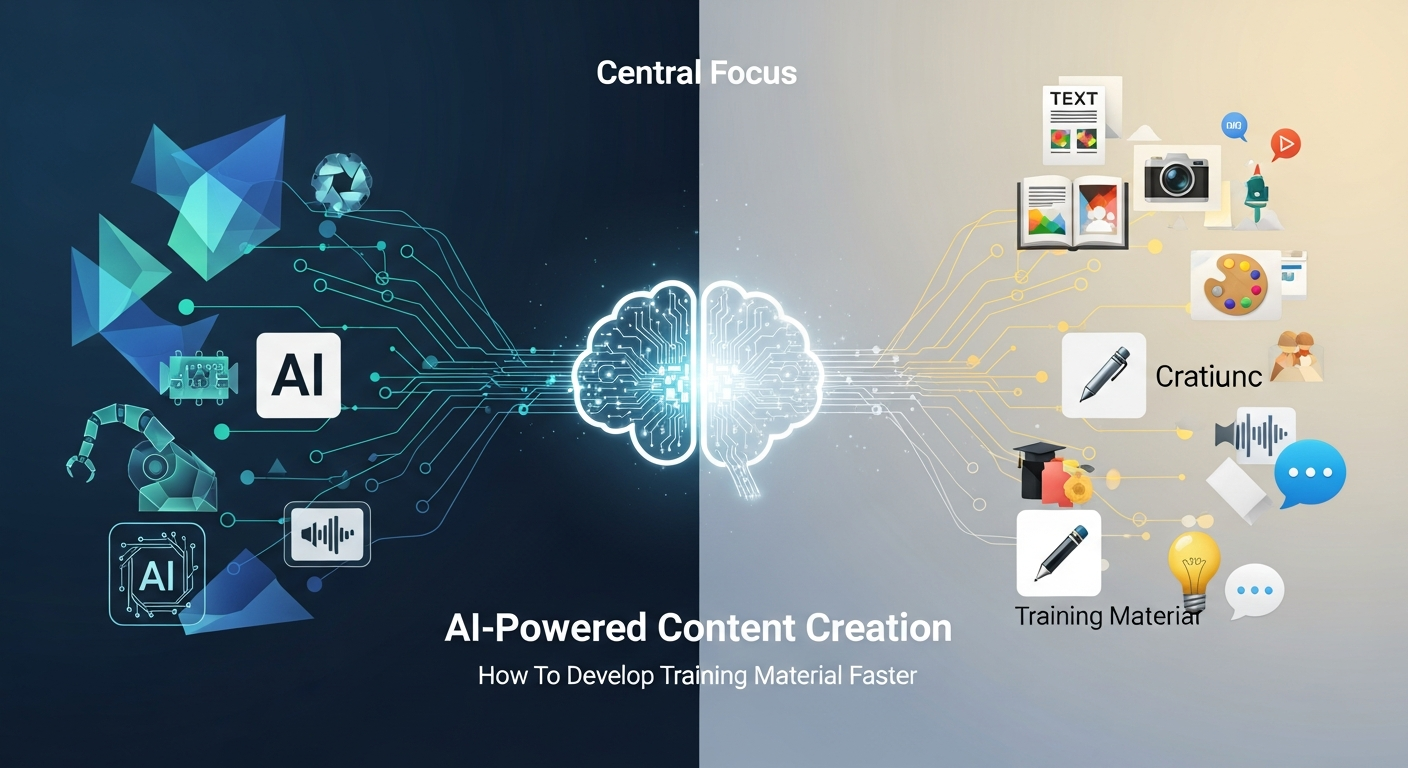
AI-Powered Content Creation: How To Develop Training Material Faster
In today's fast-paced corporate environment, the demand for timely, relevant, and engaging training material has never been higher. Learning and Development (L&D) professionals, from Vice Presidents to Directors and Managers, are under constant pressure to deliver effective learning content that meets evolving business needs across diverse industries like Compliance, Sales, Banking, Finance, Insurance, Retail, Pharma, Healthcare, Hospitality, Oil and Gas, and Mining. The traditional methods of content creation, however, often struggle to keep pace. Enter AI-powered content creation, a transformative force poised to revolutionize how organizations develop training material faster and more efficiently. This isn't just about automation; it's about intelligent augmentation that empowers L&D teams to achieve more with less.
The Escalating Demand for Rapid L&D Solutions
Modern organizations face a myriad of challenges that necessitate agile L&D responses. New product launches, updated compliance regulations, evolving sales strategies, and continuous skill gaps require a constant influx of fresh training. For a learning management system (LMS) to be truly effective, it must be fed with a steady stream of high-quality, up-to-date content. The bottleneck often lies in the labor-intensive process of designing, drafting, reviewing, and deploying these materials.
Consider the banking sector, where regulatory changes can happen overnight, or the pharmaceutical industry, requiring rapid updates on drug protocols. In these scenarios, the ability to develop Risk-focused Training quickly and accurately is paramount. The traditional approach, involving extensive manual drafting and review cycles, simply cannot meet these demands. This is where artificial intelligence steps in, offering a powerful suite of tools to accelerate every stage of the content lifecycle, making your learning content management system a dynamic hub of knowledge.
How Artificial Intelligence Transforms Training Material Development
1. Content Generation and Curation at Speed
One of the most immediate impacts of AI is its ability to generate raw content drafts, summaries, and outlines in a fraction of the time it would take a human. Using an AI Powered Authoring Tool, L&D professionals can input existing documents, subject matter expert interviews, or even simple prompts, and receive initial content modules. This drastically reduces the time spent on research and first drafts, allowing instructional designers to focus on refining, adding pedagogical value, and ensuring alignment with learning objectives. AI can also scour vast repositories of information to curate relevant content, ensuring your learning management software always has access to the most current and impactful resources.
2. Personalization and Adaptive Learning Paths
AI's analytical capabilities extend beyond content creation to understanding individual learner needs. By analyzing learner performance data, preferences, and progress, AI can dynamically adjust the learning path, recommend resources, and even generate personalized feedback. This capability is at the heart of Adaptive Learning, ensuring that each employee receives training that is precisely tailored to their skill level and role. Imagine a sales team where new recruits receive a foundational curriculum, while seasoned veterans automatically get advanced modules based on their historical performance – all managed seamlessly by an intelligent learning management solution.
3. Enhanced Efficiency and Scalability Across the Enterprise
The ability to create high-quality training materials faster means L&D teams can scale their efforts significantly without a proportional increase in resources. AI tools can automate repetitive tasks, translate content into multiple languages for global workforces, and ensure brand and style consistency across all modules. This is particularly beneficial for large enterprises utilizing a cloud based learning management system, allowing for rapid deployment and updates across various departments and geographical locations. An enterprise learning management strategy truly thrives when supported by AI's power to streamline operations and deliver consistent, high-quality content at scale.
4. Boosting Engagement with Microlearning and Gamification
AI can also assist in breaking down complex topics into digestible, bite-sized units, supporting the creation of effective Microlearning LMS content. Furthermore, AI can help identify opportunities for gamification, suggesting interactive elements, quizzes, and scenarios that resonate with learners. A Gamified LMS, supercharged by AI, can analyze engagement patterns and recommend optimal game mechanics to keep learners motivated and invested in their development journey. This combination makes learning more appealing and helps knowledge stick, which is crucial for achieving desired performance outcomes across all industries.
Addressing Key L&D Questions with AI
As L&D leaders consider integrating AI, several critical questions emerge regarding its practical application and benefits.
How can artificial intelligence significantly accelerate the creation of learning content across diverse industries?
AI accelerates content creation by automating the foundational work. For instance, in Healthcare, AI can quickly synthesize complex medical research papers into accessible training modules for nurses or administrative staff. In Retail, it can analyze product specifications and generate training materials for new sales associates almost instantly. By processing vast amounts of information and generating first drafts, summaries, and even interactive elements, AI drastically reduces the manual labor involved. This means L&D teams can spend less time on tedious drafting and more time on strategic design, pedagogical refinement, and ensuring the content's real-world applicability. This capability transforms a traditional learning management system into a dynamic content engine.
What are the global implications and benefits for organizations adopting AI in their learning and development strategies?
Globally, AI offers unparalleled benefits in standardizing and localizing training. For multinational corporations in Banking or Oil and Gas, AI can translate training materials into multiple languages while maintaining linguistic nuance and cultural relevance, ensuring global consistency and compliance. This capability ensures that a sales team in Tokyo receives the same high-quality, contextually appropriate training as a team in New York. Furthermore, AI's ability to analyze global performance data helps identify universal skill gaps and tailor programs that resonate across diverse geographies, fostering a truly unified and high-performing global workforce. It allows organizations to deploy a single, robust lms learning management system globally, reducing overhead and improving training efficacy worldwide.
How does intelligent automation enhance the learner experience and overall effectiveness of training programs?
Intelligent automation enhances the learner experience by making it highly personalized and engaging. AI can dynamically assess a learner's prior knowledge and learning style, then present content in the most effective format – be it video, interactive simulation, or text-based module. For example, in Hospitality, AI can create realistic customer service scenarios that adapt based on the learner's responses, providing immediate, constructive feedback. This personalized approach, delivered through an advanced LCMS, leads to deeper understanding, better retention, and increased motivation. Learners feel more valued and empowered, as the training adapts to them, rather than a one-size-fits-all approach. This direct impact on engagement and retention directly translates to more effective training programs and measurable improvements in employee performance.
Implementing AI in Your L&D Strategy
Adopting AI in L&D isn't just about purchasing new software; it's about strategically integrating these tools into your existing workflows. The first step involves selecting a learning management system that is designed to be AI-ready or already incorporates AI functionalities. A modern learning management solution should offer seamless integration with AI-powered authoring tools and analytics engines.
Key considerations for L&D leaders:
- **Pilot Programs:** Start with a smaller project to understand AI's capabilities and iron out any integration challenges.
- **Data Governance:** Ensure robust policies for data privacy and security, especially when using AI to personalize learning paths.
- **Human-AI Collaboration:** Position AI as an assistant, not a replacement. L&D professionals' expertise in pedagogy, empathy, and strategic thinking remains irreplaceable.
- **Continuous Evaluation:** Regularly assess the impact of AI on content creation speed, learner engagement, and training effectiveness.
Platforms like MaxLearn LMS exemplify how a comprehensive learning management system can leverage AI to deliver cutting-edge learning experiences. From facilitating rapid content development to enabling highly personalized learning journeys, MaxLearn provides the infrastructure for an intelligent L&D ecosystem.
The Future of L&D is Intelligent
The convergence of AI and L&D is not merely a trend; it's the future of developing training material faster, more intelligently, and more effectively. For Vice Presidents, Directors, and Managers of L&D across Compliance, Sales, Banking, Finance, Insurance, Retail, Pharma, Healthcare, Hospitality, Oil and Gas, and Mining, embracing AI-powered content creation is no longer optional. It's a strategic imperative to ensure your workforce is always equipped with the knowledge and skills needed to drive success. By harnessing AI, L&D teams can move beyond reactive content delivery to proactive, predictive, and personalized learning experiences that truly empower employees and contribute directly to organizational growth.
.jpg)


