

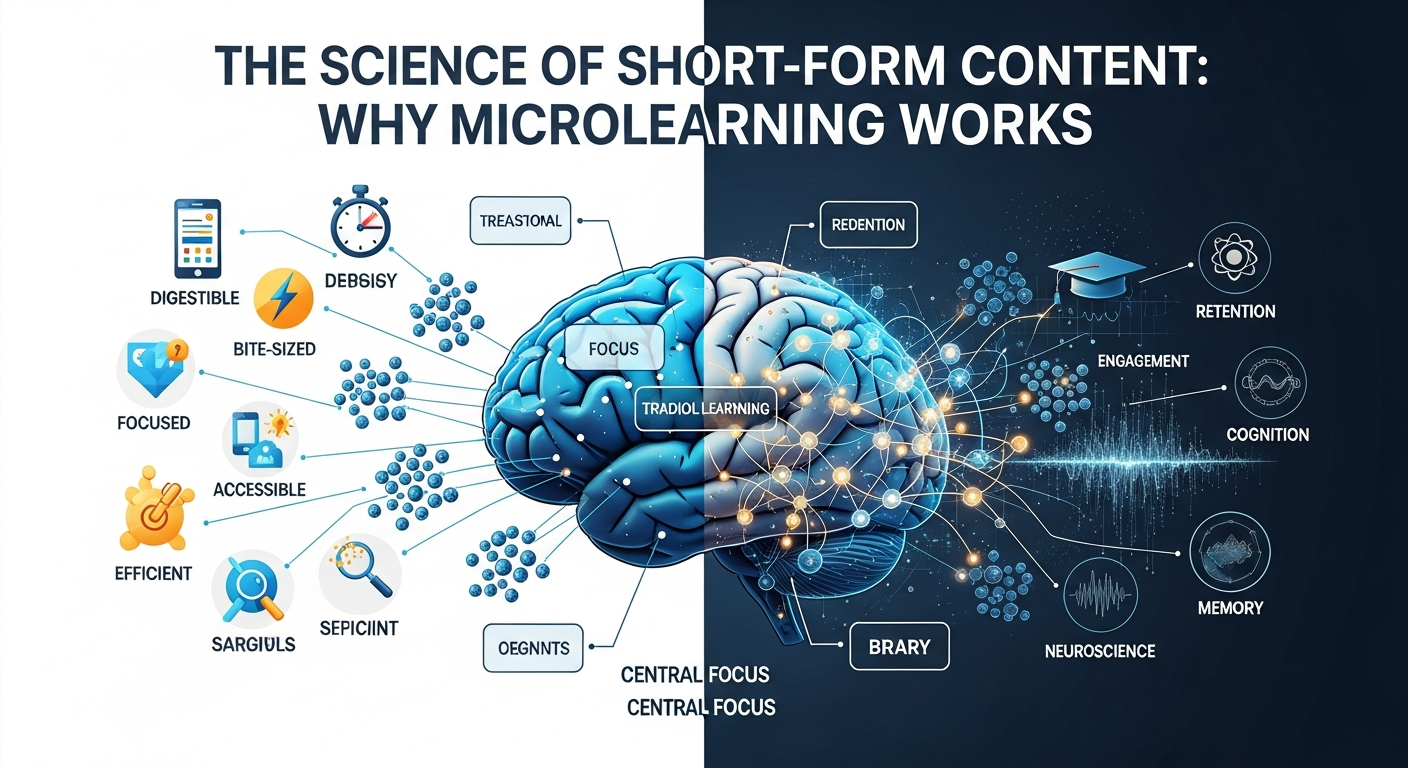
The Science Of Short-Form Content: Why Microlearning Works For Modern L&D
In today's fast-paced corporate environment, the traditional approach to learning and development often struggles to keep pace. L&D leaders, VPs, and Directors across industries from Compliance to Sales, Banking, Healthcare, and beyond are continually seeking effective ways to equip their teams with essential skills and knowledge without disrupting critical workflows. Enter microlearning – a scientifically backed methodology that transforms how employees learn, retain, and apply information.
The challenge is clear: dwindling attention spans, overwhelming information, and the need for just-in-time knowledge. Long, exhaustive training sessions are often met with disengagement and low retention rates. This article delves into the cognitive science behind microlearning, revealing why this short-form content strategy is not just a trend, but a fundamental shift towards more effective, brain-friendly learning.
Understanding Microlearning: More Than Just "Bite-Sized"
Microlearning is precisely what its name suggests: learning delivered in small, focused bursts. These aren't just shorter versions of existing content; they are intentionally designed, standalone learning modules, typically lasting 2-10 minutes. Each module addresses a single learning objective, providing immediate, relevant information that can be easily consumed and applied. Whether it’s a quick video tutorial on a new software feature, an interactive quiz on compliance regulations, or an infographic explaining a complex financial product, microlearning delivers knowledge when and where it's needed most.
Its power lies in its ability to integrate seamlessly into an employee's daily workflow, making learning an ongoing process rather than a sporadic event. This approach is revolutionizing corporate training, especially when facilitated by an advanced Microlearning LMS that supports diverse content formats and delivery mechanisms.
The Cognitive Science Fueling Microlearning's Success
The effectiveness of microlearning isn't merely anecdotal; it's deeply rooted in how the human brain processes and retains information. Several key cognitive principles underpin why short-form content outperforms lengthy training modules:
1. Combatting the Forgetting Curve
- Research by Hermann Ebbinghaus revealed the "forgetting curve," demonstrating that we rapidly lose newly acquired information if it's not reinforced. Microlearning, especially when delivered through regular, spaced intervals, acts as a potent antidote. By revisiting key concepts in short bursts, learning is consolidated, pushing information from short-term to long-term memory.
2. Optimizing Attention Spans
- In our digitally saturated world, human attention spans are shorter than ever. Microlearning respects this reality by delivering content in easily digestible chunks that can be fully absorbed before focus wanes. This minimizes cognitive overload, ensuring learners remain engaged and receptive throughout the module.
3. Cognitive Load Theory in Practice
- Cognitive Load Theory suggests that our working memory has a limited capacity. Presenting too much information at once (high cognitive load) overwhelms the learner and hinders comprehension and retention. Microlearning reduces intrinsic cognitive load by breaking down complex topics into simpler, manageable units, allowing learners to process information more effectively without feeling overwhelmed.
4. The Power of Chunking and Retrieval Practice
- The brain naturally "chunks" information into meaningful units. Microlearning mirrors this natural process, presenting information in pre-chunked segments. Furthermore, many microlearning modules incorporate quick quizzes or interactive elements, engaging in "retrieval practice." This act of recalling information strengthens neural pathways, significantly improving long-term retention compared to passive learning.
5. Enhancing Motivation and Self-Efficacy
- Completing short, focused learning tasks provides immediate gratification and a sense of accomplishment. This positive reinforcement boosts learner motivation and self-efficacy, encouraging them to pursue further learning. This effect is often amplified when integrated into a Gamified LMS environment, where progress and achievements are recognized.
Tangible Benefits for L&D Leaders
For L&D professionals, embracing a learning management system that champions microlearning offers a cascade of benefits that directly impact organizational performance and employee development:
- Improved Engagement and Retention: Learners are more likely to complete and remember concise, relevant content.
- Enhanced Flexibility and Accessibility: Learning becomes on-demand, accessible anytime, anywhere, on any device, aligning with modern remote and hybrid work models.
- Faster Time-to-Competency: Critical skills can be acquired and applied more quickly, accelerating employee readiness.
- Agile Content Creation and Updates: Microlearning modules are quicker to develop and easier to update, ensuring learning materials remain current with evolving business needs, especially with an AI Powered Authoring Tool.
- Personalized Learning Journeys: Microlearning facilitates targeted content delivery, allowing for Adaptive Learning paths that cater to individual skill gaps and career goals.
- Cost-Effectiveness: Reduced development time and increased efficiency translate into lower overall training costs.
Industries like Compliance, Banking, Pharma, and Healthcare, where information accuracy and frequent updates are paramount, find microlearning indispensable for maintaining high standards. For Sales and Retail, it offers quick product updates and customer service tips. Even in sectors like Oil and Gas or Mining, it provides crucial safety refreshers and equipment operation protocols, often serving as vital Risk-focused Training.
Leveraging Modern Technology for Optimal Microlearning
The true potential of microlearning is unlocked through sophisticated learning management software. A robust enterprise learning management solution acts as the backbone, providing the infrastructure to create, deliver, track, and manage microlearning content at scale. A leading learning content management system, or LCMS, such as MaxLearn LMS, offers capabilities crucial for success:
- Content Authoring: Tools for rapidly creating engaging micro-content.
- Delivery and Distribution: Seamless delivery across multiple devices, including mobile.
- Tracking and Analytics: Detailed insights into learner progress and content effectiveness.
- Integration: Compatibility with existing HR systems and other business tools.
- Personalization: Features that enable the deployment of adaptive learning paths, ensuring each learner receives the most relevant content.
The shift towards a cloud based learning management system further enhances accessibility and scalability, making it easier for global organizations to implement a unified learning strategy.
Addressing Common L&D Inquiries
L&D leaders often grapple with how to best implement and optimize learning initiatives. Here are answers to common questions in the realm of short-form learning:
How can organizations ensure that learning content is relevant and up-to-date for a dynamic workforce, especially across different global regions?
Leveraging a sophisticated learning management system (LMS) with strong content management capabilities is key. An advanced LCMS allows for modular content creation, making it simple to update specific segments without overhauling entire courses. This agility ensures that information remains current, addressing localized compliance, product, or procedural changes swiftly. Real-time feedback mechanisms and analytics within the LMS learning management system can also highlight content areas needing revision, driven by learner performance or engagement data.
What strategies can L&D leaders employ to personalize learning paths efficiently across diverse employee roles and skill levels?
Personalization becomes achievable through a combination of data analytics and adaptive learning technology. Modern learning management software can assess a learner's existing knowledge, role, and performance data to automatically recommend relevant microlearning modules. By segmenting learners based on department, experience, or skill gaps, an effective LMS can dynamically adjust content delivery, ensuring each employee receives a tailored educational journey, maximizing relevancy and minimizing wasted effort.
In what ways can technology enhance the creation and delivery of short-form learning modules to improve knowledge retention and application?
Technology plays a transformative role. AI-powered authoring tools dramatically speed up content creation, helping L&D teams convert existing material into engaging microlearning formats. Interactive elements, such as simulations, quick quizzes, and virtual scenarios, delivered through a modern learning management solutions platform, boost engagement and facilitate active recall. Furthermore, intelligent scheduling features can optimize content delivery based on the forgetting curve, ensuring timely refreshers that reinforce learning for better long-term retention and practical application in real-world scenarios.
How does continuous, bite-sized training contribute to meeting evolving industry standards and compliance requirements?
Continuous, bite-sized training is instrumental in maintaining compliance. For industries under strict regulation, like banking, finance, healthcare, and pharma, constant updates to policies and procedures are common. Microlearning allows organizations to push out critical updates in an instant, digestible format, ensuring all employees are informed and compliant without extensive downtime. This agile approach enables businesses to proactively manage risks and adapt quickly to new regulatory landscapes, making it an essential component of any robust risk-focused training strategy within a comprehensive enterprise learning management framework.
Conclusion
The science is clear: microlearning is not just a passing trend but a powerful, cognitively aligned approach to corporate education. By respecting how the brain truly learns, processes, and retains information, L&D leaders can leverage short-form content to create more engaging, effective, and efficient training programs. Investing in a cutting-edge learning management system that supports and optimizes microlearning is no longer a luxury but a strategic imperative for any organization committed to fostering a culture of continuous learning and driving performance in the modern era.
.jpg)


