

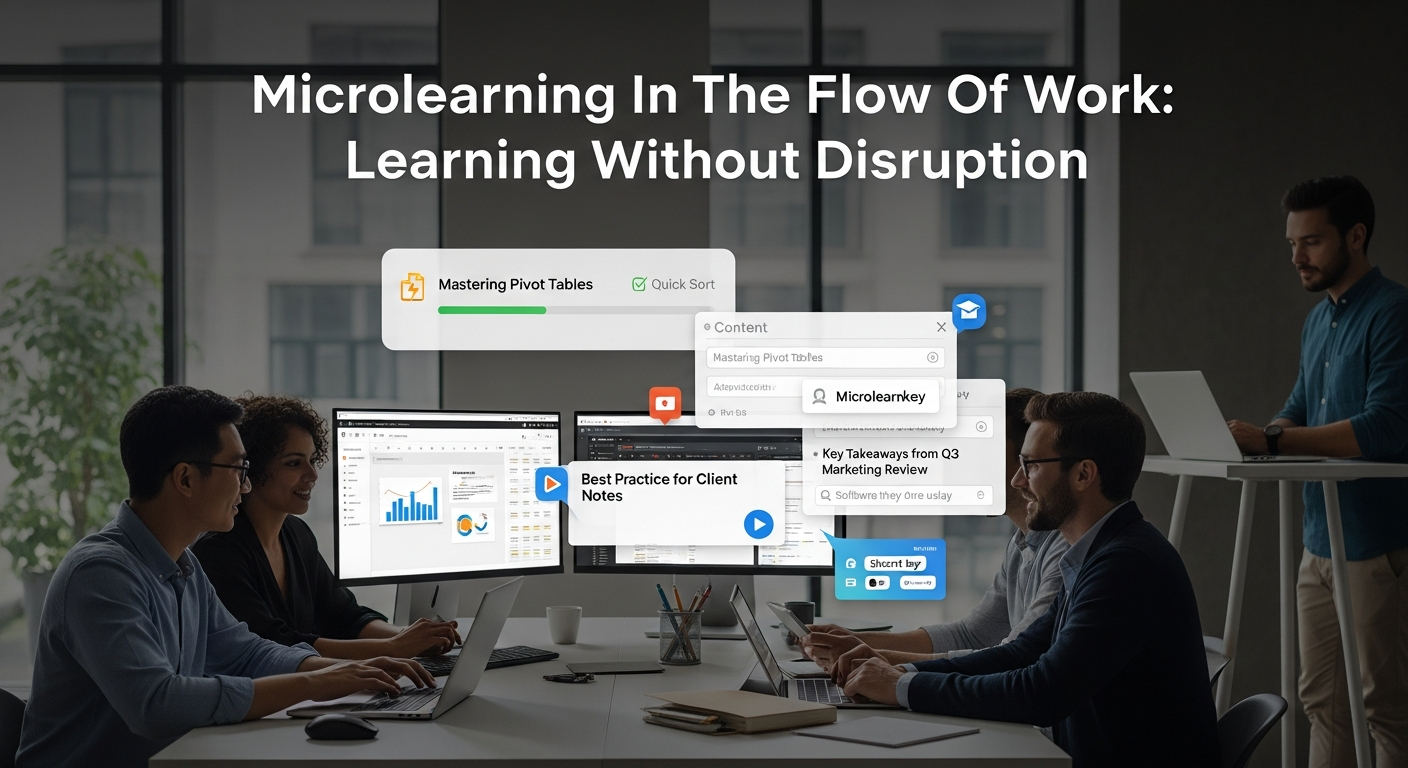
Microlearning In The Flow Of Work: Learning Without Disruption
In today's relentlessly accelerating business landscape, the traditional approach to employee training often feels like a relic from another era. For L&D Vice Presidents, Directors, and Managers across industries like Compliance, Sales, Banking, Finance, Insurance, Retail, Pharma, Health care, Hospitality, Oil and Gas, and Mining, the challenge is universal: how do you equip your workforce with critical knowledge and skills without pulling them away from their core responsibilities, thus disrupting productivity?
The answer lies in a powerful paradigm shift: microlearning delivered "in the flow of work." This isn't just a trend; it's a strategic imperative that promises to revolutionize how your organization approaches skill development, compliance updates, and performance enhancement. Imagine a learning environment where employees access precise, bite-sized information exactly when and where they need it, seamlessly integrated into their daily tasks. This is learning without disruption, designed for the modern professional.
The Modern Workplace Conundrum: Why Traditional Learning Falls Short
The demands on your employees are higher than ever. Lengthy classroom sessions or multi-day online courses, while comprehensive, often face significant hurdles. Time away from desks equates to lost productivity and potential backlogs. Moreover, the human brain's ability to retain large volumes of information over extended periods is limited, leading to the "forgetting curve" – much of what's learned is quickly lost if not reinforced or immediately applied.
This creates a critical gap: the need for continuous skill development versus the operational realities of a lean, high-performing team. In sectors like Finance and Healthcare, where regulations evolve rapidly, or Sales and Retail, where product knowledge and customer interaction strategies must be agile, slow-paced learning can become a significant competitive disadvantage. Your enterprise learning management strategy needs to adapt.
Microlearning: The Agility Your Workforce Needs
Microlearning is the antithesis of the lengthy course. It breaks down complex topics into short, focused modules, typically 2-5 minutes in length. These can be videos, infographics, short quizzes, interactive simulations, or quick how-to guides. The key is their conciseness and singular learning objective.
The benefits are profound:
- Higher Engagement: Short bursts of learning are less daunting and more appealing.
- Improved Retention: Focused content allows for better absorption and recall.
- Immediate Application: Learners can apply new knowledge instantly, reinforcing understanding.
- Flexibility: Content can be accessed on demand, anytime, anywhere.
To truly unlock the power of this approach, an efficient Microlearning LMS is indispensable. It serves as the central hub for delivering these concise, impactful learning experiences.
Integrating Learning "In The Flow": How It Works
Learning in the flow of work means making knowledge accessible precisely when an employee needs it to perform a task or solve a problem. It's about context, relevance, and immediacy. Consider a new bank teller needing to understand a specific transaction type, a pharma sales rep needing to recall drug efficacy details before a client meeting, or a manufacturing technician troubleshooting a machine fault.
Instead of searching through dense manuals or waiting for the next training session, they can pull up a 90-second video or a quick infographic directly from their workstation or mobile device. This just-in-time learning minimizes errors, boosts confidence, and accelerates problem-solving. A robust learning management system (LMS) or cloud based learning management system designed for this purpose integrates seamlessly with existing workflows, offering tools for content discovery and delivery without forcing a separate "learning" event.
The Technological Backbone: Powering In-Flow Microlearning
Effective in-flow microlearning doesn't happen by accident; it's powered by sophisticated technology. A modern LMS acts as the central nervous system for your learning ecosystem. Beyond mere content delivery, a comprehensive learning management system should offer features that enhance the learning experience and simplify administration.
For instance, a Gamified LMS can transform mundane compliance training or product updates into engaging challenges, complete with points, badges, and leaderboards, significantly boosting participation and retention. Furthermore, Adaptive Learning capabilities personalize the learning path for each employee, serving up relevant micro-content based on their existing knowledge, role, and performance data.
Creating this wealth of short, targeted content can be a daunting task for L&D teams. This is where an AI Powered Authoring Tool becomes invaluable. Such tools can drastically reduce content development time by automating various stages of creation, from topic generation to initial draft writing, making the production of fresh, relevant micro-modules faster and more efficient. For a holistic solution, consider a robust learning content management system (LCMS) that merges content creation and management within the learning management software, simplifying your overall learning management solutions.
Intelligence & The Future of In-Flow Learning
How can intelligent algorithms make in-flow learning more relevant for individual employees?
Intelligent algorithms can play a transformative role in personalizing learning. By analyzing an employee's job role, past performance data, completed training, and even their current project tasks, these algorithms can dynamically recommend or push highly relevant micro-content. For instance, if an algorithm detects a common error pattern in a particular process, it can trigger a short, targeted micro-module to address that specific knowledge gap for affected employees. This ensures that the learning is not just "just-in-time" but also "just-for-me," making it incredibly impactful. This forms the core of an effective Adaptive Learning strategy.
What impact does intelligent automation have on developing microlearning modules rapidly?
Intelligent automation, especially through an AI Powered Authoring Tool, significantly speeds up the development cycle of microlearning content. These tools can automatically extract key information from larger documents, summarize complex topics, and even generate various formats (e.g., quiz questions from text, video scripts) with minimal human intervention. This capability is crucial for L&D teams needing to keep content fresh and responsive to rapidly changing industry demands, such as new compliance regulations in Banking or updated protocols in Healthcare.
How can advanced analytics inform an organization's microlearning strategy?
Advanced analytics provides L&D leaders with unparalleled insights into learning effectiveness and potential areas of improvement. By tracking engagement rates, completion times, quiz scores, and critically, how learned concepts translate into improved job performance, analytics can identify patterns. For example, if many employees struggle with a specific regulatory requirement, analytics can flag this, allowing L&D to proactively deploy targeted micro-modules to address this vulnerability. This data-driven approach is essential for developing Risk-focused Training, ensuring that critical knowledge gaps are closed before they lead to costly mistakes or non-compliance.
Benefits for L&D Leaders and Organizations
Embracing microlearning in the flow of work offers a compelling value proposition for L&D leaders and their organizations:
- Enhanced Productivity: Less time away from tasks, immediate problem-solving.
- Improved Compliance & Reduced Risk: Targeted, frequent updates ensure employees are always current with regulations, especially vital in Banking, Finance, and Pharma. This strengthens Risk-focused Training.
- Greater Employee Engagement & Retention: Learning becomes less of a chore and more of a continuous support system, fostering a culture of continuous development.
- Optimized Training ROI: Efficient content delivery and measurable impact lead to better returns on your training investment.
- Agile Workforce: Rapid upskilling and reskilling capabilities ensure your workforce remains adaptable to market shifts and technological advancements.
Choosing the Right Solution
Selecting the right learning management solutions is paramount. When evaluating a potential lms learning management system or learning management software, consider its ability to host diverse microlearning formats, its user-friendliness, and its integration capabilities with existing enterprise systems. Look for robust analytics that provide actionable insights and ensure it's a scalable, MaxLearn LMS that can grow with your organization.
A leading learning content management system (LCMS) should offer intuitive content creation tools, seamless delivery across devices, and comprehensive tracking features. These elements are vital for any enterprise learning management strategy aiming to deliver learning without disruption.
Conclusion
The future of corporate learning is agile, personalized, and integrated. Microlearning in the flow of work is not just a strategic advantage; it's a necessity for organizations striving for peak performance, compliance, and employee satisfaction in the 21st century. By leveraging the power of a modern Microlearning LMS and intelligent technologies, L&D leaders can transform learning from an intermittent disruption into a continuous, empowering experience, equipping their workforce for sustained success.
It's time to empower your employees with knowledge, exactly when and where they need it, creating a truly intelligent and adaptive learning environment that fuels growth and innovation across all sectors.
.jpg)


