

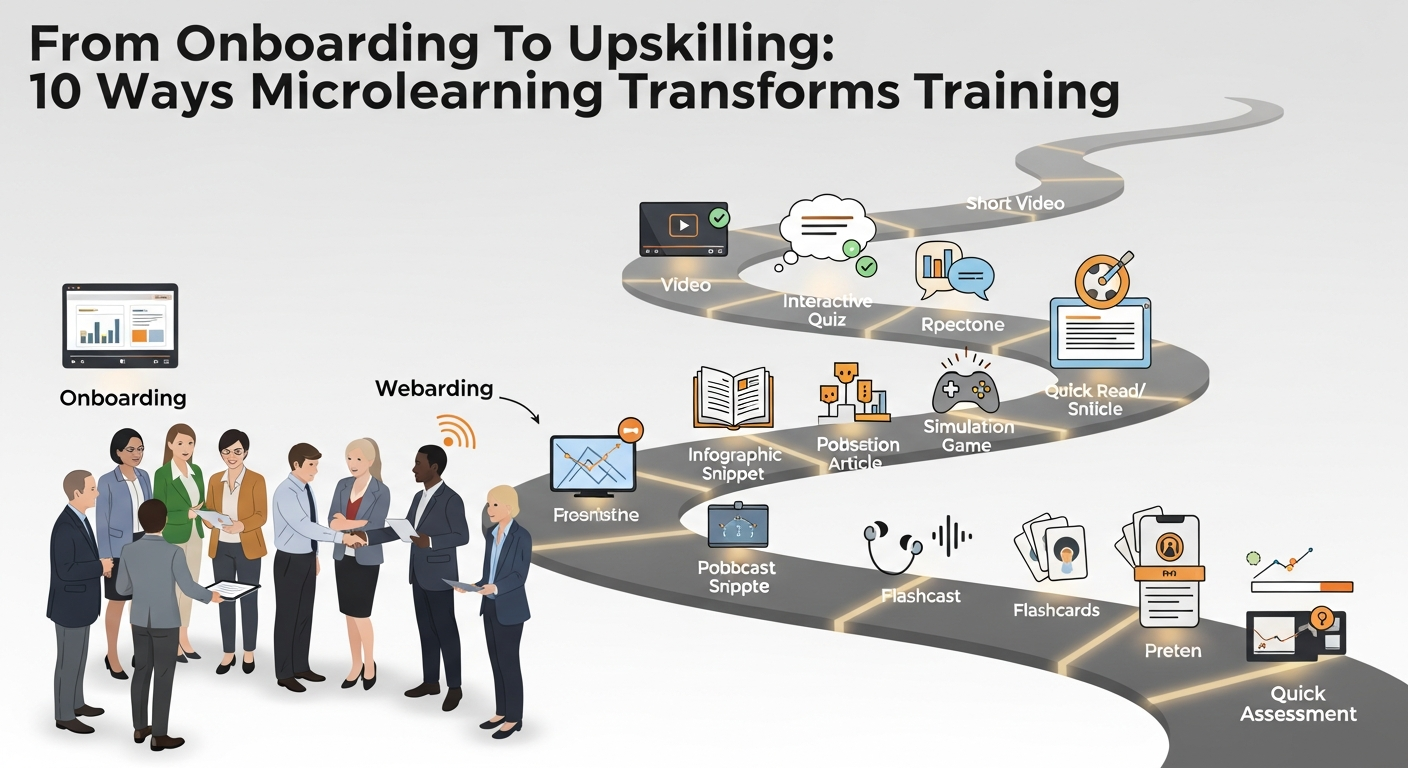
From Onboarding To Upskilling: 10 Ways Microlearning Transforms Training
In today's fast-paced corporate world, where information overload is the norm and attention spans are shrinking, traditional lengthy training sessions are increasingly becoming a relic of the past. Learning and Development (L&D) leaders – from VPs to senior managers – are actively seeking innovative solutions to enhance employee engagement, retention, and performance. Enter microlearning: a paradigm shift that delivers bite-sized, focused content designed for immediate applicability. It’s not just a trend; it's a strategic imperative for organizations aiming to stay agile and competitive. A modern Microlearning LMS is crucial for delivering this transformative approach.
Microlearning breaks down complex topics into digestible modules, typically lasting 2-10 minutes, making learning more accessible and effective. Whether it's for compliance, sales, banking, finance, insurance, retail, pharma, healthcare, hospitality, oil and gas, or mining, microlearning offers a versatile and powerful solution. This article will explore ten compelling ways microlearning is revolutionizing corporate training, from initial onboarding to continuous upskilling.
The Power of Precision: How Microlearning Redefines L&D
1. Accelerates Onboarding and Time-to-Productivity
First impressions matter, and efficient onboarding sets the stage for a new hire’s success. Instead of overwhelming new employees with days of dense material, microlearning delivers essential information in easily digestible chunks. New hires can learn about company policies, product features, or CRM basics in short bursts, often through a Gamified LMS. This approach allows them to absorb critical knowledge at their own pace, reducing cognitive load and accelerating their journey to full productivity. For industries like banking and finance, where regulatory knowledge is paramount from day one, microlearning ensures quick compliance without lengthy delays.
2. Enhances Knowledge Retention and Recall
The "forgetting curve" is a well-known challenge in traditional training. Microlearning directly combats this by employing spaced repetition and just-in-time learning. Short, targeted modules reinforce key concepts, leading to better long-term retention. Imagine a healthcare professional quickly reviewing a protocol before a procedure or a retail employee refreshing product knowledge before interacting with a customer. This immediate applicability solidifies learning and makes recall effortless, especially when delivered through an efficient learning content management system.
3. Boosts Employee Engagement and Motivation
Long, tedious training sessions often lead to disengagement. Microlearning, with its concise format and interactive elements, makes learning more appealing. Employees are more likely to complete a 5-minute module than a 2-hour course. When coupled with a gamified approach within a sophisticated learning management software, it can transform learning into an enjoyable and rewarding experience, driving higher completion rates and sustained motivation across all sectors, particularly in sales training.
4. Facilitates Continuous Upskilling and Reskilling
The pace of change in industries like tech, pharma, and finance demands continuous learning. Microlearning makes ongoing upskilling and reskilling practical and efficient. Employees can learn new software features, updated compliance regulations, or advanced sales techniques without disrupting their core responsibilities. This agile approach to continuous professional development ensures that your workforce remains competitive and adaptable to evolving market demands, making a flexible learning management system indispensable.
5. Drives Performance Improvement through Just-in-Time Learning
Microlearning excels at providing knowledge exactly when it's needed. A sales team member can quickly access a module on objection handling before a client call, or an oil and gas technician can review a safety procedure on-site. This just-in-time access to information directly impacts performance, allowing employees to apply what they've learned instantly to real-world scenarios. A powerful learning management system with a robust content delivery mechanism is key here.
6. Ensures Compliance and Reduces Risk Effectively
For highly regulated industries like banking, insurance, pharma, and mining, compliance training is non-negotiable. Microlearning breaks down complex regulations into manageable, understandable segments, making compliance easier to grasp and remember. Regular, short refreshers on critical policies or new legal requirements significantly reduce the risk of non-compliance. This focus on Risk-focused Training is invaluable for business growth and operational integrity. An enterprise learning management solution is vital for tracking and proving compliance.
7. Supports Personalized and Adaptive Learning Paths
Not all learners are the same. Microlearning, especially when powered by advanced analytics, allows for highly personalized learning experiences. Employees can choose modules relevant to their roles, skill gaps, or career aspirations. An Adaptive Learning approach uses data to recommend specific content, ensuring that each learner receives the most pertinent information. This tailored experience is highly effective for diverse workforces in hospitality or global corporations.
8. Reduces Training Costs and Time Investment
Developing lengthy courses can be expensive and time-consuming. Microlearning modules are quicker to create, update, and deploy. This agility saves significant L&D resources, allowing companies to respond rapidly to new training needs or market changes. Furthermore, by reducing time spent away from work for training, microlearning minimizes productivity loss, offering a superior return on investment for any organization seeking efficient learning management solutions.
9. Facilitates Global Scalability and Accessibility
For multinational corporations, consistency in training across different regions and languages is a challenge. Microlearning modules are easily translatable and adaptable to various cultural contexts. Delivered via a cloud based learning management system, they can be accessed anytime, anywhere, on any device. This global scalability ensures that all employees, whether in a retail store in New York or an oil rig off the coast of Africa, receive consistent, high-quality training.
10. Empowers Employee Autonomy and Self-Directed Learning
Microlearning shifts the control of learning from the trainer to the learner. Employees can actively choose what to learn, when to learn, and how to learn, fostering a sense of ownership over their professional development. This autonomy is a powerful motivator, transforming employees into proactive learners who are invested in their own growth and the success of the organization. MaxLearn LMS provides the tools to empower this self-directed approach.
Intelligent Insights for Future-Ready Training
As L&D leaders strategize for the future, leveraging data and intelligent systems becomes paramount. Here are some insights into how advanced analytical capabilities can further enhance microlearning:
How can data-driven insights optimize learning paths for individual employees?
By analyzing engagement metrics, completion rates, assessment scores, and job performance data, intelligent systems can identify specific knowledge gaps and preferred learning styles. This allows for dynamic adjustments to learning paths, recommending precise microlearning modules that address individual needs, ensuring more effective skill acquisition and professional development. For a sales team, this might mean identifying specific product knowledge deficiencies and pushing relevant, bite-sized updates.
What localized training challenges can microlearning address effectively across different regions?
Microlearning’s modular nature allows for easy localization of content. Intelligent systems can automatically flag content that requires cultural or linguistic adaptation, or even legal review for different geographic regions. For a global hospitality chain, this ensures that local customs and service standards are incorporated into training, while for a pharmaceutical company, it guarantees compliance with regional healthcare regulations, all without extensive re-development of core materials. The ease of content adaptation within a modern AI Powered Authoring Tool is a game-changer.
How does intelligent content delivery improve learning outcomes across diverse sectors?
Intelligent algorithms can analyze an individual's past performance, role, and even current projects to deliver the most relevant microlearning content at the optimal time. This "smart push" ensures learners receive timely updates or refreshers. For example, in the insurance sector, an agent might receive a micro-module on new policy changes just before meeting a client, or a mining engineer gets an immediate safety update based on real-time operational data, significantly enhancing practical application and safety.
Conclusion
Microlearning is more than just a training method; it's a strategic framework that aligns with the demands of the modern workforce and business environment. From streamlining onboarding to fostering a culture of continuous upskilling, its benefits are far-reaching. By adopting a microlearning approach, supported by a robust lms learning management system like MaxLearn LMS, L&D leaders can create highly effective, engaging, and cost-efficient training programs that truly transform their organizations. The shift towards bite-sized learning is not just about making training easier; it's about making it smarter, more impactful, and intrinsically linked to business success.
.jpg)


