

Mastering Performance: How Operant Conditioning Elevates Modern L&D Strategies
In the dynamic world of corporate learning and development, the pursuit of measurable results and sustained behavioral change is paramount. For Vice Presidents, Directors, and Managers of L&D across industries like Compliance, Sales, Banking, Finance, Insurance, Retail, Pharma, Healthcare, Hospitality, Oil and Gas, and Mining, the challenge isn't just delivering content, but ensuring that learning translates into tangible improvements in performance. This is where the enduring principles of operant conditioning, a cornerstone of behavioral psychology, offer profound insights and practical applications for today’s sophisticated eLearning environments.
At its heart, operant conditioning is about understanding how consequences influence behavior. Developed by B.F. Skinner, this theory posits that behaviors followed by desirable consequences are more likely to be repeated, while those followed by undesirable consequences are less likely. For L&D professionals, this isn't just academic theory; it's a powerful framework for designing training programs that actively shape desired employee behaviors, whether it's adhering to complex compliance protocols, mastering new sales techniques, or adopting safer operational procedures.
The Core Tenets of Operant Conditioning in L&D
To leverage operant conditioning effectively, L&D leaders must grasp its key components:
-
Positive Reinforcement: The Engine of Desired Behavior
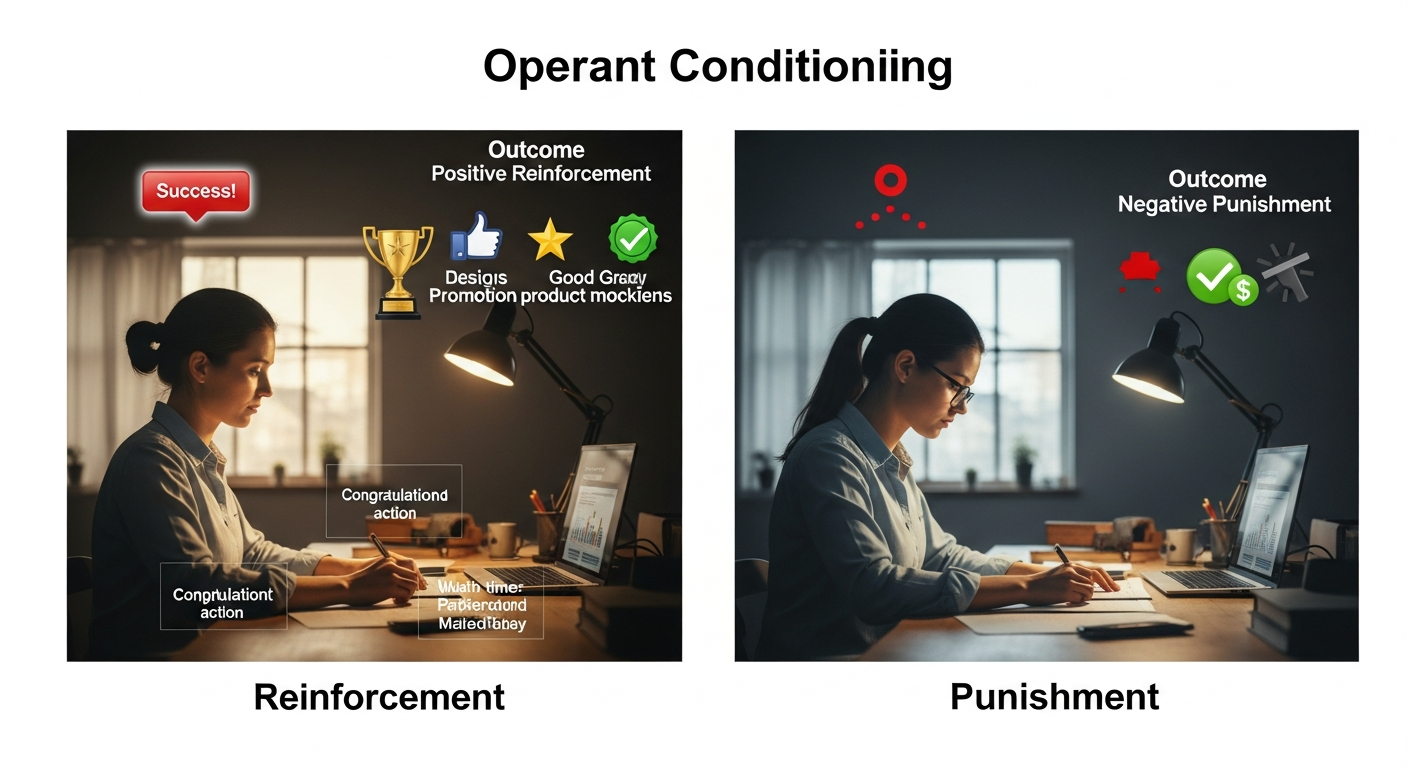
This is arguably the most powerful tool in the L&D arsenal. Positive reinforcement involves presenting a favorable stimulus after a desired behavior, increasing the likelihood of that behavior recurring. In an eLearning context, this could manifest as immediate positive feedback, points awarded in a Gamified LMS, badges for module completion, or visible progress indicators. Imagine a sales professional completing a challenging product knowledge module on an LMS and immediately receiving a congratulatory message, a digital trophy, or access to an exclusive advanced module. This positive feedback reinforces the effort and success, encouraging further engagement and mastery.
-
Negative Reinforcement: Encouraging Action Through Removal
Often misunderstood, negative reinforcement is not punishment. Instead, it involves removing an unpleasant stimulus after a desired behavior, thereby increasing the likelihood of that behavior. Consider a complex compliance training program. If an employee completes all mandatory modules on time, they might avoid receiving reminder emails or having their manager follow up. The removal of these undesirable prompts acts as a negative reinforcer, encouraging timely completion of future tasks. A well-designed cloud based learning management system can automate these processes, making negative reinforcement a subtle yet effective motivator.
-
Punishment: A Tool to Be Used with Caution
Punishment aims to decrease an undesirable behavior by introducing an unpleasant stimulus or removing a desirable one. While effective in certain scenarios (e.g., immediate corrective feedback for a safety violation in a simulation), punishment can also lead to resentment, avoidance, or a decline in morale. In L&D, it’s generally preferred to focus on reinforcement strategies. If punishment is used, it should be fair, immediate, consistent, and clearly linked to the undesirable action, not the individual. An enterprise learning management system might flag non-compliance, leading to mandatory retraining, which serves as a form of corrective action rather than punitive punishment.
-
Extinction: Reducing Undesired Behaviors
Extinction involves withholding reinforcement from a previously reinforced behavior, leading to its eventual decrease. If an employee habitually skips optional but beneficial training sessions because there are no consequences (positive or negative), introducing a system where participation leads to recognition or rewards (positive reinforcement) will make the non-participatory behavior less likely over time through extinction of the old, unreinforced pattern.
Applying Operant Conditioning in Modern eLearning
The principles of operant conditioning are not confined to traditional classrooms. They thrive in digital learning environments, offering L&D professionals powerful levers for behavior modification:
- Microlearning & Immediate Feedback: Delivering content in bite-sized chunks through a Microlearning LMS allows for frequent opportunities for desired behaviors (e.g., answering a quiz correctly, completing a scenario) and immediate positive reinforcement. This rapid feedback loop is crucial for effective conditioning.
- Gamification: Points, badges, leaderboards, and progress bars within a Gamified LMS are classic examples of positive reinforcement, making learning engaging and rewarding. This is particularly effective for large-scale training in industries like Retail or Banking, where consistent engagement is key.
- Adaptive Pathways: Adaptive Learning systems can tailor content based on a learner's performance. Successfully completing a module might unlock advanced content (positive reinforcement), while struggling might trigger remedial content (negative reinforcement – removing the stress of difficult material by providing support).
- Performance-Based Scenarios: In industries like Healthcare or Oil and Gas, simulations where correct actions lead to positive outcomes (e.g., successful patient care, avoiding a safety incident) are powerful forms of conditioning. The learning content management system (LCMS) makes it easy to create and manage these complex scenarios.
Intelligence in Learning: Questions & Answers for L&D Leaders
As L&D increasingly integrates advanced technologies, questions arise about optimizing learning outcomes and ensuring global consistency.
How can intelligent algorithms enhance the effectiveness of learning programs?
Intelligent algorithms significantly boost learning effectiveness by personalizing pathways, recommending relevant content, and identifying individual knowledge gaps with precision. For instance, in sales training, an intelligent system can analyze a salesperson's performance data and suggest specific modules or scenarios to address weaknesses, providing a highly targeted form of positive reinforcement. Furthermore, an AI Powered Authoring Tool can dynamically adapt content difficulty and examples to a learner's progress, ensuring optimal challenge and engagement. This data-driven approach means that every interaction is optimized to reinforce desired behaviors and knowledge acquisition, leading to better outcomes across all segments, from Finance to Pharma.
What strategies do leading organizations use to ensure consistent, high-quality training across diverse geographical locations and business units?
Leading organizations leverage robust, centralized learning management software to deliver standardized content while allowing for regional customization where necessary. A single, comprehensive learning management system (LMS) acts as the backbone, ensuring that all employees, whether in London, Lagos, or Louisiana, access the same high-quality core training materials. This uniformity in content delivery, combined with data analytics on completion rates and performance, provides a consistent standard. The system tracks engagement and outcomes globally, enabling L&D leaders to identify and address inconsistencies, thus reinforcing a culture of continuous learning and compliance across all locations, essential for global operations in Mining or Hospitality.
How can L&D leverage advanced technology to achieve holistic improvement in employee performance and organizational outcomes?
By integrating learning platforms with performance management systems and business intelligence tools, L&D can create a holistic ecosystem for employee development. This means the MaxLearn LMS doesn't just deliver courses; it becomes a central hub that influences and measures business impact. For example, in the banking sector, Risk-focused Training delivered through an advanced learning management solutions platform can directly correlate with a reduction in compliance violations. This integrated approach, often facilitated by a sophisticated enterprise learning management solution, provides a clear line of sight from training investment to improved key performance indicators, creating a powerful feedback loop that reinforces learning's strategic value.
Strategic Impact for L&D Leaders
Understanding and applying operant conditioning isn't just about psychology; it's about strategic advantage. For L&D leaders, this translates into:
- Increased ROI: By deliberately designing for behavior change, L&D programs yield more tangible results, justifying investment in lms learning management system technology and content.
- Enhanced Engagement: Well-applied reinforcement keeps learners motivated and active, reducing drop-off rates in critical training, especially for mandatory compliance or technical skills development.
- Sustainable Performance Improvement: Instead of one-off training events, a system built on operant conditioning fosters continuous skill development and behavioral adaptation, crucial for industries facing rapid change like Pharma or Tech.
- Reduced Risk: In high-stakes environments such as Oil and Gas or Healthcare, conditioning correct safety procedures through simulations and immediate feedback can directly prevent accidents and ensure adherence to protocols.
Conclusion
Operant conditioning provides a timeless yet incredibly relevant framework for L&D professionals seeking to optimize employee performance. By strategically applying positive reinforcement, judiciously using negative reinforcement, and carefully managing extinction, L&D leaders can design eLearning experiences that don't just transfer knowledge, but actively shape and sustain desired behaviors. Coupled with the power of modern MaxLearn LMS technologies and intelligent algorithms, the principles of operant conditioning empower organizations to build a workforce that is not only knowledgeable but consistently performs at its best. Embrace these psychological insights to transform your L&D strategy from good to truly great.
.jpg)


