

Ebbinghaus Curve of Forgetting: Optimizing Corporate Learning Across Industries
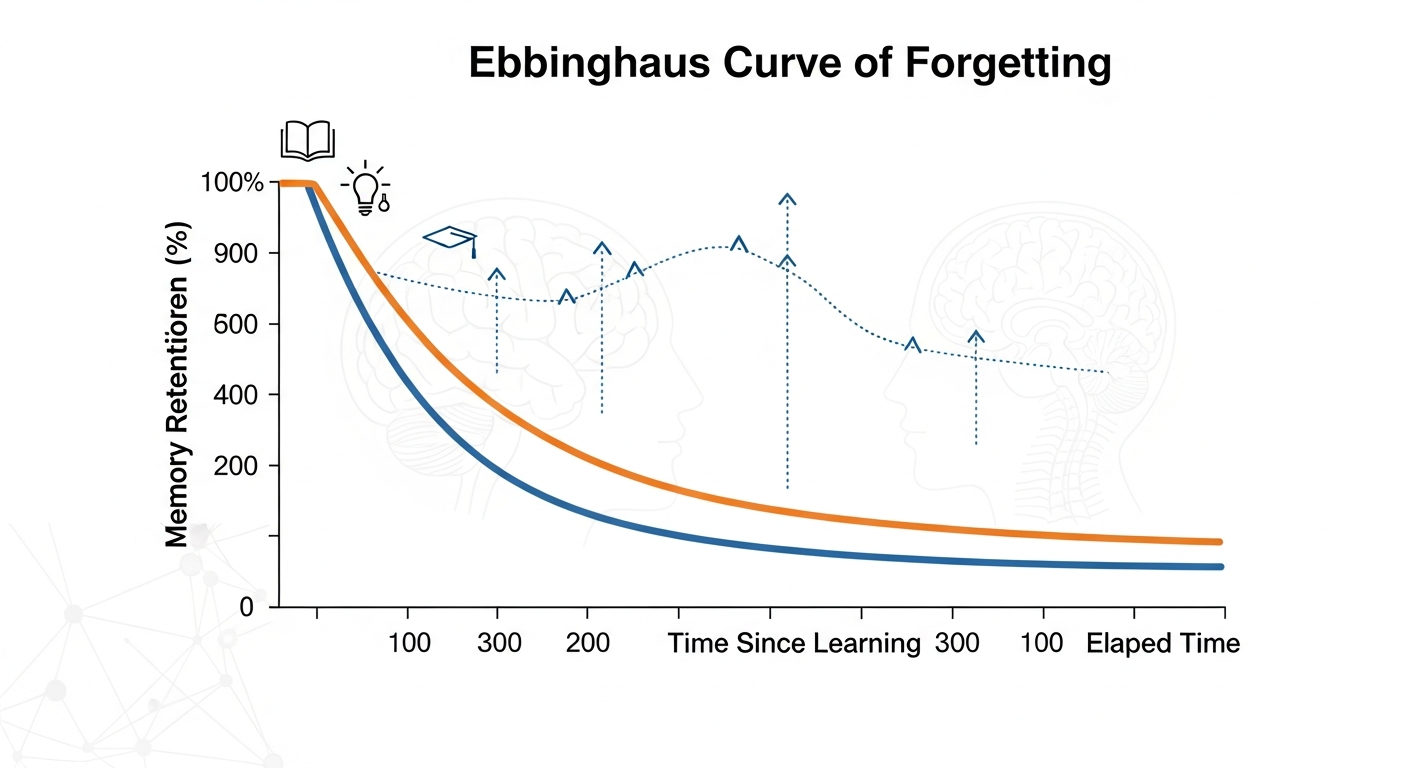
In today's fast-paced corporate environment, knowledge is power. Yet, a fundamental human challenge persists: forgetting. Hermann Ebbinghaus, a pioneering German psychologist, shed light on this phenomenon over a century ago with his groundbreaking research on memory and retention, giving us the concept known as the "Ebbinghaus Curve of Forgetting." This curve illustrates how information is lost over time when there is no attempt to retain it. For businesses across diverse sectors like Finance, Healthcare, Retail, and Mining, understanding and counteracting this natural decline is not merely an academic exercise – it's a critical strategic imperative for maintaining competence, ensuring compliance, and fostering innovation.
The Ebbinghaus Curve reveals that we forget approximately 50% of newly learned information within an hour, and around 70% within 24 hours, if there's no reinforcement. This rapid decay poses a significant challenge for corporate Learning & Development (L&D) departments, where substantial investments are made in training employees on everything from new compliance regulations in Banking to intricate safety protocols in Oil and Gas. Without effective strategies to combat forgetting, these investments yield diminishing returns, leading to knowledge gaps, increased errors, and reduced productivity.
Understanding the Mechanics of Memory Decay
Ebbinghaus's experiments, conducted by memorizing nonsense syllables, demonstrated a consistent pattern: the steepest drop-off in retention occurs soon after learning. Subsequent forgetting happens at a slower rate. Several factors influence the steepness of this curve:
- Meaningfulness of Material: Highly relevant and engaging content is remembered longer.
- Learning Method: Passive learning (e.g., listening to a lecture) leads to faster forgetting than active learning (e.g., hands-on practice, problem-solving).
- Sleep: Adequate sleep after learning consolidates memories, slowing the forgetting process.
- Stress: High-stress environments can impair memory formation and retrieval.
- Repetition: The most crucial factor in combating the curve is spaced repetition – reviewing material at increasing intervals.
For L&D professionals, especially those designing training for complex operations in Pharma or customer-facing roles in Insurance, recognizing these factors is the first step toward building more resilient learning programs.
The Business Impact Across Key Industries
Finance and Banking: Securing Compliance and Product Acumen
In Finance and Banking, the stakes are exceptionally high. Regulatory compliance, anti-money laundering (AML) protocols, and intricate product knowledge are non-negotiable. Forgetting even a small detail can lead to hefty fines, reputational damage, or significant financial losses. Continuous, reinforced learning is essential to ensure that tellers, advisors, and compliance officers consistently apply the correct procedures and offer accurate information to clients.
Healthcare and Pharma: Patient Safety and Innovation
The Healthcare and Pharmaceutical industries demand absolute precision. From new drug protocols and patient care techniques to complex medical device operation and regulatory updates (e.g., FDA guidelines), a lapse in memory can have life-or-death consequences. Sales teams in Pharma also require up-to-date knowledge of product efficacy and competitor offerings. L&D must ensure that critical information on patient safety, treatment methodologies, and ethical guidelines is not just learned but deeply embedded and readily accessible.
Insurance: Policy Mastery and Customer Trust
Insurance professionals deal with a vast array of policy types, terms, and claims procedures. Keeping agents, underwriters, and claims adjusters updated on new products, regulatory changes, and customer service best practices is vital. Forgetting policy specifics can lead to incorrect advice, missed sales opportunities, or processing errors, eroding customer trust and increasing operational costs.
Retail: Elevating Customer Experience and Sales Performance
In Retail, product knowledge, sales techniques, and customer service excellence directly impact revenue and brand loyalty. Employees must quickly recall features, benefits, and troubleshooting steps for a diverse inventory. Rapid staff turnover common in the industry further exacerbates the forgetting curve challenge, making efficient and effective training crucial for maintaining a high standard of customer interaction.
Mining and Oil & Gas: Prioritizing Safety and Operational Efficiency
For industries like Mining and Oil and Gas, safety is paramount. Operators must meticulously follow complex safety protocols, understand equipment mechanics, and respond effectively to emergencies. Environmental regulations also demand constant vigilance. Forgetting a critical safety procedure or maintenance step can lead to severe accidents, environmental disasters, or costly operational downtime. L&D initiatives must ensure that safety knowledge is not just learned but ingrained and frequently refreshed.
Counteracting Forgetting with Modern L&D Strategies
The good news is that the Ebbinghaus Curve is not an insurmountable barrier. Modern L&D leverages scientific principles and technology to flatten the curve and enhance retention:
- Spaced Repetition: Reintroducing information at increasing intervals is the most effective way to transfer knowledge from short-term to long-term memory.
- Microlearning: Breaking down complex topics into short, digestible modules makes learning less overwhelming and easier to retain. A MaxLearn Microlearning Platform can deliver these bite-sized lessons effectively.
- Active Recall: Encouraging learners to retrieve information from memory (e.g., through quizzes, flashcards) rather than just passively re-reading.
- Gamification: Incorporating game-like elements such as points, badges, and leaderboards can boost engagement and motivate learners to interact with content more frequently. A Gamified LMS makes this possible.
- Adaptive Learning: Tailoring the learning path and content difficulty based on an individual's performance and knowledge gaps. This personalized approach ensures learners focus on what they need most, optimizing retention. Learn more about Adaptive Learning methodologies.
- Scenario-Based Training: Applying knowledge in realistic simulations helps learners solidify understanding and prepare for real-world challenges, especially in Risk-focused Training scenarios.
The Role of Artificial Intelligence in Beating the Curve
Artificial intelligence is revolutionizing how L&D departments tackle the forgetting curve. AI-powered platforms can personalize, deliver, and reinforce learning content with unprecedented precision:
- Personalized Learning Paths: AI analyzes individual learner data to identify strengths, weaknesses, and preferred learning styles, then dynamically adjusts content and pace to maximize engagement and retention.
- Predictive Analytics: Intelligent algorithms can predict when an employee is likely to forget specific information based on their past performance and engagement, triggering timely refreshers.
- Intelligent Content Delivery: AI can deliver content at optimal moments, using spaced repetition algorithms to schedule quizzes, reminders, or short modules precisely when memory recall is most effective.
- Automated Content Creation: AI Powered Authoring Tools can quickly generate new learning materials, quizzes, and scenarios, reducing the burden on L&D teams and allowing for rapid updates, crucial in fast-changing regulatory landscapes.
Addressing Common AI and Learning Inquiries
Question: How can intelligent algorithms enhance knowledge retention in remote teams?
Answer: By tailoring content based on individual performance and scheduling timely refreshers, smart systems ensure critical information sticks, regardless of an employee's geographical location or work setting. This ensures consistency and competence across dispersed workforces.
Question: What's the practical application of smart technology for improving industry-specific compliance training?
Answer: Advanced systems can identify common compliance pitfalls, deliver scenario-based training, and use interactive simulations to solidify understanding, significantly reducing human error and ensuring adherence to complex regulations in sectors like Finance, Pharma, and Mining.
Question: Can intelligent learning platforms truly measure and predict an employee's knowledge decay over time?
Answer: Absolutely. By analyzing engagement data, assessment results, and interaction patterns, these platforms can predict when knowledge is likely to fade and automatically suggest targeted review sessions. This proactive approach makes learning more efficient and effective, preventing critical knowledge gaps before they occur.
Conclusion
The Ebbinghaus Curve of Forgetting remains a significant challenge for any organization committed to building a highly skilled and knowledgeable workforce. However, by embracing modern L&D methodologies such as microlearning, gamification, and adaptive learning, and by integrating the transformative power of artificial intelligence, businesses can effectively flatten this curve. For industries ranging from the intricate world of Pharma to the safety-critical environment of Oil and Gas, investing in intelligent, retention-focused learning solutions is not just about mitigating knowledge loss – it's about optimizing performance, ensuring compliance, driving innovation, and securing a competitive edge in an increasingly complex global economy.
.jpg)


