

Shaping Success: How Operant Behavior Drives High-Performance L&D
In the dynamic landscape of modern business, the efficacy of Learning & Development (L&D) initiatives is paramount to organizational success. From navigating complex compliance regulations to supercharging sales teams, the goal remains consistent: to cultivate specific, measurable behaviors that drive desired outcomes. But how do we reliably encourage positive actions and mitigate unproductive ones? The answer lies rooted in the science of operant behavior, a powerful psychological framework that, when strategically applied, can revolutionize your L&D strategy.
For Vice Presidents, Directors, and Senior Managers in L&D, understanding operant behavior isn't just academic; it's a strategic imperative. It provides the blueprint for designing learning experiences that don't just impart knowledge but actively shape employee actions, ensuring a tangible return on your training investment across every industry, from Banking and Finance to Pharma and Oil and Gas.
The Core of Operant Behavior: Shaping Actions Through Consequences
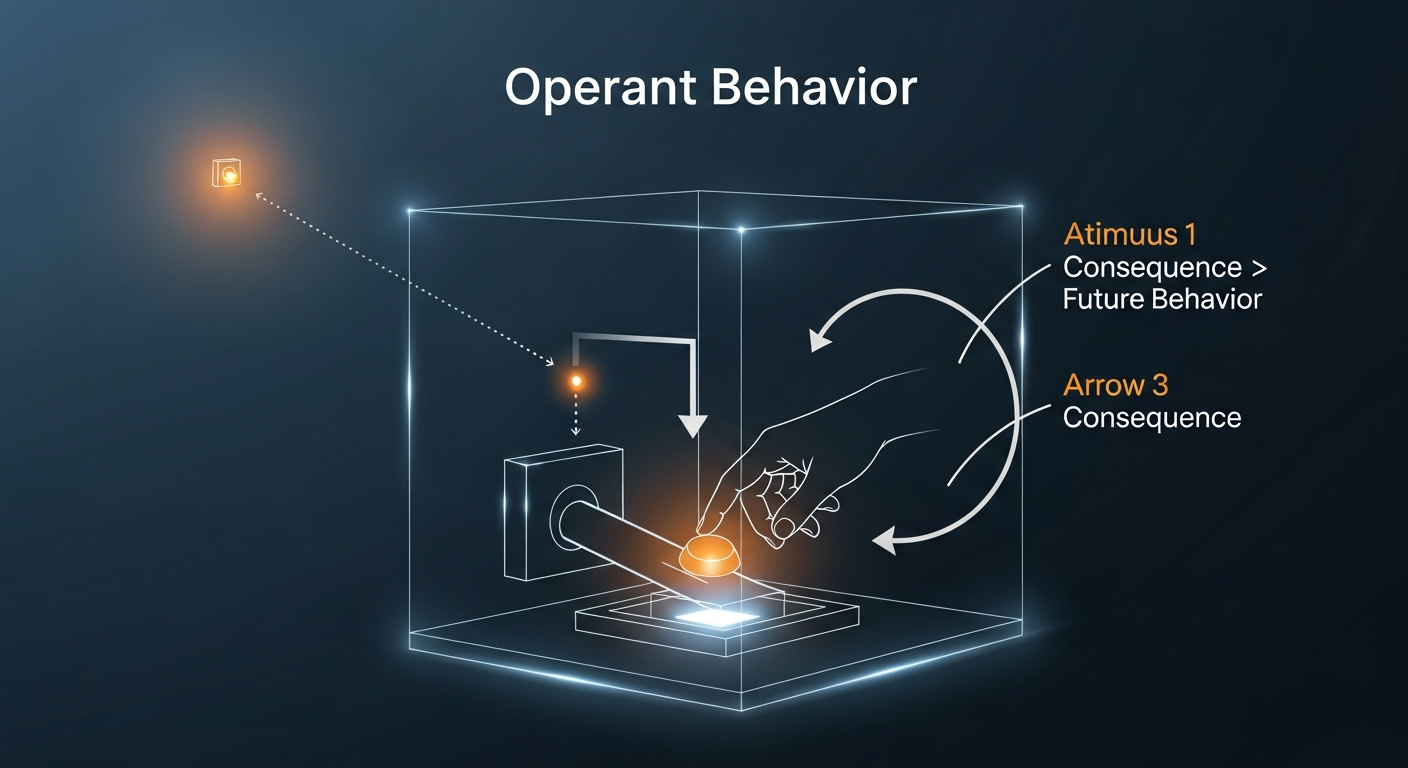
At its heart, operant behavior describes how voluntary behaviors are influenced by their consequences. Pioneered by B.F. Skinner, this principle states that actions followed by positive consequences (reinforcement) are more likely to be repeated, while those followed by negative consequences (punishment) are less likely to occur again. It's a fundamental aspect of how we learn, adapt, and perform in any environment, especially the workplace.
Think about a sales professional who closes a complex deal and receives a bonus (positive reinforcement) or a new employee who successfully completes a mandatory compliance module and avoids a penalty (negative reinforcement by avoiding an undesirable outcome). These experiences directly influence future behavior. In L&D, the challenge and opportunity lie in intentionally structuring these consequences to guide employees towards peak performance and adherence to organizational standards.
Shaping Desired Behaviors
L&D programs can actively shape new behaviors by rewarding successive approximations of the target behavior. This means breaking down complex skills into smaller, manageable steps and reinforcing each step as the learner progresses. For instance, in a new software rollout, initially rewarding basic navigation, then more complex functions, and finally mastery of advanced features.
Reinforcing Positive Outcomes
Positive reinforcement is the cornerstone of effective L&D. It involves providing desirable consequences (e.g., recognition, career progression opportunities, points in a Gamified LMS) when an employee demonstrates the desired behavior. This could be consistent adherence to safety protocols in Mining, exceptional customer service in Retail, or flawless execution of financial regulations in Banking.
Addressing Undesirable Actions
While positive reinforcement is generally more effective, understanding punishment is also crucial. In L&D, this often manifests as corrective feedback or mandatory retraining for non-compliance. The goal isn't solely punitive but to clearly communicate the unacceptability of certain actions and guide individuals back to the correct path, particularly critical in high-stakes environments like Healthcare and Pharma.
Strategic Application Across Industries
The principles of operant behavior are universally applicable, offering robust frameworks for L&D leaders across diverse sectors:
- Compliance: In industries like Banking, Finance, and Pharma, where regulatory adherence is non-negotiable, L&D can use positive reinforcement (e.g., certification, progression) to ensure employees not only understand but consistently apply compliance rules. For complex, critical areas, Risk-focused Training leverages these principles to highlight consequences and reinforce safe, compliant actions.
- Sales: Sales training benefits immensely from immediate reinforcement. Achieving milestones, successful role-plays, or closing deals can be reinforced through leaderboards, recognition, and performance-based incentives. An AI Powered Authoring Tool can help create scenarios that reinforce effective sales techniques.
- Healthcare & Hospitality: Consistent service quality and patient/guest satisfaction are critical. L&D can reinforce best practices through simulations, scenario-based learning, and feedback loops that highlight successful interactions and areas for improvement.
- Oil and Gas & Mining: Safety training is paramount. Reinforcing correct operational procedures, hazard identification, and emergency response through drills and immediate feedback significantly reduces incidents.
- Retail: Training on new product lines, customer engagement techniques, and inventory management can be enhanced by rewarding correct application in a simulated or real-world environment.
Modern L&D platforms, such as a Microlearning LMS, are perfectly suited to apply these principles. They deliver bite-sized content, allowing for immediate feedback and reinforcement, which is far more effective than traditional, lengthy training sessions.
Leveraging Technology for Enhanced Operant Learning
The evolution of learning technology has significantly enhanced our ability to apply operant conditioning principles at scale. A robust LMS (Learning Management System) is no longer just a content repository; it's an intelligent environment for behavior shaping. Whether you need a cloud based learning management system for global reach or an enterprise learning management solution for complex organizations, the right platform can make all the difference.
Modern learning management software and learning management solutions allow for:
- Instant Feedback: Quizzes, simulations, and interactive modules provide immediate reinforcement or correction, crucial for linking behavior to consequences.
- Gamification: Points, badges, leaderboards, and progress tracking act as powerful positive reinforcers, driving engagement and motivation. This is a core strength of a Gamified LMS.
- Personalized Learning Paths: Adaptive Learning tailors content and challenges based on performance, reinforcing correct behaviors and providing targeted remediation for errors.
- Performance Tracking: Comprehensive analytics within an LMS learning management system or LCMS (Learning Content Management System) help identify behavior patterns, allowing L&D leaders to fine-tune reinforcement strategies. Solutions like MaxLearn LMS exemplify this integrated approach.
Intelligent Technologies & Operant Behavior: Forward-Thinking L&D
As L&D leaders, you're constantly looking for ways to innovate and improve. The intersection of operant behavior and advanced technology, particularly in areas like artificial intelligence, presents exciting new frontiers.
How can intelligent systems be leveraged to personalize the reinforcement of desired behaviors in our training programs?
Intelligent systems can analyze individual learning styles, performance data, and even emotional responses to training content. This allows them to deliver highly personalized feedback and reinforcement – for example, dynamically adjusting the difficulty of challenges, offering contextual hints, or presenting real-world scenarios that resonate most with an individual's role. This level of customization ensures that positive consequences are delivered optimally, maximizing behavioral change.
What is the role of automated data analysis in objectively tracking and shaping employee performance over time?
Automated data analysis, driven by sophisticated algorithms, can monitor vast amounts of performance data – from course completion rates and assessment scores to on-the-job application of skills. By identifying patterns and deviations, these systems can trigger targeted interventions, offer real-time performance nudges, or suggest additional reinforcement activities. This objective, continuous feedback loop is critical for shaping and sustaining desired behaviors, especially in fields requiring consistent precision and compliance.
Could advanced computational models and predictive insights help us anticipate and proactively address potential compliance risks or skill gaps?
Absolutely. By analyzing historical data on employee performance, training efficacy, and incident reports, advanced computational models can identify employees or teams at higher risk of non-compliance or skill degradation. This predictive capability allows L&D to proactively deploy specific reinforcement interventions, such as refresher modules, targeted coaching, or personalized practice scenarios, *before* issues arise. This shifts L&D from reactive problem-solving to proactive behavior shaping and risk mitigation.
The Benefits for L&D Leaders
Embracing operant behavior principles in your L&D strategy offers compelling benefits:
- Measurable Behavioral Change: Move beyond knowledge transfer to demonstrable changes in employee actions.
- Enhanced Compliance & Reduced Risk: Proactively build a culture of adherence to regulations and best practices.
- Increased Employee Engagement & Motivation: Positive reinforcement creates a more rewarding and effective learning experience.
- Improved ROI: Efficiently shape behaviors that directly impact productivity, sales, safety, and customer satisfaction.
- Agile Adaptation: Quickly reinforce new policies, procedures, or skill sets in rapidly evolving industries.
By intentionally designing learning environments that reinforce desired actions and provide clear consequences for undesirable ones, L&D leaders can cultivate a workforce that not only understands what to do but consistently performs at its best. This strategic application of operant behavior is key to driving organizational growth and resilience in a competitive world.
.jpg)


