

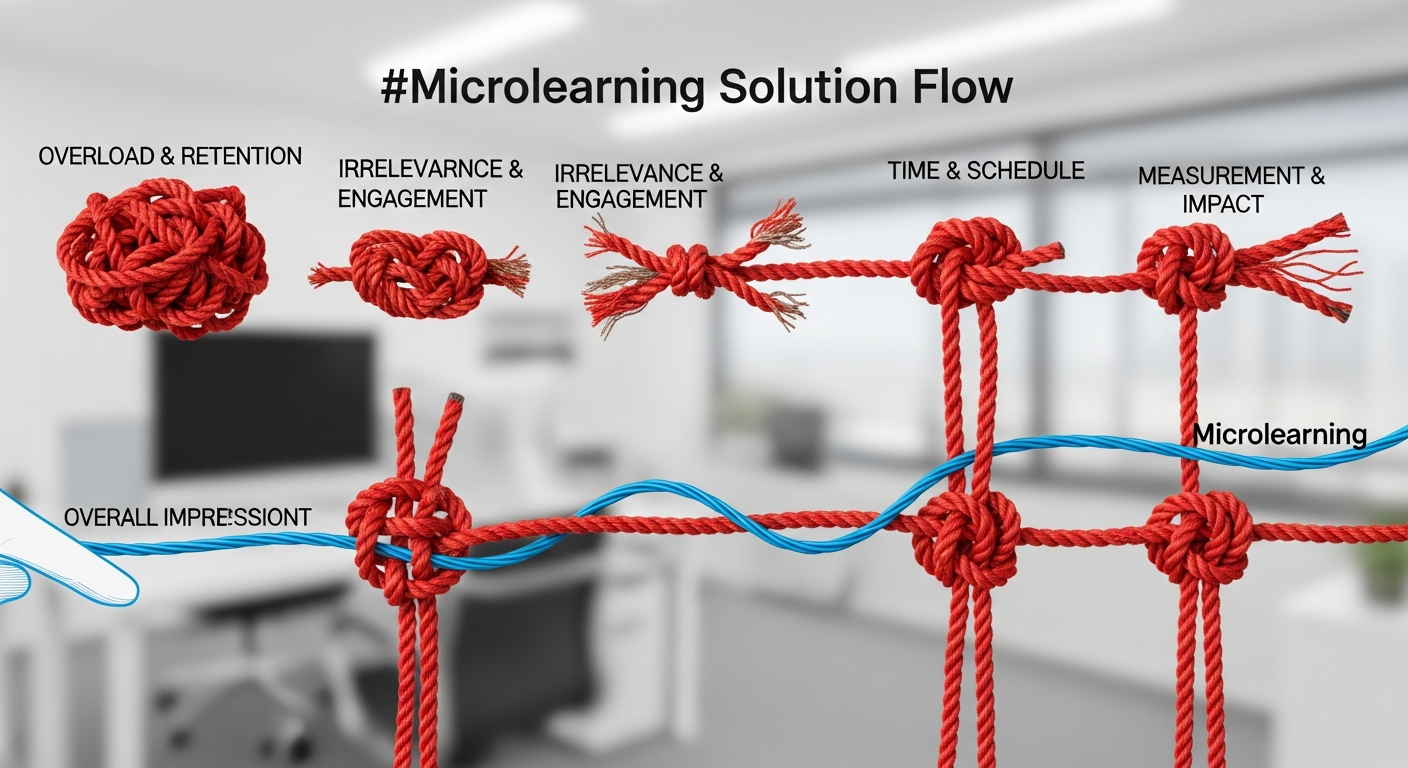
5 Common Corporate Training Problems Solved By Microlearning
In today's fast-paced corporate landscape, effective employee training is not just an advantage—it's a necessity. However, L&D professionals, from Vice Presidents to Managers, frequently grapple with systemic issues that hinder the true impact of their programs. Low engagement, rapid knowledge decay, and the sheer challenge of scaling personalized learning are persistent roadblocks. This is where microlearning emerges as a powerful, agile solution, transforming traditional corporate training into an efficient, engaging, and measurable experience.
Microlearning, characterized by bite-sized, focused content delivered in short bursts, aligns perfectly with how modern professionals consume information. It's not merely a trend; it's a strategic shift that addresses critical pain points in corporate learning. Let's explore five common corporate training problems and how microlearning, supported by an advanced Microlearning LMS, provides definitive solutions.
Problem 1: Low Engagement & Completion Rates
Solution: Bite-Sized, Relevant Content
One of the most disheartening challenges for L&D teams is seeing meticulously designed courses suffer from low learner engagement and high drop-off rates. Traditional lengthy modules often clash with busy work schedules and dwindling attention spans. Employees, especially in high-pressure sectors like Banking, Sales, and Healthcare, simply don't have hours to dedicate to uninterrupted learning.
Microlearning directly tackles this by breaking down complex topics into digestible chunks, typically 2-10 minutes long. This approach makes learning less intimidating and more approachable. When content is concise and highly relevant, learners are more likely to commit and complete modules. Imagine a salesperson needing to quickly grasp a new product feature or a healthcare professional needing an immediate refresh on a specific procedure; a short, targeted microlearning module is far more effective than a multi-hour course. An advanced Gamified LMS can further boost engagement by integrating points, badges, and leaderboards, transforming learning into an interactive and rewarding experience.
Problem 2: Rapid Knowledge Decay
Solution: Spaced Repetition & Just-in-Time Access
The "forgetting curve" is a harsh reality in corporate training. Learners forget a significant portion of what they've learned soon after a training session. This is particularly problematic in industries like Compliance, Pharma, and Finance, where remembering critical information is paramount to avoiding errors and mitigating risks.
Microlearning combats knowledge decay through spaced repetition—delivering short refreshers at optimal intervals to reinforce learning. These timely nudges help solidify information in long-term memory. Furthermore, microlearning content is inherently designed for just-in-time access. Need to recall a specific compliance regulation, a new software function, or a safety protocol in Oil and Gas? Employees can quickly search and access the exact piece of information they need, precisely when they need it, directly from their learning management software. This immediate applicability ensures knowledge is not just acquired, but also retained and utilized effectively on the job.
Problem 3: Difficulty in Personalizing Training at Scale
Solution: Adaptive Learning Paths
Every learner comes with a unique set of skills, prior knowledge, and learning preferences. Delivering a one-size-fits-all training program across a large organization—be it in Retail, Hospitality, or any enterprise learning environment—often leads to boredom for advanced learners and frustration for beginners. Personalization at scale has long been an elusive goal for many L&D departments.
Microlearning, especially when powered by an intelligent LMS, makes personalized learning a reality. By utilizing Adaptive Learning algorithms, the system can assess a learner's proficiency and guide them through customized learning paths. This means an employee proficient in one area might skip introductory modules and dive straight into advanced topics, while another receives foundational content and extra support where needed. This tailored approach optimizes learning time, increases relevance, and ensures every employee receives the most impactful training for their individual development needs, enhancing the overall enterprise learning management strategy.
Problem 4: Outdated Content & Slow Updates
Solution: Agile Content Creation & AI Powered Authoring
In dynamic industries like Technology, Finance, and Retail, products, policies, and regulations change constantly. Updating traditional, lengthy training courses can be a cumbersome, time-consuming, and expensive process. This often leaves employees working with outdated information, leading to inefficiencies or, worse, compliance breaches.
Microlearning’s modular nature facilitates agile content creation and rapid updates. Because content is broken into small units, specific modules can be revised or replaced quickly without overhauling an entire course. This agility is significantly enhanced by an AI Powered Authoring Tool, which can assist in generating new content, summarizing existing materials, and even suggesting improvements based on learning analytics. L&D teams using a modern learning content management system or LCMS can respond to market changes, new product launches, or regulatory updates with unprecedented speed, ensuring employees always have access to the most current and relevant information. This is critical for areas like Risk-focused Training, where timely updates are paramount.
Problem 5: Measuring ROI & Impact
Solution: Granular Data & Performance Alignment
Demonstrating the return on investment (ROI) of training programs is a persistent challenge for L&D leaders. Traditional training often provides only aggregate data, making it difficult to pinpoint specific areas of impact or identify correlations with business performance.
A sophisticated learning management system designed for microlearning offers granular data on learner interactions, completion rates for specific modules, knowledge gaps, and performance improvements. Because microlearning modules are focused on specific outcomes, it becomes easier to link learning activities directly to performance metrics. For example, specific micro-modules on customer service techniques can be tied to customer satisfaction scores, or sales training modules to conversion rates. A robust learning management software can provide detailed analytics, allowing L&D teams to optimize content, identify areas for improvement, and clearly articulate the tangible business impact of their training initiatives, making the case for investing in a cloud based learning management system like MaxLearn LMS.
How to Enhance Learning with Advanced Technology and Strategy
Leveraging Intelligent Systems for Optimized Delivery
Modern learning platforms are increasingly integrating advanced computational capabilities to refine the training experience. How can these intelligent systems elevate the delivery of learning content and personalize the journey for each employee? By analyzing learner interactions, performance data, and even emotional responses, these systems can dynamically recommend the most relevant micro-modules, suggest optimal learning paths, and even adapt content difficulty in real-time. This level of responsiveness ensures that training is always challenging, engaging, and precisely aligned with individual needs.
Adapting Training for a Global Workforce
For multinational corporations operating in diverse markets, ensuring training programs resonate with all employees, regardless of location, is crucial. What are the key considerations for developing and deploying training programs that are effective and culturally appropriate for teams spread across various regions? The answer lies in localized content. This involves not just translating language but also adapting scenarios, examples, and cultural nuances to make the training highly relevant to each geographical context. Understanding regional regulations and compliance standards is also paramount, ensuring that global training initiatives meet local requirements without compromising overall standards. A versatile learning management system facilitates this by allowing for multi-language support and content variations based on location.
Designing for Specific Business Objectives
Effective training isn't just about imparting knowledge; it's about driving measurable business outcomes. How can L&D leaders ensure their learning initiatives are explicitly designed to address specific organizational goals and enhance employee performance where it matters most? This requires a laser focus on outcome-driven design. Each microlearning module should have a clear, measurable objective that contributes to a larger business goal. By continuously monitoring performance metrics—from skill acquisition to job-specific task completion—and correlating them with training interventions, L&D can demonstrate a direct link between learning activities and improved business results, solidifying the value proposition of a comprehensive lms learning management system.
Conclusion: The Future is Micro
The challenges facing corporate training are significant, but the solutions offered by microlearning are transformative. From boosting engagement and retention to enabling scalable personalization and ensuring content remains current, microlearning addresses the core problems L&D leaders face. By adopting a microlearning strategy, supported by a robust Microlearning LMS like MaxLearn LMS, organizations can move beyond traditional, ineffective training models. They can cultivate a culture of continuous learning, empower their workforce in sectors from Retail to Mining, and achieve measurable improvements in performance and business growth. The future of corporate training is efficient, engaging, and undeniably micro.
.jpg)


