

Mastering Modern L&D: How Skinner's Learning Theory Powers Today's eLearning Strategies
For Vice Presidents, Directors, and Senior Managers in Learning & Development, the relentless pursuit of effective training solutions is a core mission. In an era dominated by rapid technological advancement and evolving workforce demands, it might seem counterintuitive to look back to a mid-20th-century behavioral psychologist for answers. Yet, B.F. Skinner's groundbreaking work on operant conditioning offers profound insights that remain remarkably relevant, forming the bedrock of many successful eLearning strategies today. Understanding Skinner's principles isn't just an academic exercise; it's a strategic imperative for optimizing learning outcomes and driving business growth across every industry, from Compliance to Healthcare, Finance to Retail.
In this article, we'll delve into the core tenets of Skinner's theory, explore its contemporary applications in the digital learning landscape, and discuss how intelligent learning management solutions leverage these timeless principles to shape desired employee behaviors and foster a culture of continuous improvement.
Deconstructing Skinner's Operant Conditioning
The Foundation: Behavior and Consequences
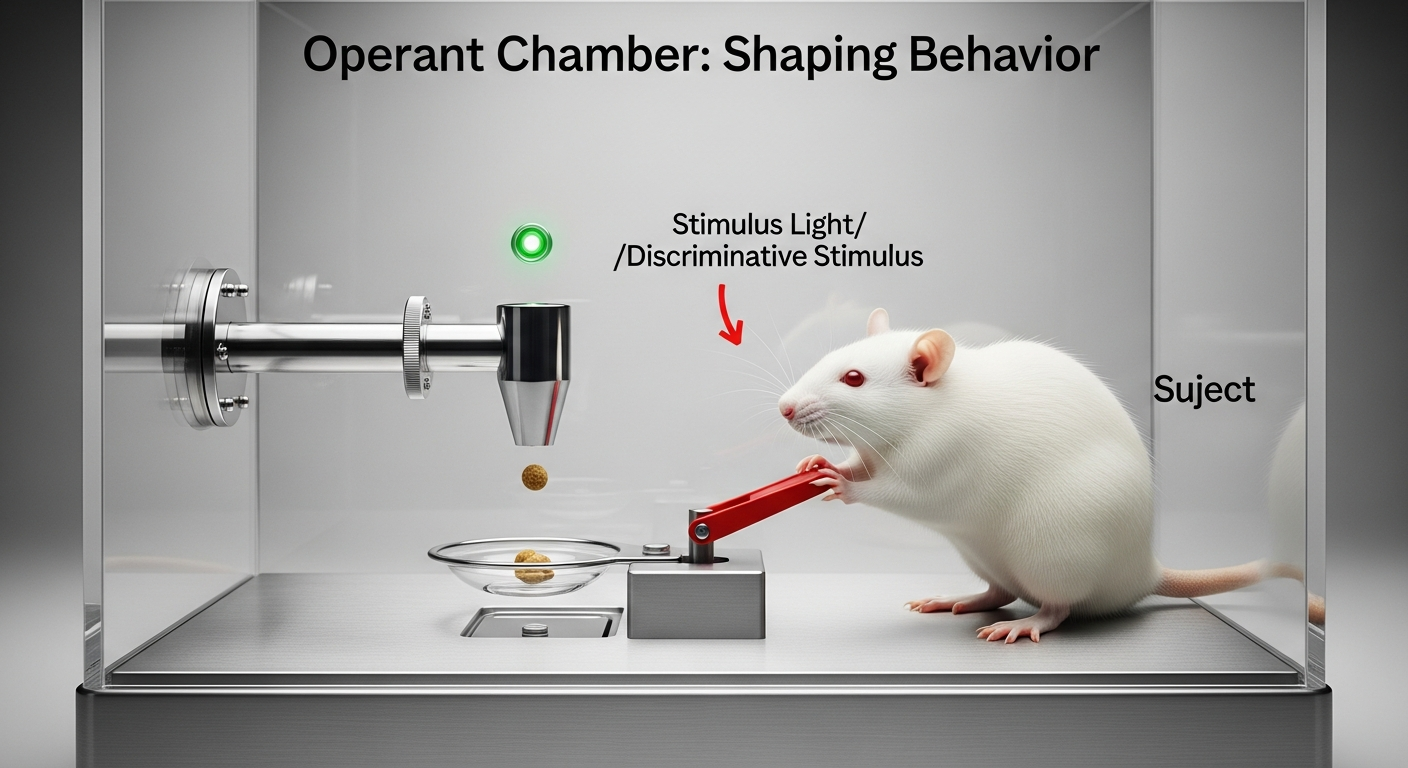
At its heart, Skinner's theory of operant conditioning posits that learning is a function of change in overt behavior. Changes in behavior are the result of an individual's response to events (stimuli) that occur in their environment. A response produces a consequence, and whether that behavior is repeated or extinguished depends on the nature of that consequence. Unlike classical conditioning, which focuses on involuntary responses, operant conditioning deals with voluntary behaviors that are "operated" on the environment.
The Art of Reinforcement and Punishment
- Positive Reinforcement: This involves adding a desirable stimulus after a behavior to increase the likelihood of that behavior occurring again. In L&D, this could be immediate feedback for a correct answer, points in a Gamified LMS, or recognition for completing a module.
- Negative Reinforcement: This involves removing an undesirable stimulus after a behavior to increase the likelihood of that behavior occurring again. An example might be an employee completing mandatory compliance training to avoid penalties or warnings.
- Positive Punishment: This involves adding an undesirable stimulus after a behavior to decrease the likelihood of that behavior occurring again. While less common and often less effective in L&D, it could manifest as a failing grade or the need to repeat a complex module due to errors.
- Negative Punishment: This involves removing a desirable stimulus after a behavior to decrease the likelihood of that behavior occurring again. For instance, losing access to certain advanced modules due to a lack of foundational understanding.
The strategic application of reinforcement, particularly positive reinforcement, is key to fostering engaging and effective learning experiences. It guides learners toward desired actions and makes the learning process intrinsically rewarding.
Skinner's Enduring Legacy in Modern eLearning
The principles of operant conditioning, when combined with cutting-edge technology, provide a powerful framework for designing highly effective corporate training. Modern LMS platforms and content strategies are inherently Skinnerian in their design, whether explicitly acknowledged or not.
Structured Feedback for Immediate Reinforcement
One of the most direct applications of Skinner's theory in eLearning is the provision of immediate and constructive feedback. When a learner answers a question correctly or completes a task, immediate positive affirmation reinforces that learning. Conversely, immediate feedback on incorrect responses allows for quick correction and prevents the reinforcement of errors. This real-time interaction is far more effective than delayed feedback, which weakens the association between the behavior and its consequence.
What role do advanced algorithms play in providing real-time, constructive feedback and reinforcing desired behaviors in a scalable manner across diverse training programs?
The Engaging Power of Gamification
Gamified LMS platforms are essentially sophisticated Skinner boxes. Points, badges, leaderboards, and virtual rewards serve as powerful positive reinforcers, motivating learners to complete modules, achieve mastery, and engage in healthy competition. The incremental nature of game progression, where learners unlock new levels or content upon successful completion of tasks, is a direct application of "shaping" – gradually guiding behavior towards a complex goal through successive approximations.
Microlearning for Focused Reinforcement
Microlearning LMS strategies thrive on Skinnerian principles. By breaking down complex topics into short, digestible modules, microlearning ensures frequent opportunities for reinforcement. Each successfully completed micro-module, quiz, or activity provides immediate positive feedback, building confidence and encouraging continued engagement. This approach is particularly effective for training in fast-paced environments like sales or healthcare, where quick bursts of reinforced learning are more practical and impactful.
Adaptive Learning Paths for Personalized Progress
How can intelligent systems personalize the learning journey based on individual learner responses to optimize skill acquisition and retention? Adaptive Learning systems are perhaps the most advanced application of Skinner's principles. These systems continuously analyze a learner's performance, strengths, and weaknesses, then dynamically adjust the learning path, content difficulty, and frequency of reinforcement. If a learner struggles with a concept, the system provides more practice or remedial content (negative reinforcement by removing the struggle through more support). If they excel, they can bypass known content, receive more challenging tasks, or explore advanced topics (positive reinforcement through progress and new opportunities).
Skinner's Insights Across Industries
The applicability of operant conditioning extends across virtually all industries that require skilled, compliant, and continuously improving workforces.
- Compliance Training: In highly regulated sectors like Banking, Finance, and Pharma, Risk-focused Training is paramount. Clear guidelines, immediate feedback on policy adherence scenarios, and reinforcement for correct procedures (e.g., successful completion of a KYC module) are critical. Negative reinforcement comes into play by mitigating the risk of non-compliance.
- Sales Enablement: For Sales teams, an AI Powered Authoring Tool can help create scenarios that simulate customer interactions. Successful navigation through a sales call simulation, positive feedback on product knowledge, or earning a 'deal closed' badge, all reinforce effective selling behaviors.
- Healthcare & Hospitality: In these service-oriented sectors, ensuring correct procedures and customer interaction protocols is vital. Consistent positive reinforcement for adherence to safety protocols or exceptional guest service fosters a culture of excellence.
- Manufacturing & Oil and Gas: Safety training often leverages Skinnerian principles, where correct identification and mitigation of hazards are immediately reinforced, while incorrect actions lead to corrective feedback (punishment) to prevent accidents.
Can a universal learning framework based on behavioral science truly scale across diverse geographical and cultural contexts, ensuring consistent outcomes globally?
Optimizing the Learning Ecosystem with Advanced Learning Management Solutions
The modern enterprise learning management system acts as the central nervous system for implementing Skinnerian principles at scale. A robust learning content management system allows L&D leaders to design, deliver, and track training programs that integrate immediate feedback, gamification, microlearning, and adaptive pathways. It transforms theoretical concepts into actionable strategies that drive measurable behavioral change.
Consider the role of a sophisticated learning management software in shaping desired behaviors. From a cloud based learning management system offering accessibility to a comprehensive learning management system providing detailed analytics, these platforms are crucial. They provide the infrastructure for consistent reinforcement schedules and the data to refine them.
As learning management software evolves, how might predictive analytics, driven by vast learning data, inform future instructional design to maximize skill acquisition and retention across an organization?
A cutting-edge MaxLearn LMS, for instance, goes beyond content delivery. It provides the tools for L&D professionals to craft experiences where every interaction is an opportunity for learning and reinforcement. It's about creating a dynamic environment where desired behaviors are consistently rewarded, and learning is a continuous, engaging, and ultimately profitable endeavor.
Conclusion
B.F. Skinner’s theories on operant conditioning, developed decades ago, remain remarkably pertinent for L&D leaders today. By understanding and strategically applying principles of reinforcement, punishment, and shaping, organizations can design eLearning programs that are not only engaging but also highly effective in driving desired behavioral changes. From the nuanced feedback loops in a Microlearning LMS to the motivational triggers in a Gamified LMS, modern learning solutions are a testament to Skinner's enduring influence.
For L&D professionals seeking to elevate their training initiatives, embracing these foundational psychological principles, coupled with advanced learning management system technologies, is the key to unlocking true potential. It's about moving beyond simply delivering content to actively engineering learning environments that shape behavior, foster mastery, and ultimately contribute to a more skilled, compliant, and productive workforce.
.jpg)


