

Unlocking Human Potential: How Skinner's Reinforcement Theory Drives Modern eLearning Success
For L&D Vice Presidents, Directors, Senior Managers, and Managers, the pursuit of effective, measurable training is a constant endeavor. In an era of rapid change and digital transformation, understanding the fundamental principles that govern human behavior and learning is more crucial than ever. Enter B.F. Skinner’s Reinforcement Theory – a psychological cornerstone that, when strategically applied, can revolutionize corporate eLearning and yield unparalleled results across industries from Compliance to Sales, Banking, Finance, Insurance, Retail, Pharma, Healthcare, Hospitality, Oil and Gas, and Mining.
B.F. Skinner, a towering figure in behavioral psychology, proposed that an individual's behavior is a function of its consequences. This concept, known as operant conditioning, suggests that behaviors followed by pleasant outcomes are more likely to be repeated, while those followed by unpleasant outcomes are less likely. For L&D professionals, this isn't just theory; it's a powerful framework for designing training programs that genuinely motivate, engage, and change employee performance.
The Core Concepts of Skinner's Reinforcement Theory
At the heart of Skinner's work is the idea that we can shape behavior through systematic application of reinforcement. Understanding the nuances is key for effective implementation in an enterprise learning management strategy.
Operant Conditioning
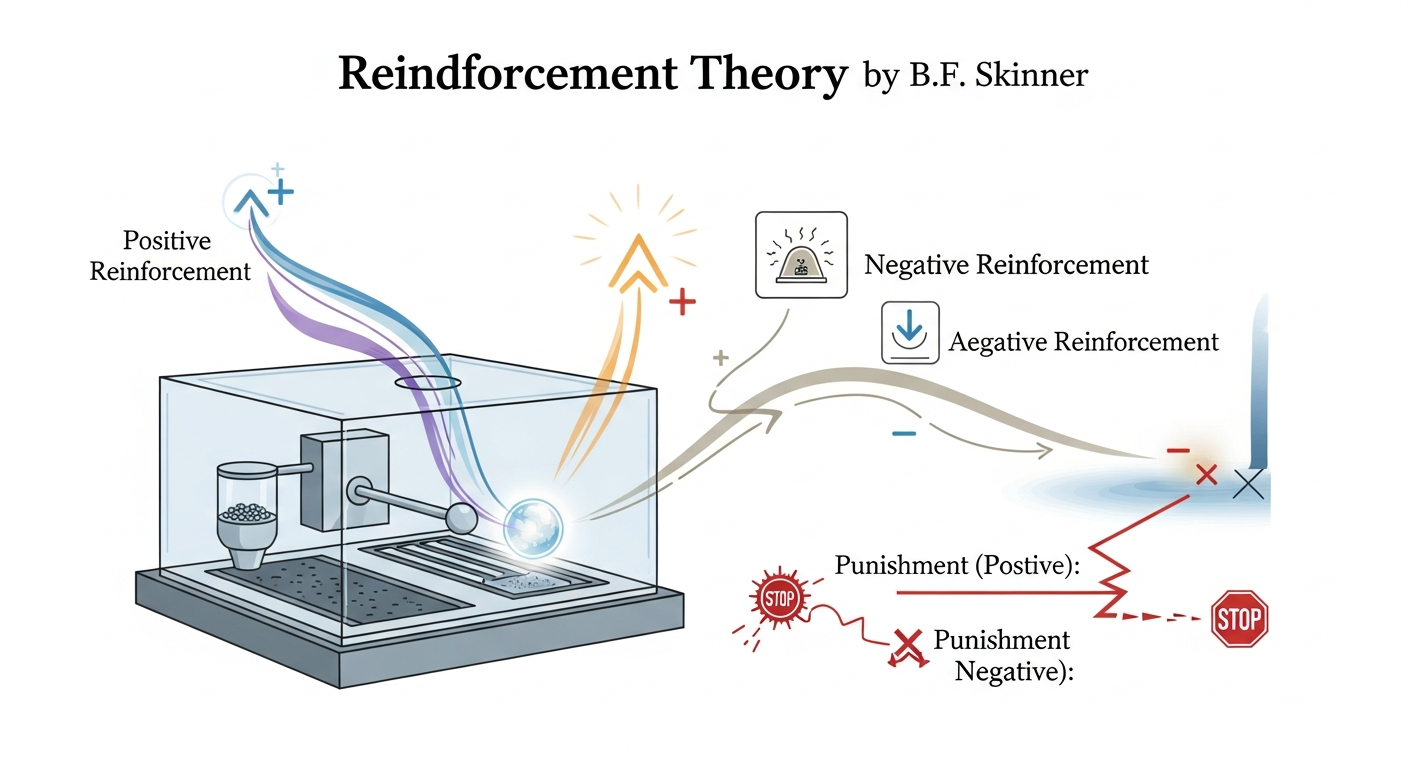
Operant conditioning is a learning process where the strength of a behavior is modified by reinforcement or punishment. Skinner developed a special chamber, dubbed the "Skinner box," to study how animals learn to operate on their environment to produce desired outcomes. In a corporate context, this means that the learning environment – your LMS – becomes the "box," and employees' interactions with it (completing modules, passing quizzes, applying new skills) are the "operants" that can be reinforced.
Types of Reinforcement
Reinforcement is anything that increases the likelihood of a behavior being repeated. It's the engine of learning within a robust learning management software.
- Positive Reinforcement: This involves adding a desirable stimulus after a behavior to increase the likelihood of that behavior recurring. Imagine an employee completing a challenging compliance module and immediately receiving digital badges, points, or public recognition on a leaderboard. This positive feedback encourages them to tackle the next module with enthusiasm. In sales training, successfully completing a simulated customer interaction might unlock advanced resources or peer mentorship opportunities, directly linking achievement to reward.
- Negative Reinforcement: Often misunderstood as punishment, negative reinforcement actually involves removing an undesirable stimulus after a behavior to increase its likelihood. For example, if an employee completes mandatory Risk-focused Training to avoid continuous reminders or performance flags, the removal of those persistent nudges acts as negative reinforcement. The behavior (completing training) is strengthened because it removes an unpleasant consequence (reminders).
Punishment
While reinforcement increases behavior, punishment aims to decrease it. Skinner identified two types:
- Positive Punishment: Presenting an undesirable stimulus after a behavior to decrease its likelihood. For instance, receiving a negative performance review for not adhering to new banking regulations.
- Negative Punishment: Removing a desirable stimulus after a behavior to decrease its likelihood. An example might be losing access to certain desirable projects due to consistent failure to meet quality standards learned in a new software training module.
While punishment can suppress unwanted behaviors, L&D strategies typically favor reinforcement. Punishment can create anxiety, resentment, and a reluctance to engage, which are counterproductive to a positive learning culture. Focusing on reinforcement builds a more sustainable and positive learning environment, making your lms learning management system a place of growth, not fear.
Schedules of Reinforcement
How and when reinforcement is delivered significantly impacts its effectiveness and the persistence of learned behavior:
- Continuous Reinforcement: Every desired response is reinforced. Excellent for initial learning, like immediate feedback on every quiz answer in a new product training module for retail staff.
- Partial Reinforcement: Only some responses are reinforced. This creates more persistent behavior and is closer to real-world scenarios. Types include:
- Fixed Ratio: Reinforcement after a specific number of responses (e.g., a bonus after every 5 sales calls).
- Variable Ratio: Reinforcement after an unpredictable number of responses (e.g., lottery wins, or sporadic recognition for outstanding contributions in a team, keeping employees engaged and motivated). This is very powerful for sustained effort, much like the engagement strategies in a Gamified LMS.
- Fixed Interval: Reinforcement after a specific time period (e.g., monthly performance reviews).
- Variable Interval: Reinforcement after an unpredictable time period (e.g., surprise spot bonuses for excellent customer service in healthcare, ensuring consistent high performance).
Applying Reinforcement Theory in Modern eLearning
The principles of reinforcement are highly adaptable to digital learning environments. A well-designed Microlearning LMS can be a powerful tool for implementing these theories.
- Personalized Learning Paths: Tailoring content and challenges based on a learner's progress ensures that success is achievable, providing consistent positive reinforcement. An Adaptive Learning system automatically adjusts, providing immediate feedback and appropriate next steps.
- Gamification and Rewards: Integrating points, badges, leaderboards, and virtual rewards within a Gamified LMS leverages variable ratio reinforcement, keeping learners engaged and motivated through intrinsic and extrinsic rewards. This is particularly effective in industries like Pharma for drug knowledge recall or Hospitality for service standards.
- Immediate and Constructive Feedback: Rapid feedback acts as an immediate reinforcer (positive or corrective). A learning content management system that provides instant results after assessments helps learners understand what they did right and where they need to improve, reinforcing correct behaviors.
- Microlearning and Spaced Repetition: Breaking down complex topics into bite-sized Microlearning LMS modules allows for frequent, achievable successes, each acting as a positive reinforcer. Spaced repetition reinforces learning over time, solidifying knowledge without overwhelming the learner.
Advanced Intelligence Optimizes Reinforcement-Based Learning
The advent of artificial intelligence (AI) elevates the application of Skinner's theory, offering unprecedented precision in delivering reinforcement through modern learning management solutions.
How can artificial intelligence personalize learning experiences to maximize positive outcomes for each learner?
Intelligent systems can analyze vast amounts of learner data – their progress, preferences, performance patterns, and even emotional responses to content. An AI Powered Authoring Tool, for example, can dynamically adjust the difficulty of a compliance scenario, recommend supplementary resources for a struggling sales professional, or automatically present review questions on concepts where a finance employee previously faltered. This hyper-personalization ensures that each learner receives the "just right" challenge followed by immediate, relevant reinforcement, making success feel achievable and motivating them to continue. It optimizes the timing and type of reinforcement, moving beyond static pathways to truly Adaptive Learning.
How do intelligent systems assist organizations in deploying effective reinforcement-based training across diverse global locations or operational environments?
For global enterprises in Oil and Gas or Mining, delivering consistent, reinforced training is a significant challenge. An advanced cloud based learning management system leveraging AI can automatically localize content, ensuring cultural relevance and adherence to regional regulations. It can identify language barriers and provide real-time translation or offer content in preferred languages. Furthermore, by analyzing performance data across different geographies, the system can pinpoint areas where reinforcement strategies are most effective, allowing for the rapid deployment of proven methods. This ensures that positive behaviors are consistently reinforced, regardless of an employee's location, streamlining enterprise learning management.
What are the key considerations for using advanced algorithms to ensure fair, unbiased, and highly effective reinforcement strategies in corporate training?
While AI offers immense potential, ethical considerations are paramount. L&D leaders must ensure that algorithms are designed to be fair and unbiased, avoiding the perpetuation of existing stereotypes or inequalities. This means transparent data collection, regular auditing of AI decisions, and ensuring that reinforcement strategies are equitable across all demographic groups. The goal is to maximize positive behavioral change for everyone, especially in critical areas like Risk-focused Training, where biased learning pathways could have severe consequences. Continual refinement of the content delivered by an LMS and the algorithms powering it ensures that reinforcement is always driving towards operational excellence and measurable business impact.
Choosing the Right Learning Management System
To effectively harness Skinner's Reinforcement Theory and AI's capabilities, selecting the right LMS is critical. A robust learning management system should offer features that naturally support reinforcement, such as:
- Comprehensive tracking and reporting for immediate feedback.
- Gamified LMS elements to introduce points, badges, and leaderboards.
- Personalized learning pathways and Adaptive Learning capabilities.
- Integration with an AI Powered Authoring Tool for dynamic content creation.
- Support for Microlearning LMS modules.
A sophisticated MaxLearn LMS or LCMS can provide the infrastructure for a behavioral science-driven learning strategy, turning abstract theories into concrete improvements in employee performance and organizational outcomes.
Conclusion
B.F. Skinner’s Reinforcement Theory, far from being an outdated concept, remains profoundly relevant in the digital age. For L&D leaders, understanding and deliberately applying its principles – especially when supercharged by artificial intelligence – offers a powerful blueprint for creating highly effective, engaging, and measurable eLearning experiences. By strategically reinforcing desired behaviors and outcomes, organizations can unlock their employees' full potential, drive continuous improvement, and achieve unparalleled success across all industries and operational landscapes. Embrace the science of behavior to build a learning ecosystem that truly thrives.
.jpg)


