

Mastering Modern Learning: Unpacking the Core Principles of Microlearning for L&D Leaders
In today's fast-paced corporate landscape, traditional lengthy training modules often struggle to capture and retain the attention of busy professionals. Vice Presidents, Directors, and Senior Managers in Learning & Development face the constant challenge of delivering impactful training that aligns with business objectives, ensures compliance, and drives performance across diverse industries like Sales, Banking, Finance, Insurance, Retail, Pharma, Health care, Hospitality, Oil and Gas, and Mining. The solution lies in a paradigm shift towards more agile, learner-centric methodologies. Enter microlearning – a powerful approach built on principles designed for the modern attention span and the demands of continuous professional development.
What Defines Effective Microlearning? The Foundational Principles
Microlearning isn't merely about making content shorter; it's a strategic design philosophy. It focuses on delivering specific, relevant information in digestible formats, ensuring maximum retention and immediate applicability. Understanding these core principles is crucial for any L&D leader looking to revolutionize their training programs.
Brevity and Focus: The Power of Bite-Sized Content
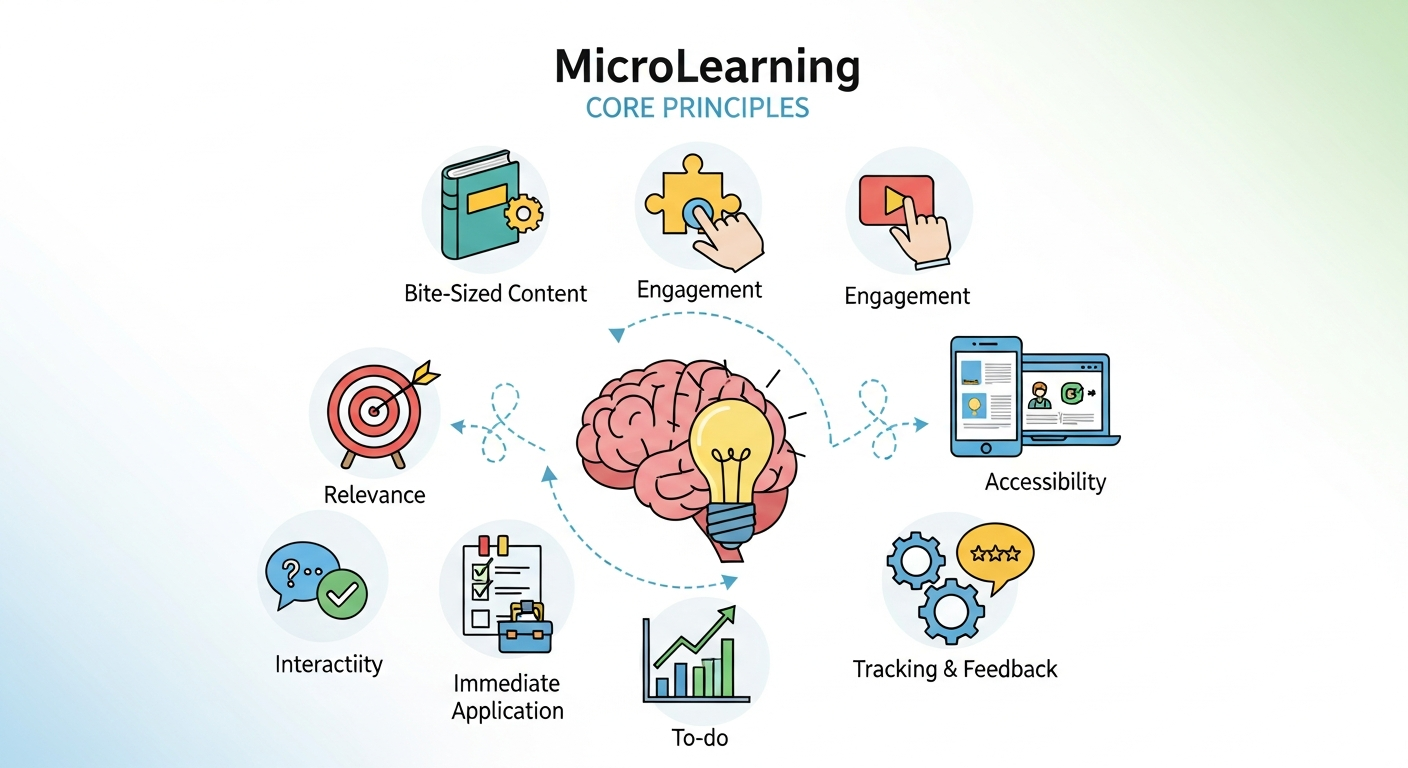
At its heart, microlearning champions brevity. Content is broken down into small, manageable units, typically lasting 2-10 minutes. This isn't just about reducing length but optimizing for cognitive load. Each segment delivers precisely what's needed, preventing information overload and allowing learners to absorb key concepts without feeling overwhelmed.
Single Objective Focus: Clarity in Learning Goals
Each microlearning module is designed around a single, clearly defined learning objective. Whether it's understanding a new compliance regulation, mastering a specific sales technique, or learning a critical safety procedure, the singular focus ensures clarity and purpose. This precision allows learners to quickly grasp one concept before moving to the next, fostering a sense of accomplishment and progressive skill-building.
Engagement and Interactivity: Captivating the Modern Learner
Passive learning is ineffective. Microlearning thrives on engagement through interactive elements such as quizzes, polls, short simulations, decision-making scenarios, and multimedia rich content. These interactions actively involve the learner, reinforcing understanding and making the experience more memorable. Incorporating a Gamified LMS further amplifies engagement, turning learning into an enjoyable and competitive activity that drives higher completion rates and knowledge retention.
Relevance and Context: Learning That Sticks
For training to be truly effective, it must be highly relevant to the learner's role and immediate needs. Microlearning content is tailored to address specific problems or skill gaps, providing practical, actionable knowledge that can be applied immediately. This contextual relevance significantly boosts motivation and ensures that the acquired skills translate directly to improved job performance.
Accessibility and Flexibility: Learning Anywhere, Anytime
In today’s mobile-first world, learners expect training to be available on their terms. Microlearning content is designed to be easily accessible across various devices – smartphones, tablets, and desktops – allowing learning to happen on the go, during commutes, or in brief downtime. A robust Microlearning LMS is essential for delivering this flexible, on-demand access, empowering employees to take ownership of their professional development.
Just-in-Time Delivery: The Right Information, Right Now
Microlearning excels as a performance support tool. It provides learners with immediate access to information exactly when they need it – whether it's before a client meeting, when encountering a new system, or during a critical operational task. This "just-in-time" approach minimizes errors, boosts confidence, and enhances productivity by offering instant answers and guidance.
Measurability and Feedback: Driving Continuous Improvement
Effective L&D strategies rely on measurable outcomes. Microlearning platforms often come with robust analytics that track completion rates, performance on assessments, and areas where learners might be struggling. This data provides invaluable feedback, allowing L&D teams to refine content, identify knowledge gaps, and demonstrate the tangible ROI of their training initiatives.
Strategic Advantages for L&D Teams Across Industries
Adopting microlearning principles offers distinct strategic advantages for L&D leaders aiming to foster a culture of continuous learning and high performance:
- Increased Learner Engagement and Completion Rates: Shorter, more engaging modules combat learner fatigue and lead to higher participation.
- Enhanced Knowledge Retention and Application: Focused content and spaced repetition improve long-term memory and on-the-job application.
- Improved Compliance Rates: For sectors like Finance, Pharma, and Oil & Gas, delivering Risk-focused Training in bite-sized, frequent bursts ensures critical regulations are understood and adhered to consistently.
- Faster Skill Development and Performance Improvement: In Sales and Retail, rapid deployment of micro-lessons on new products or selling techniques translates directly to better performance and quicker ramp-up times.
- Cost-Effectiveness and Efficient Resource Allocation: Microlearning can be quicker and more economical to produce and update than lengthy traditional courses, allowing L&D teams to be more agile with their budgets.
Integrating Intelligent Technology for Enhanced Microlearning
The true power of microlearning is amplified when combined with advanced technology, particularly intelligent systems. These systems can transform how content is created, delivered, and consumed, making learning even more personalized and impactful.
Question: How can smart systems personalize and enrich the learning journey?
Answer: Intelligent systems leverage data analytics and machine learning to understand individual learner behavior, preferences, and performance. This allows for truly personalized learning paths, recommending content tailored to specific needs and skill gaps. For instance, an intelligent system can identify that a learner struggles with a particular concept and automatically suggest additional micro-modules or resources for remediation. This capability is at the core of Adaptive Learning, where the learning experience adjusts dynamically to the individual, optimizing efficacy and engagement.
Question: What innovative platforms assist in creating and delivering dynamic training content?
Answer: Modern authoring tools, often enhanced with artificial intelligence, are revolutionizing content creation. An AI Powered Authoring Tool can dramatically speed up the development cycle, helping L&D teams convert existing material into micro-content, suggest relevant media, or even draft initial module outlines. These tools enable rapid prototyping and deployment of engaging, interactive lessons, ensuring that training content remains fresh, relevant, and responsive to evolving business needs, particularly in fast-moving environments like Sales training.
Question: How do intelligent solutions optimize skill development for globally distributed workforces?
Answer: For multinational corporations in sectors like Pharma, Banking, or Hospitality, intelligent learning solutions provide unparalleled scalability and consistency. They can automatically localize content, manage diverse learning paths based on regional compliance requirements, and track performance metrics across different geographical locations. This ensures that all employees, regardless of where they are, receive high-quality, relevant training, fostering a unified standard of expertise and reducing administrative overhead associated with managing a global learning program.
Practical Application Across Key Industries
Microlearning's versatility makes it invaluable across the breadth of industries represented by L&D leaders:
- Compliance: Rapid updates on regulations in Finance, Pharma, or Oil & Gas.
- Sales: Product knowledge, objection handling, and soft skills training in Retail and other sales-driven sectors.
- Banking & Finance: New service offerings, fraud prevention, and customer service protocols.
- Insurance: Policy updates, claims processing, and client engagement strategies.
- Health care: Best practices, equipment operation, and patient safety modules.
- Hospitality: Customer experience standards, reservation systems, and cross-cultural communication.
- Oil and Gas & Mining: Safety procedures, equipment maintenance, and environmental regulations.
Implementing a Robust Microlearning Strategy
To successfully integrate microlearning into your L&D framework, consider these steps:
- Conduct a Needs Analysis: Identify specific skill gaps or knowledge deficiencies that microlearning can effectively address.
- Design with Specificity: Ensure each module targets a single learning objective and is designed for maximum engagement.
- Leverage the Right Technology: Invest in a modern Microlearning LMS that supports diverse content formats, robust analytics, and potentially integrates Gamified LMS features.
- Pilot and Iterate: Test microlearning modules with a small group, gather feedback, and refine before a wider rollout.
- Measure Impact: Continuously track key metrics to demonstrate the effectiveness and ROI of your microlearning initiatives.
Conclusion: The Future-Ready L&D Imperative
For L&D Vice Presidents, Directors, and Managers, embracing microlearning principles is no longer an option but a strategic imperative. It offers a powerful, efficient, and engaging way to equip your workforce with the knowledge and skills needed to thrive in an ever-evolving market. By focusing on brevity, relevance, interactivity, and leveraging intelligent technologies, you can build a dynamic learning ecosystem that drives continuous improvement, ensures compliance, and ultimately propels your organization forward.
.jpg)


