

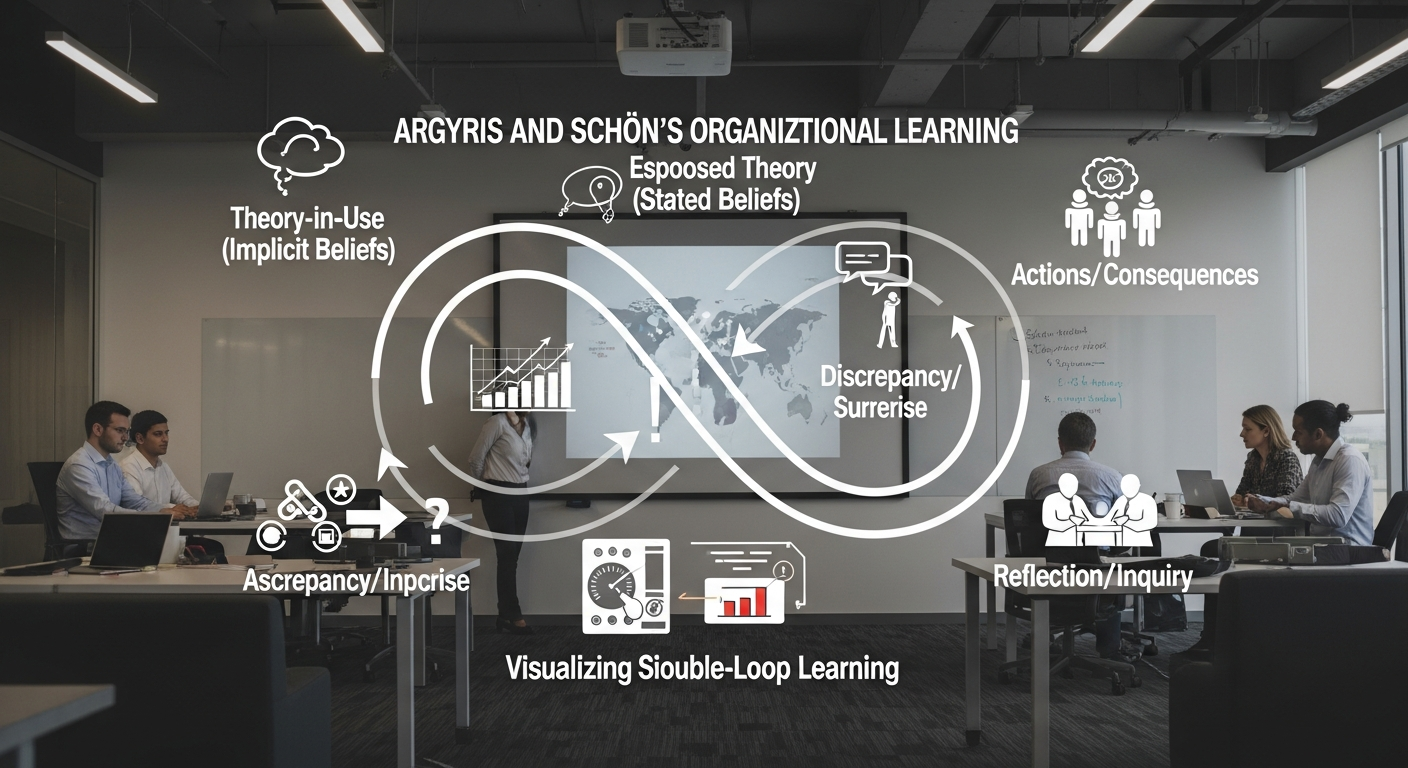
Mastering the Art of Adaptation: Leveraging Argyris & Schon for Modern Organizational Learning
In today's volatile business landscape, the ability to adapt, innovate, and continuously improve is not merely an advantage; it's a survival imperative. For Vice Presidents, Directors, and Managers of Learning & Development (L&D), understanding how organizations truly learn is critical to designing effective corporate training programs that drive tangible business outcomes. This is where the enduring work of Chris Argyris and Donald Schön on organizational learning offers profound insights, particularly when combined with cutting-edge eLearning solutions.
From the compliance demands of banking and finance to the rapid product cycles in pharmaceuticals and retail, or the safety protocols in oil & gas and healthcare, the need for robust organizational learning transcends industry boundaries. Argyris and Schön's framework doesn't just describe how learning happens; it prescribes how organizations can move beyond superficial adjustments to achieve deep, transformative change.
Deconstructing Argyris & Schön's Transformative Framework
At the heart of Argyris and Schön's theory lies a distinction between two fundamental types of learning: Single-Loop and Double-Loop Learning. This framework offers a lens through which L&D leaders can evaluate the true efficacy of their current training initiatives.
Single-Loop Learning: The Course Correction
Single-Loop Learning is akin to a thermostat. When the temperature drops below a set point, the furnace turns on. When it rises above, the furnace turns off. It's about detecting errors and correcting them without questioning the underlying goals, values, or assumptions that guide the current actions. In an organizational context, this looks like:
- A sales team failing to meet quarterly targets and then implementing a new sales script or more frequent coaching sessions.
- A compliance department identifying a training gap and rolling out a refresher course on existing policies.
- A manufacturing plant fixing a defect in a product by adjusting a machine setting.
While essential for day-to-day operations and problem-solving, Single-Loop Learning often treats symptoms without addressing root causes. It's about 'doing things better' within the existing framework.
Double-Loop Learning: The Paradigm Shift
Double-Loop Learning is where true transformation occurs. It involves questioning the fundamental assumptions, values, and policies that led to the actions in the first place. Instead of just correcting errors, the organization reflects on its governing variables and asks: "Are we doing the right things?" or "Why are we doing things this way, and should we be?"
Consider these examples:
- The sales team not only missed targets but upon reflection, questioned if their sales methodology was outdated for the current market, leading to a complete re-evaluation of their customer engagement strategy.
- The compliance department, facing repeated policy violations, questioned if the policies themselves were overly complex, poorly communicated, or misaligned with operational realities, leading to a complete overhaul of the compliance framework.
- The manufacturing plant, facing recurring defects, questioned the entire design process or material sourcing, leading to a fundamental redesign of the product or supply chain.
This deeper level of inquiry requires psychological safety, open communication, and a willingness to challenge established norms – areas where L&D can play a pivotal role.
Organizational Learning: Beyond Individual Minds
Argyris and Schön emphasized that organizational learning isn't simply the sum of individual learning. It happens when individual learning is embedded in the organizational memory – in its systems, processes, culture, and shared mental models. For Double-Loop Learning to be truly organizational, individuals must share their insights, collectively question norms, and integrate new understandings into collective action.
Why Argyris & Schön Resonate with Modern L&D Challenges
The principles of Argyris and Schön are more relevant than ever for L&D leaders facing unprecedented rates of change. The proliferation of new technologies, evolving market demands, and the imperative for continuous skill development across industries (e.g., cybersecurity in banking, new drug discoveries in pharma, data privacy in retail) necessitate an L&D strategy that fosters more than just skill acquisition.
L&D must move beyond simply delivering content (Single-Loop) to facilitating critical thinking, challenging existing paradigms, and cultivating a culture of inquiry (Double-Loop). This is particularly true for high-stakes environments like Risk-focused Training, where questioning assumptions about potential threats can prevent catastrophic failures.
Leveraging Modern Learning Technologies for Organizational Transformation
Today's L&D landscape is rich with tools that, when strategically applied, can significantly enhance an organization's capacity for both Single-Loop and Double-Loop learning. These technologies can help create environments conducive to questioning, reflection, and the rapid dissemination of new insights.
- Agile Content Delivery: A modern Microlearning LMS allows organizations to rapidly deploy targeted content for Single-Loop corrections, while also providing quick access to resources that support deeper inquiry. Its bite-sized nature means learning can be agile, iterative, and immediately applicable, fostering quick experimentation and feedback.
- Engaging Deeper Reflection: A Gamified LMS can motivate learners to engage with complex scenarios that encourage critical thinking, not just rote memorization. By simulating real-world challenges and offering rewards for innovative problem-solving, it can create a safe space for learners to practice challenging assumptions.
- Personalized Learning Journeys: Adaptive Learning platforms can tailor content based on individual learning styles and performance, effectively supporting Single-Loop mastery. More importantly, they can identify areas where learners struggle with underlying concepts, prompting L&D to create interventions that encourage Double-Loop reflection.
- Rapid Content Innovation: An AI Powered Authoring Tool empowers L&D teams to quickly create and update learning content that reflects new insights and challenges existing norms. This agility is crucial for disseminating the outcomes of Double-Loop Learning across the organization, transforming shared mental models into actionable training.
Addressing Key Learning Challenges in the Digital Age
In the context of the Argyris and Schön framework, L&D leaders must consider how advanced intelligent systems can enhance learning capabilities, bridge global divides, and amplify strategic opportunities.
How can intelligent systems enhance an organization's capability to learn from its operational data and improve continuously?
Intelligent systems provide unprecedented capabilities for
data analysis, identifying patterns and anomalies in operational performance and learning engagement. By leveraging these insights, L&D can pinpoint not just where employees need more training (Single-Loop), but also areas where existing processes, policies, or even core assumptions might be flawed, necessitating Double-Loop inquiry. Predictive analytics can flag emerging skill gaps before they become critical, allowing for proactive, rather than reactive, learning interventions. Automation can streamline feedback loops, ensuring that insights from performance are rapidly fed back into learning content and strategies, optimizing the cycle of continuous improvement.
What role do advanced learning technologies play in harmonizing learning across diverse global business units and cultures?
Advanced learning technologies are instrumental in breaking down geographical and cultural barriers. AI-powered translation tools can instantly localize content, making learning accessible and culturally relevant for diverse global teams in industries like hospitality or banking with international operations. Centralized learning platforms can aggregate learning data from across the globe, allowing L&D leaders to identify shared challenges that might stem from universal organizational assumptions (Double-Loop) while still respecting local nuances. This fosters a unified learning culture, ensuring that collective insights gained in one region can inform and transform practices across the entire global enterprise, driving consistent performance and shared strategic understanding.
Beyond basic automation, how can cutting-edge intelligent applications truly empower individual and collective learning for strategic advantage?
Cutting-edge intelligent applications move beyond automating administrative tasks to fundamentally transform the learning experience. They empower individuals through highly personalized learning paths, adapt content difficulty in real-time based on learner mastery, and provide intelligent tutoring that can guide learners through complex problem-solving scenarios. For collective learning, these applications facilitate sophisticated simulations and virtual environments where teams can experiment with new strategies and question established approaches without real-world risk. Conversational interfaces can act as intelligent coaches, prompting learners to reflect on their decisions and underlying assumptions, thereby directly fostering Double-Loop Learning. This strategic application of intelligence ensures that learning is not just efficient but deeply transformative, directly contributing to competitive advantage.
Practical Strategies for Fostering Double-Loop Learning
Implementing Argyris and Schön's principles requires a deliberate strategy from L&D:
- Cultivate Psychological Safety: Create environments where employees feel safe to question, challenge, and experiment without fear of reprisal. This is foundational for Double-Loop Learning.
- Design for Reflection: Integrate reflective practices into training programs, encouraging learners to not just learn "how," but also "why" and "what if." Case studies, simulations, and group discussions can be powerful tools.
- Empower Inquiry: Train managers and leaders to ask open-ended questions that challenge assumptions, rather than just providing solutions. This models the behavior required for Double-Loop Learning throughout the organization.
- Utilize Feedback Loops: Establish robust mechanisms for collecting feedback, not just on the learning content, but on the effectiveness of current processes and policies, ensuring that insights lead to systemic change.
- Lead by Example: L&D leaders themselves must embody Double-Loop Learning, regularly questioning their own assumptions about learning efficacy and program design.
Conclusion
The insights of Argyris and Schön provide L&D professionals with a timeless framework for understanding and cultivating true organizational learning. By distinguishing between Single-Loop and Double-Loop Learning, leaders can design corporate training programs that not only fix immediate problems but also drive profound, systemic transformation. In an era where agility and continuous adaptation are paramount, leveraging modern eLearning technologies to foster a culture of inquiry and critical reflection is no longer optional. It's the strategic imperative for building resilient, future-ready organizations across all industries.
Embrace the challenge of fostering Double-Loop Learning within your organization. The future of your enterprise depends on its ability to not just learn, but to truly transform.
.jpg)


