

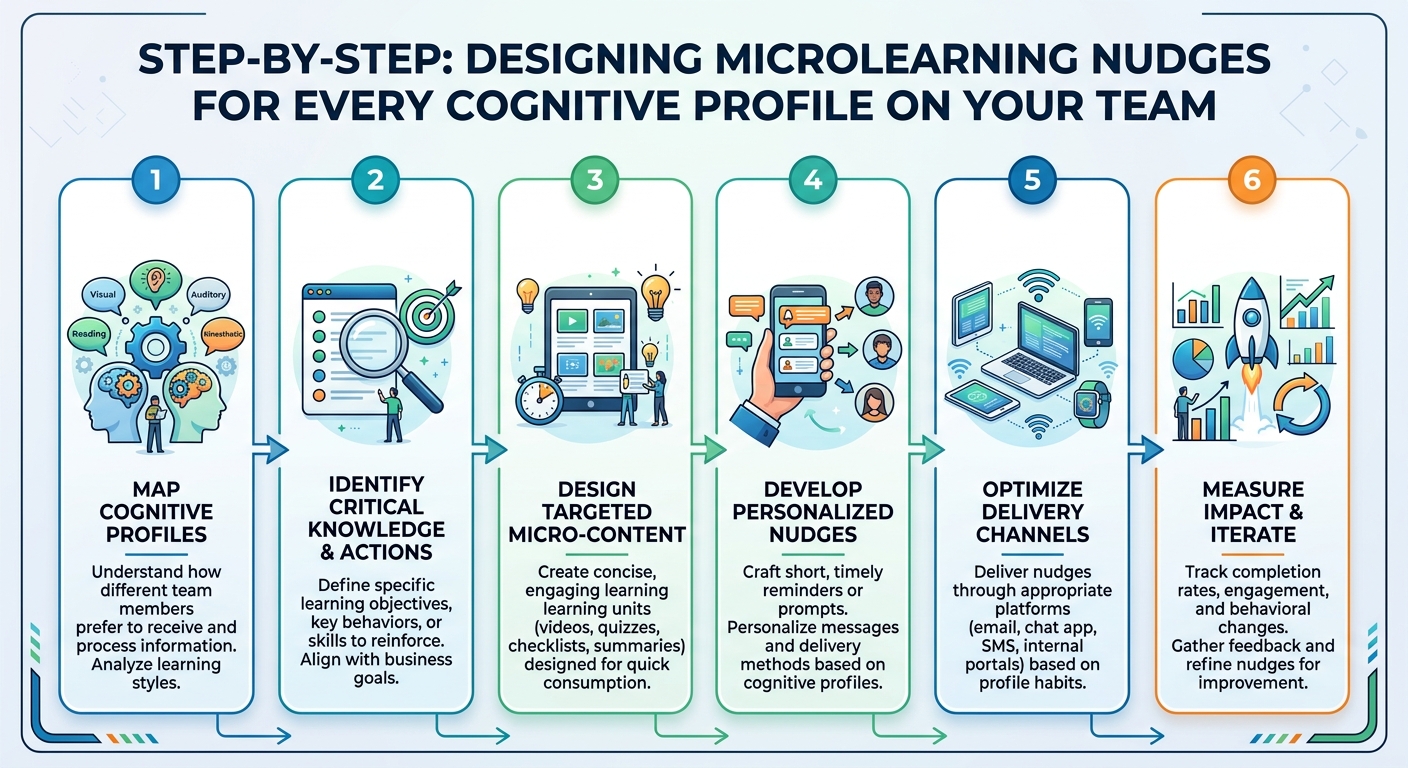
Step-by-Step: Designing Microlearning Nudges for Every Cognitive Profile on Your Team
In today's fast-paced corporate environment, particularly across diverse sectors like Compliance, Sales, Banking, Finance, Insurance, Retail, Pharma, Health care, Hospitality, Oil and Gas, and Mining, the effectiveness of employee training is paramount. As Vice Presidents, Directors, and Senior Managers of L&D, you understand that a one-size-fits-all approach to learning often falls short. Your teams are composed of individuals with unique cognitive profiles, learning preferences, and attention spans. The challenge? How to deliver impactful learning that resonates with everyone, ensuring high engagement and retention.
The solution lies in strategically designed microlearning nudges, tailored to meet diverse cognitive needs. This article will guide you through a professional, step-by-step process to craft these targeted interventions, ensuring every member of your team not only learns but thrives.
Understanding Cognitive Profiles in L&D
Cognitive profiles refer to the distinct ways individuals perceive, process, and retain information. Recognizing these differences is the foundation of truly personalized learning. Some team members might be visual learners, thriving on infographics and video. Others are analytical, needing data, logic, and case studies. Some prefer hands-on, practical applications, while others grasp concepts better through auditory explanations or reflective exercises.
Why Cognitive Diversity Matters in Learning
Ignoring cognitive diversity in training leads to disengagement, poor knowledge retention, and ultimately, ineffective learning outcomes. When learning experiences align with an individual's natural processing style, comprehension increases, the learning curve shortens, and the overall impact of the training program is significantly amplified. This is critical for everything from understanding complex financial regulations to mastering new sales techniques or adhering to stringent healthcare protocols.
Many L&D leaders often wonder: "What's the best way to identify learning styles in my team?" The answer isn't a single magic bullet but a combination of methods. Observing how employees naturally approach new tasks, administering simple self-assessment questionnaires, or even leveraging features within a modern learning content management system that tracks interaction patterns can provide valuable insights. A robust enterprise learning management solution can help centralize this data.
The Power of Microlearning Nudges
Microlearning is the delivery of learning content in small, digestible chunks, typically lasting 1-10 minutes. Nudges take this a step further: they are timely, context-specific, and often interactive micro-moments designed to reinforce learning, introduce new concepts, or prompt behavior change.
What are Microlearning Nudges?
Imagine a quick video demonstrating a compliance procedure, an interactive quiz on a new product feature, or a scenario-based challenge on handling a customer objection—all delivered precisely when and where they are most relevant. These are microlearning nudges. They are not meant to replace comprehensive training but to complement it, acting as powerful reinforcement tools that combat the forgetting curve and sustain engagement over time.
A common inquiry among L&D professionals is: "How can short learning modules improve corporate training results?" The answer lies in their ability to fit into busy schedules, provide just-in-time support, and offer immediate relevance. By breaking down complex topics into manageable pieces, microlearning reduces cognitive overload, making learning less daunting and more accessible. When paired with a sophisticated Microlearning LMS, these nudges become incredibly effective tools for driving continuous learning.
Step-by-Step Guide to Designing Nudges
Step 1: Assess Your Team's Cognitive Landscape
Before designing, understand who you're designing for. Use a multi-faceted approach to gather data on your team's learning preferences, existing knowledge gaps, and performance needs. This could involve surveys, performance reviews, interviews, and even analyzing past training engagement data. Look for patterns: do some departments respond better to visual aids? Are others driven by competitive elements? A powerful learning management system can provide analytics to help uncover these trends.
You might be asking, "Are there tools to help map team learning preferences?" Absolutely. Beyond traditional surveys, modern cloud based learning management system platforms often incorporate analytics dashboards that can highlight preferred content types or engagement patterns. For example, if a team consistently completes video modules faster and scores higher on related assessments, it suggests a strong visual/auditory preference. MaxLearn LMS provides robust reporting to assist in this critical first step.
Step 2: Define Learning Objectives & Nudge Goals
For each identified cognitive profile or team segment, clearly define what you want them to know, do, or achieve after interacting with a nudge. These objectives should be SMART (Specific, Measurable, Achievable, Relevant, Time-bound). For instance, an objective for a sales team's analytical profile might be: "By end of week, identify 3 key data points from the new market report that directly impact product positioning." For a visual learner in compliance, it might be: "Recall the 5 critical steps for incident reporting after viewing an infographic." Tailoring objectives is key to effective Adaptive Learning.
Step 3: Tailor Content Formats for Each Profile
This is where cognitive alignment comes to life. Match the nudge format to the cognitive profile:
- Visual Learners: Short animated videos, infographics, interactive diagrams, image-based quizzes.
- Auditory Learners: Mini-podcasts, short audio explanations, voice-overs on presentations.
- Analytical/Logical Learners: Case studies, data-driven summaries, problem-solving simulations, decision-tree scenarios.
- Kinesthetic/Practical Learners: Hands-on simulations, quick step-by-step guides for tasks, interactive drag-and-drop exercises.
- Reading/Writing Learners: Concise articles, short policy summaries, interactive checklists, reflection prompts.
When considering different types of content, an L&D manager might inquire, "What content formats are most engaging for busy professionals?" The answer often points to highly visual, interactive, and concise formats. Videos, interactive quizzes, and bite-sized articles excel because they demand minimal time commitment while offering immediate value. An AI Powered Authoring Tool can significantly streamline the creation of diverse microlearning content, adapting to various formats with ease.
Step 4: Strategize Delivery & Cadence
The timing and frequency of your nudges are as important as their content. Consider the context: when will a specific piece of information be most useful? Just-in-time learning, delivered right before a task or meeting, can be incredibly powerful. A Gamified LMS can help schedule and deliver these nudges, making the experience more engaging through points, badges, and leaderboards.
- Frequency: Daily quick reminders for critical compliance procedures, weekly skill-building challenges, or monthly deep dives into new product features.
- Channels: Utilize your learning management software, internal communication platforms, or even integrated apps. A modern learning management system offers multi-channel delivery capabilities.
- Context: Deliver nudges based on triggers—e.g., a reminder about data security best practices before an employee accesses sensitive information.
Step 5: Implement Feedback Loops & Iteration
Microlearning nudges are not set-it-and-forget-it tools. Continuous monitoring and iteration are crucial. Track engagement rates, completion rates, knowledge retention scores, and, most importantly, observable behavior changes. Use a robust learning management software to collect data.
It's common for leaders to ask, "How do I measure the impact of personalized learning interventions?" The key is to link nudge engagement to business outcomes. For sales teams, this might be improved conversion rates. For compliance, it could be a reduction in incidents or audit flags. In industries like Banking, Pharma, or Healthcare, this directly ties into mitigating risks. The analytics provided by a sophisticated learning management system can highlight which nudges are most effective for specific profiles, allowing for data-driven adjustments. This iterative process, often supported by features of a comprehensive LCMS, ensures that your training remains relevant and impactful, particularly for Risk-focused Training scenarios.
Key Considerations for Implementation
Implementing a successful microlearning nudge strategy requires the right technological backbone. A comprehensive learning management solution is essential. Look for a cloud based learning management system that offers features like personalized learning paths, advanced analytics, and integration capabilities. A dedicated MaxLearn LMS provides an ideal platform, offering an intuitive experience for both learners and administrators, consolidating all learning management system needs into one powerful solution.
Conclusion
Designing microlearning nudges tailored to every cognitive profile on your team is not just a best practice—it's a strategic imperative for any forward-thinking L&D department. By understanding individual learning styles, leveraging the power of bite-sized content, and implementing a robust learning content management system, you can transform your training programs from generic obligations into dynamic, engaging, and highly effective tools for organizational growth. Embrace this personalized approach to unlock your team's full potential and drive measurable business impact across all industries.


