

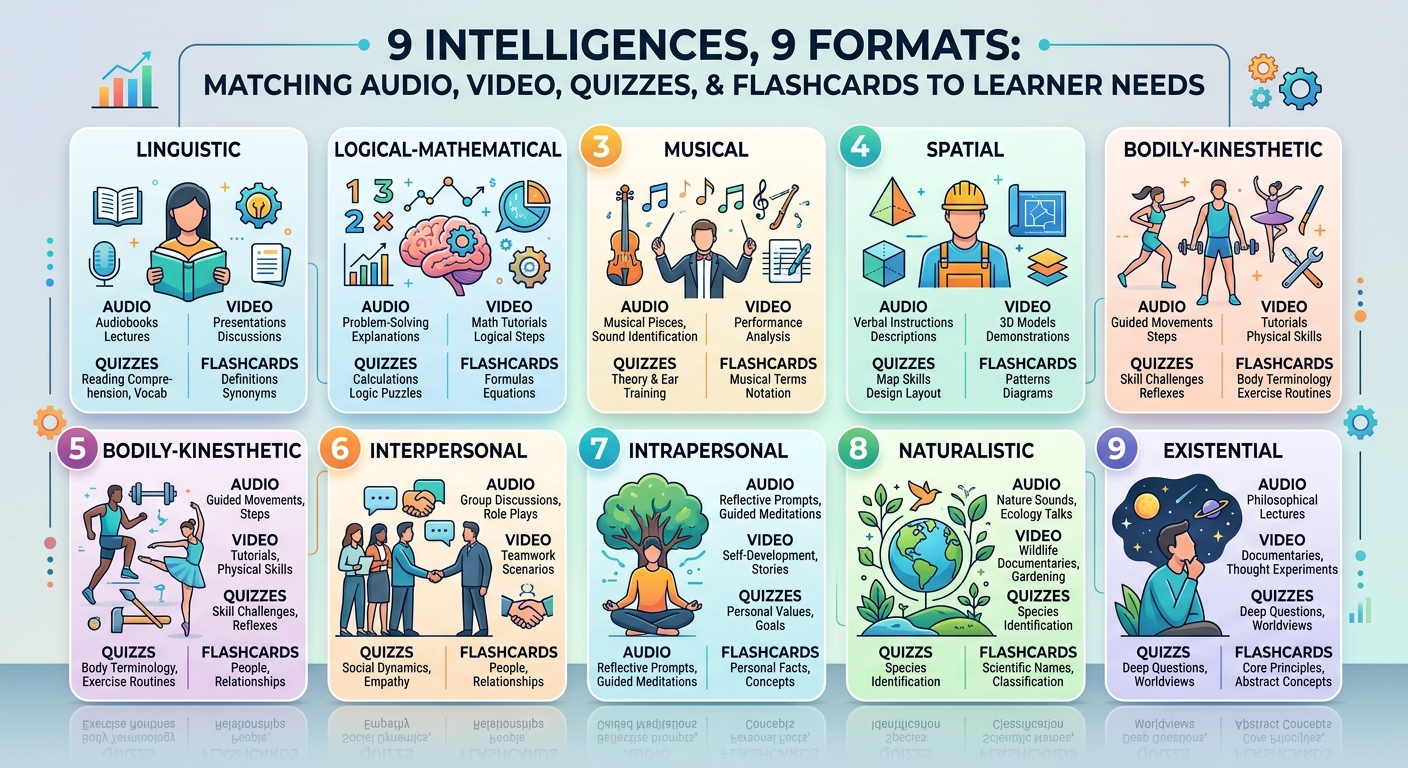
9 Intelligences, 9 Formats: Matching Audio, Video, Quizzes, and Flashcards to Learner Needs
In today's dynamic corporate landscape, ensuring effective employee learning and development is paramount for organizational success. L&D leaders across industries, from
Compliance
toBanking
,Finance
,Insurance
,Retail
,Pharma
,Health care
,Hospitality
,Oil and Gas
, andMining
, face the constant challenge of engaging a diverse workforce with varied learning preferences. The traditional "one-size-fits-all" approach to training is no longer sufficient. To truly elevate employee proficiency and drive performance, L&D strategies must embrace personalization and adaptability.This is where the groundbreaking work of Howard Gardner on Multiple Intelligences becomes a powerful framework. By understanding that individuals possess different cognitive strengths, we can strategically align learning content formats—such as audio, video, interactive quizzes, and flashcards—to resonate deeply with each learner. The goal is not just to deliver information, but to facilitate genuine comprehension, retention, and application, ultimately maximizing the return on your L&D investments through a sophisticated LMS.
Unlocking Potential: Understanding the 9 Intelligences
Howard Gardner's theory posits that intelligence is not a singular entity but rather a spectrum of distinct abilities. For L&D professionals, recognizing these intelligences provides a roadmap for creating highly effective and inclusive learning experiences. Many L&D leaders often ask, "What's the best way to understand different learning strengths within my workforce?" The answer lies in appreciating the nuances of these nine intelligences:
- Linguistic Intelligence: The ability to think in words and use language to express meaning. Learners excel with reading, writing, storytelling, and debates.
- Logical-Mathematical Intelligence: The capacity to carry out mathematical operations and analyze problems logically. These learners thrive with reasoning, patterns, and problem-solving.
- Spatial Intelligence: The ability to think in three dimensions and visualize. They understand maps, charts, graphs, and visual arts well.
- Bodily-Kinesthetic Intelligence: The capacity to manipulate objects and fine-tune physical skills. Learning by doing, movement, and hands-on activities is preferred.
- Musical Intelligence: The ability to discern pitch, rhythm, timbre, and tone. Learners respond well to sounds, music, and rhythmic patterns.
- Interpersonal Intelligence: The ability to understand and interact effectively with others. They excel in group activities, discussions, and empathy.
- Intrapersonal Intelligence: The capacity to understand oneself—one's own emotions, goals, and motivations. These learners prefer self-reflection and independent study.
- Naturalistic Intelligence: The ability to recognize and categorize elements of the natural world. They appreciate patterns in nature and practical application to real-world environments.
- Existential Intelligence: The capacity to tackle deep questions about human existence, such as the meaning of life, death, and reality. They are driven by purpose and big-picture thinking.
By moving beyond generic learning approaches, your organization can leverage these insights to build a more impactful learning content management system.
Strategic Content Formats for Enhanced Engagement
Now that we understand the diverse intellectual strengths, the next step is to align them with the right learning content formats. "How can I make my corporate training more engaging for all employees?" is a common question among L&D managers. The key is diversification and intelligent matching within your learning management software.
Matching Intelligences to Formats: A Practical Guide
-
Linguistic Intelligence:
Formats: Audio podcasts, detailed written guides, textual case studies, narrated presentations.
Application: Ideal for compliance manuals, policy updates, and in-depth product specifications in
Sales
training. An enterprise learning management system can host rich textual resources alongside engaging audio lectures. -
Logical-Mathematical Intelligence:
Formats: Interactive quizzes, problem-solving simulations, data analysis exercises, structured coding challenges.
Application: Perfect for financial modeling in
Banking
orFinance
, troubleshooting guides, and statistical analysis forHealth care
research. A robust Gamified LMS can turn complex problems into engaging challenges. -
Spatial Intelligence:
Formats: Explainer videos, animated diagrams, interactive infographics, 3D simulations, virtual tours.
Application: Visualizing complex machinery in
Oil and Gas
orMining
, understanding architectural plans inRetail
store layouts, or anatomical structures inPharma
training. High-quality video content is crucial here. -
Bodily-Kinesthetic Intelligence:
Formats: Interactive simulations, virtual reality (VR) training, role-playing video scenarios, drag-and-drop activities.
Application: Essential for customer service role-plays in
Hospitality
, surgical simulations, or practical safety procedures. A Microlearning LMS can break down these hands-on experiences into manageable, repeatable modules. -
Musical Intelligence:
Formats: Content with mnemonic jingles, rhythmic presentations, background music in videos, audio-based storytelling.
Application: While less common for core content, music can aid memory recall for specific processes or compliance regulations, enhancing the overall learning ambiance. This can be subtly integrated into various formats within a comprehensive lms learning management system.
-
Interpersonal Intelligence:
Formats: Collaborative quizzes, discussion forums (simulated or live), scenario-based video training requiring group decisions, peer feedback exercises.
Application: Crucial for leadership development, team-building exercises, and complex ethical dilemmas in
Insurance
claims processing. Modern learning management solutions facilitate rich social learning experiences. -
Intrapersonal Intelligence:
Formats: Reflective prompts in quizzes, self-paced modules with personalized feedback, journaling exercises, individual project-based learning.
Application: Fostering self-awareness in management training, goal setting, and personal development plans. A flexible cloud based learning management system allows for independent exploration and growth.
-
Naturalistic Intelligence:
Formats: Case studies based on real-world scenarios, environmental simulations, field-trip style videos, practical applications to natural contexts.
Application: Relevant for understanding supply chain logistics, environmental regulations, or sustainable practices in
Oil and Gas
orMining
. -
Existential Intelligence:
Formats: Ethical dilemma discussions, philosophical inquiries integrated into scenarios, reflective video testimonials, purpose-driven learning modules.
Application: Important for cultivating corporate values, leadership ethics, and understanding the broader impact of business decisions, particularly in sectors like
Finance
orHealth care
where societal trust is paramount.
The AI Advantage: Personalizing Learning at Scale
The vision of tailoring content to individual intelligences is now more achievable than ever, thanks to advancements in artificial intelligence. L&D leaders frequently ask, "How can artificial intelligence enhance corporate training outcomes?" The answer lies in its ability to analyze learner behavior, preferences, and performance data to deliver truly personalized pathways.
An Adaptive Learning system, powered by AI, can dynamically adjust the learning path, recommending specific formats (audio, video, quizzes, or flashcards) based on a learner's strengths and weaknesses. If a learner struggles with a concept presented in text, the system might automatically offer a supplementary video or an interactive simulation. This intelligent curation ensures that every learner receives content in the format most conducive to their success.
Furthermore, an AI Powered Authoring Tool empowers L&D teams to create diverse content formats more efficiently. Such tools can assist in generating quiz questions from video transcripts, converting text into audio narrations, or even suggesting visual elements for spatial learners, drastically cutting down content development time and cost within any learning management system (or LCMS).
Driving Strategic Outcomes with an Advanced Learning Platform
For L&D VPs, Directors, and Managers, the integration of multiple intelligences and diverse content formats isn't just about better learning—it's about strategic business impact. Questions like "What's the best way to ensure high compliance training completion rates and effectiveness?" underscore the need for a sophisticated approach.
A modern learning management system (or LMS as it's often called) like MaxLearn LMS, built for this multi-modal future, offers invaluable benefits:
- Increased Engagement and Retention: When learning resonates with individual strengths, engagement soars, leading to better knowledge retention and application.
- Improved Compliance and Risk-focused Training: Tailored training ensures critical information, especially in high-stakes environments like
Finance
orHealth care
, is fully absorbed, mitigating risks effectively. - Faster Time to Proficiency: Personalized paths accelerate skill development, getting employees job-ready more quickly.
- Higher ROI on L&D Investments: By maximizing the effectiveness of each training dollar, organizations see tangible improvements in performance and productivity.
- Scalability and Future-Proofing: A robust cloud based learning management system can adapt to evolving organizational needs and integrate new technologies seamlessly.
An advanced learning management system provides the infrastructure to host, deliver, and track a rich tapestry of learning experiences, from Microlearning LMS modules to comprehensive video libraries and interactive simulations. It's the central hub for your enterprise learning management strategy.
Conclusion
The journey to truly impactful eLearning begins with recognizing and catering to the inherent diversity of human intelligence. By thoughtfully matching audio, video, quizzes, and flashcards to the nine intelligences, L&D leaders can transcend generic training and create profoundly engaging, effective, and personalized learning experiences. This strategic approach, powered by an intelligent LMS and the capabilities of AI, transforms learning from a mere requirement into a powerful engine for organizational growth, talent development, and sustained competitive advantage across all industries. Embrace the future of learning, where every intelligence finds its perfect format, and every learner can unlock their full potential.


