

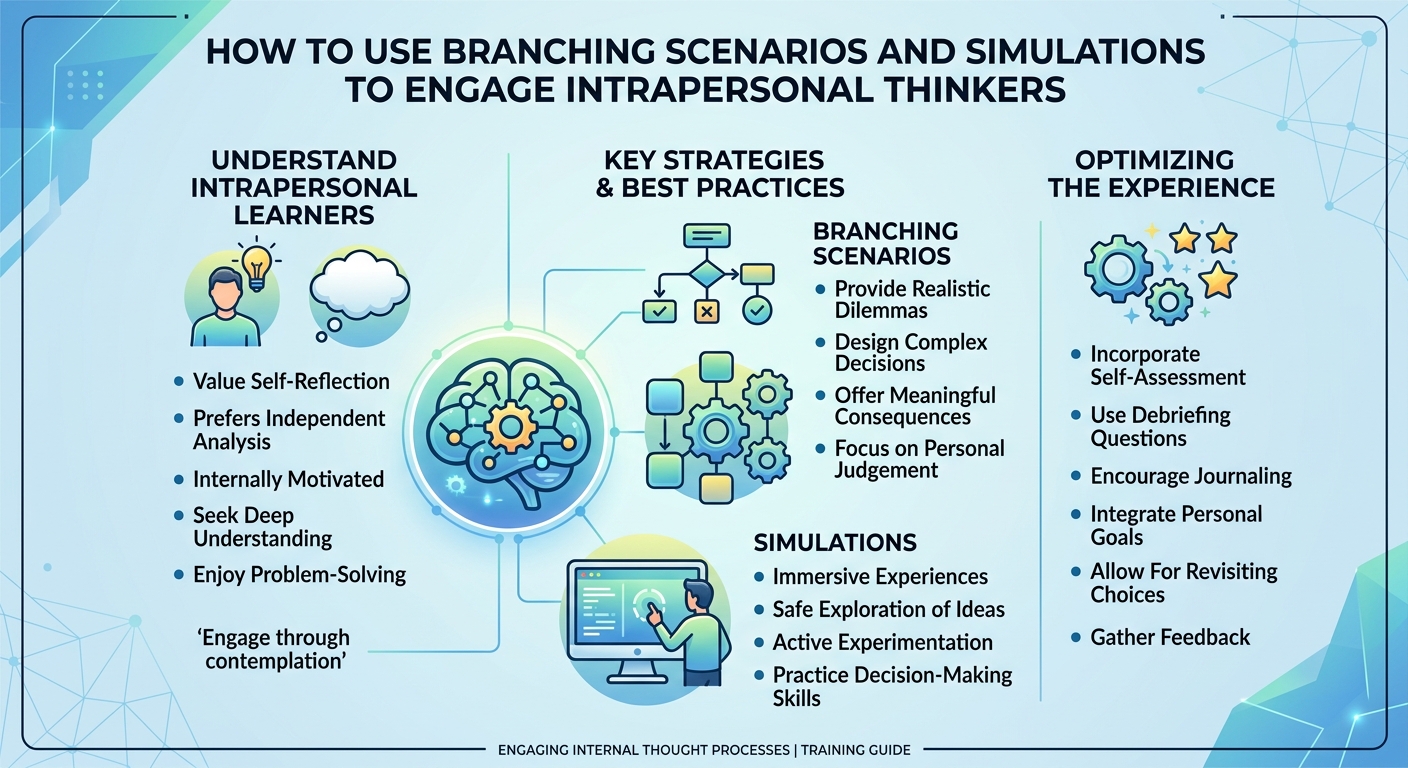
Unlock Deeper Engagement: Using Branching Scenarios and Simulations for Intrapersonal Thinkers
In the dynamic world of corporate learning and development, the goal remains constant: foster genuine engagement and drive measurable performance improvements. Yet, L&D leaders often face the challenge of designing training that resonates with every individual. Among the diverse learner profiles, intrapersonal thinkers – those who excel at self-reflection, introspection, and understanding their own thoughts and feelings – present a unique opportunity for deeply impactful learning. Traditional didactic methods, while foundational, may not fully tap into their profound capacity for personal insight and self-directed growth.
This is where innovative approaches like branching scenarios and simulations emerge as powerful tools. By creating highly personalized, reflective, and consequence-driven learning journeys, these methods can transform how intrapersonal thinkers engage with and internalize critical information, especially across complex industries such as Compliance, Sales, Banking, Finance, Insurance, Retail, Pharma, Health care, Hospitality, Oil and Gas, and Mining.
Understanding Intrapersonal Thinkers in the L&D Landscape
Intrapersonal intelligence, as described by Howard Gardner, is the capacity to understand oneself – one's emotions, motivations, strengths, and weaknesses. For these individuals, learning is often an internal process of making connections, reflecting on experiences, and discovering personal meaning. They thrive when given:
- Opportunities for independent thought and reflection.
- Control over their learning pace and path.
- Content that is personally relevant and allows for self-assessment.
- A safe environment to explore ideas and make mistakes without public judgment.
Conventional classroom lectures or linear e-learning modules, which often prioritize external input and group interaction, can sometimes leave intrapersonal thinkers feeling disengaged. Their need for internal processing time and self-directed exploration isn't always met, leading to missed opportunities for deeper learning and retention.
The Power of Branching Scenarios for Intrapersonal Connection
Branching scenarios are interactive narrative-driven learning experiences where learners make decisions that dictate the progression of the story and its outcomes. This non-linear approach is a natural fit for intrapersonal thinkers because it:
Fosters Self-Reflection:
Each decision point encourages learners to pause, consider their internal motivations, weigh pros and cons, and anticipate consequences. This mirrors their natural inclination towards introspection.Provides Autonomy and Control:
Intrapersonal learners appreciate the ability to control their journey. Branching scenarios allow them to explore different paths, revisit choices, and learn from personal experimentation, rather than being passively led.Offers Personalized Relevance:
The consequences of their choices are directly tied to their actions, making the learning experience intensely personal and memorable. This is particularly effective in Risk-focused Training, where understanding personal impact is crucial.Creates a Safe Space for Failure:
Mistakes in a branching scenario lead to different outcomes and feedback, not real-world repercussions. This allows intrapersonal thinkers to safely explore boundaries and learn from "failures" in a private, reflective manner.
Imagine a compliance scenario where an employee must navigate an ethical dilemma, or a sales training module where a rep chooses different approaches to handling customer objections. In each instance, the intrapersonal thinker doesn't just learn "what to do," but also "why they would do it" and "how it aligns with their personal values and professional responsibilities." Implementing such an approach on a robust LMS can significantly enhance learner engagement.
Simulations: Bridging Theory and Introspection for Practical Application
Simulations take interactive learning a step further by immersing learners in a highly realistic, interactive environment that mimics real-world situations. Unlike scenarios that focus on decision trees, simulations often involve direct interaction with a virtual environment, tools, or even virtual colleagues and customers. For intrapersonal thinkers, simulations are invaluable because they:
Enable Experiential Learning Through Self-Application:
Intrapersonal thinkers learn best by doing and reflecting on the experience. Simulations provide hands-on practice, allowing them to apply theoretical knowledge in a controlled setting and immediately see the results of their actions.Develop Self-Awareness in Performance:
By repeatedly performing tasks and receiving feedback within a simulated environment, individuals can gain deep insights into their own performance, identifying areas for improvement and recognizing their strengths without external pressure.Facilitate Critical Decision-Making Practice:
Whether it's a financial analyst navigating market fluctuations, a healthcare professional performing a virtual procedure, or an oil rig worker troubleshooting an issue, simulations demand critical thinking and strategic choices, followed by opportunities for internal review.Build Confidence and Competence:
The ability to repeatedly practice and master skills in a safe environment builds intrinsic confidence, which is vital for intrapersonal learners who often value personal mastery.
A sophisticated Gamified LMS or a comprehensive learning management system can effectively host these complex simulations, offering a rich, engaging experience that drives skill mastery. Such advanced learning management solutions are becoming indispensable for modern enterprise learning management.
The Synergy: Combining Branching Scenarios and Simulations for Holistic Growth
The true power lies in strategically combining branching scenarios and simulations. A learning journey might begin with a branching scenario that introduces a complex situation and requires ethical or strategic decision-making. The chosen path could then lead to a simulation where the learner must execute a plan or interact within a virtual environment based on their prior decisions. This combination creates a deeply immersive and reflective experience:
- Learners first think critically (branching scenario) and then act practically (simulation).
- The consequences of their decisions from the scenario are directly felt and experienced in the simulation.
- Feedback becomes richer, encompassing both the rationale behind decisions and the execution of actions.
This integrated approach, delivered via a modern Microlearning LMS like MaxLearn LMS, creates a learning ecosystem that fully supports the intrapersonal thinker's need for meaning, self-direction, and personal growth.
Leveraging AI for Even Deeper Engagement
The advent of artificial intelligence is further revolutionizing how L&D can engage intrapersonal thinkers through these advanced methodologies.
How can artificial intelligence personalize the learning path for an individual learner seeking self-improvement?
AI analyzes learner interactions, performance, and preferences within scenarios and simulations to dynamically adjust content difficulty, provide targeted feedback, and suggest relevant modules. This creates a highly customized experience, perfectly aligning with an intrapersonal thinker's need for personal relevance and self-direction. This form of Adaptive Learning ensures that each learner's journey is unique and optimized for their personal pace and style.
What advanced tools are available for rapidly developing complex, interactive scenarios and simulations without extensive coding?
Modern platforms often incorporate an AI Powered Authoring Tool. These tools leverage machine learning to streamline content creation, allowing L&D teams to quickly build sophisticated branching logic, realistic characters, and immersive environments with intuitive interfaces, significantly reducing development time and costs. This capability transforms the creation of engaging learning content for any learning content management system, including sophisticated cloud based learning management system options.
Beyond content creation, how does AI contribute to optimizing the overall impact and efficiency of these advanced learning methods?
AI plays a crucial role in post-training analysis and continuous improvement. It can identify patterns in learner decision-making within simulations, pinpoint areas of common misunderstanding, and even predict future training needs. This data-driven insight helps L&D refine scenarios, optimize instructional design, and prove ROI, ensuring that learning initiatives are always evolving for maximum effectiveness across the entire enterprise learning management system. A comprehensive lms learning management system, especially one designed as a powerful LCMS, becomes an invaluable asset.
Conclusion
For Vice Presidents, Directors, and Managers of L&D, the pursuit of truly engaging and effective training is paramount. By embracing branching scenarios and simulations, you're not just offering new modalities; you're fundamentally shifting the learning paradigm to cater to the inherent strengths of intrapersonal thinkers. These methods foster self-reflection, critical decision-making, and personal accountability, leading to deeper knowledge retention, improved performance, and a more self-aware workforce across all industries. Investing in modern learning management software that supports these advanced techniques is an investment in your people's profound potential and your organization's future success.


