

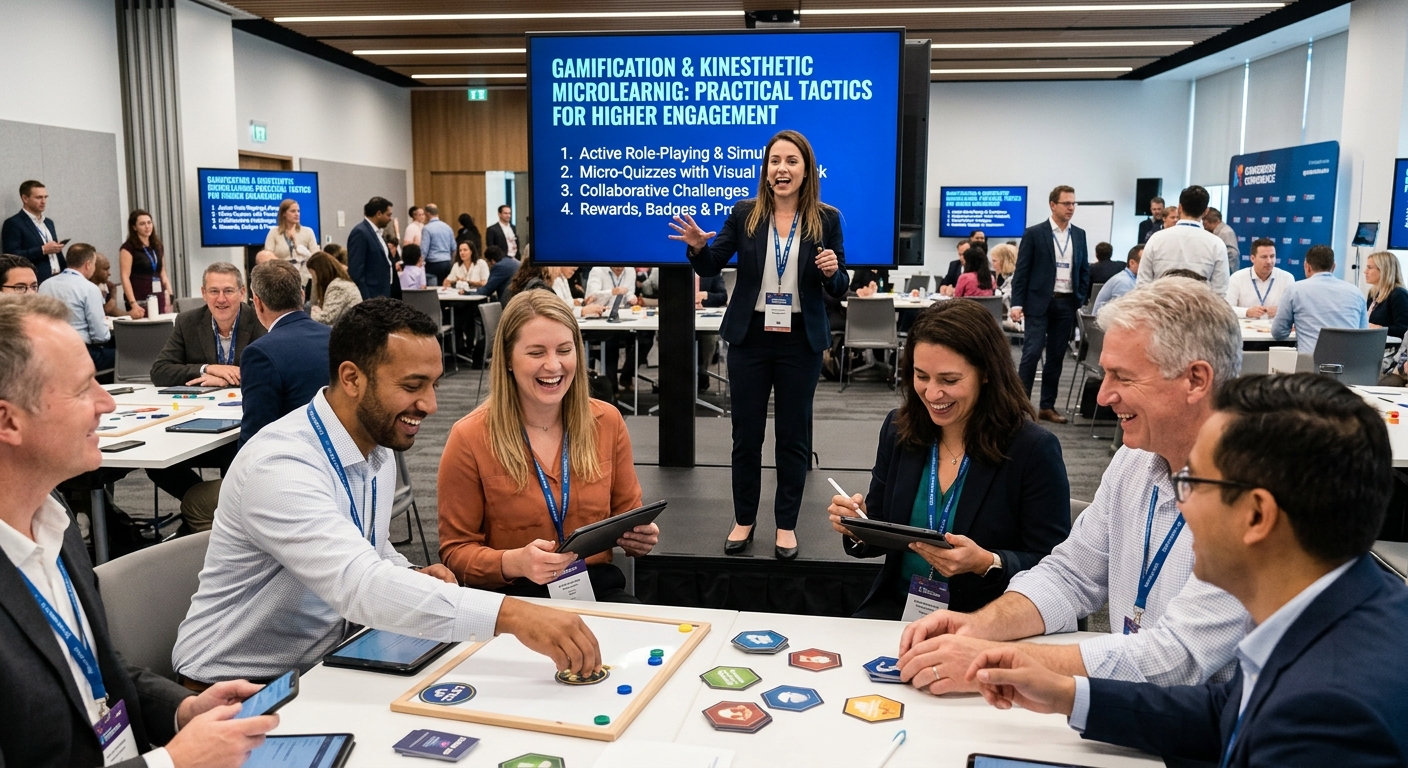
Gamification and Kinesthetic Microlearning: Practical Tactics for Higher Engagement
In today's fast-paced corporate environment, the efficacy of learning and development (L&D) initiatives hinges significantly on learner engagement. As L&D leaders, you are constantly seeking innovative strategies to break through the noise, combat dwindling attention spans, and ensure training translates into tangible skills and performance improvements. The twin pillars of gamification and kinesthetic microlearning offer a powerful, synergistic approach to achieving precisely that.
Traditional, lengthy training modules often struggle to captivate modern learners. The challenge is not just about delivering content, but about creating an immersive, memorable, and actionable learning experience. This article delves into how integrating gamification with kinesthetic microlearning can revolutionize your L&D programs, foster deeper understanding, and drive superior outcomes across diverse industries, from compliance and finance to healthcare and retail.
Why Engagement is the Linchpin of Effective L&D
Disengaged learners are costly. They lead to low completion rates, poor knowledge retention, and ultimately, a subpar return on your training investment. Conversely, highly engaged learners are more motivated, absorb information more effectively, and are quicker to apply new skills. This directly impacts productivity, compliance adherence, sales performance, and overall business growth. Strategies that actively involve learners, making them participants rather than passive recipients, are no longer a luxury but a necessity for any forward-thinking enterprise learning management strategy.
Understanding Gamification in L&D
What is Gamification?
Gamification is the strategic application of game-design elements and game principles in non-game contexts. In L&D, this means incorporating elements like points, badges, leaderboards, challenges, and storytelling into training programs to motivate learners, encourage participation, and make the learning process more enjoyable and competitive.
Benefits of Gamification
- Increased Motivation: Game mechanics tap into our innate desire for achievement and recognition.
- Enhanced Retention: The active nature of gamified learning aids memory recall.
- Immediate Feedback: Learners receive instant feedback on their performance, allowing for quick adjustments.
- Behavioral Change: Gamification can subtly guide learners towards desired behaviors and reinforce positive habits.
- Fun and Enjoyment: Transforms potentially dry subjects, like compliance or risk management, into engaging experiences.
Practical Gamification Tactics
- Points and Rewards: Award points for completing modules, achieving milestones, or demonstrating mastery. Redeem points for virtual rewards or real-world incentives.
- Badges and Certificates: Grant digital badges upon completion of specific skills or courses, providing a visual representation of achievement.
- Leaderboards: Foster healthy competition by displaying top performers, motivating others to improve their standing. This can be anonymized or team-based for sensitivity.
- Challenges and Quests: Structure learning paths as a series of challenges or quests, each unlocking new content or skills.
- Narrative and Storytelling: Embed learning within a compelling storyline, making the content more relatable and memorable. Imagine a "corporate detective" solving compliance puzzles.
Embracing Kinesthetic Microlearning
What is Kinesthetic Microlearning?
Kinesthetic learning emphasizes "learning by doing." When combined with microlearning – short, focused bursts of content – it creates highly effective, practical training experiences. Kinesthetic microlearning modules are designed to be interactive, requiring learners to physically or virtually manipulate elements, make decisions, and experience consequences in a controlled environment. This approach is particularly effective for practical skills, process training, and critical decision-making scenarios.
Benefits of Kinesthetic Microlearning
- Active Participation: Moves beyond passive listening or reading, requiring direct interaction.
- Improved Skill Application: Directly mimics real-world tasks, making skill transfer more seamless.
- Enhanced Problem-Solving: Learners develop critical thinking by experimenting and receiving immediate feedback.
- Flexibility and Accessibility: Short, digestible modules are perfect for on-the-go learning and busy schedules, accessible via a robust Microlearning LMS.
- Reduced Cognitive Load: Focuses on one concept at a time, preventing overwhelm.
Practical Kinesthetic Microlearning Tactics
- Interactive Simulations: Create realistic scenarios where learners can practice procedures, operate equipment (virtually), or handle customer interactions without real-world risk. Ideal for sales training, complex machinery operation in mining, or financial transaction processing.
- Role-Playing Exercises: Implement short, guided role-plays, perhaps with AI-driven chatbots or peer feedback, to practice communication skills, sales pitches, or difficult conversations.
- Drag-and-Drop Activities: For sequential processes or categorization tasks, like sorting compliance documents or organizing retail merchandise.
- Scenario-Based Quizzes: Present short case studies where learners must choose the correct action, with instant feedback explaining the consequences of their choices.
- Augmented Reality (AR) Experiences: For highly practical, hands-on training, AR can overlay digital information onto the real world, guiding learners through tasks or repairs in healthcare or oil and gas.
The Synergy: Gamification + Kinesthetic Microlearning
The true power emerges when these two approaches converge. Imagine a gamified simulation where learners earn points for correctly handling a critical customer service call (kinesthetic), competing on a leaderboard for the highest satisfaction scores (gamification). Or a compliance training module where learners navigate a virtual workplace, identifying risks and making ethical decisions (kinesthetic), earning badges for each successfully mitigated threat (gamification). This combined approach creates a highly immersive and sticky learning experience.
A Gamified LMS is often the central hub for such integrated strategies, providing the framework for delivering content, tracking progress, and managing rewards. Learning management solutions that combine these elements offer a superior experience.
Leveraging Technology: The Role of Intelligent Learning Platforms
Modern learning content management systems (LCMS) and enterprise learning management systems are indispensable in deploying sophisticated gamified and kinesthetic microlearning programs. These platforms provide the infrastructure to host diverse content, track learner progress, and deliver personalized experiences.
How can advanced analytics personalize learning journeys? By analyzing learner performance data, intelligent systems can identify knowledge gaps and recommend specific microlearning modules or gamified challenges, providing truly Adaptive Learning paths. This ensures each learner receives the most relevant and impactful training, optimizing their time and your resources.
Where can automated content creation streamline L&D workflows? An AI Powered Authoring Tool can significantly reduce the time and effort required to develop engaging kinesthetic microlearning scenarios and gamified elements. These tools can generate initial content drafts, suggest interactive elements, and even adapt existing materials into micro-modules, accelerating content deployment, especially for rapidly evolving subjects like regulatory compliance or new product launches.
What is the impact of predictive insights on training effectiveness? Intelligent platforms can predict potential areas of struggle for learners or identify training gaps across the organization before they become critical issues. For instance, in finance, predictive analytics might highlight a trend in incorrect transaction processing, prompting the deployment of targeted Risk-focused Training modules to proactively address the vulnerability. This proactive approach minimizes exposure and enhances operational resilience.
Choosing the right cloud based learning management system is paramount. A comprehensive learning management software like MaxLearn LMS provides the robust capabilities needed to implement these advanced strategies effectively, delivering powerful microlearning experiences.
Practical Implementation Strategies for L&D Leaders
As L&D Vice Presidents, Directors, and Managers, your role is to spearhead this transformation. Here’s how to begin:
- Start Small, Think Big: Pilot gamified kinesthetic microlearning in one department or for a specific, high-impact training need, such as onboarding or a critical compliance update.
- Define Clear Learning Objectives: Ensure every game mechanic or interactive element directly contributes to a measurable learning outcome.
- Contextualize Everything: Make the training relevant to the learner's job role and industry. A retail associate needs different scenarios than a pharmaceutical sales representative.
- Gather Feedback Iteratively: Continuously collect data and learner feedback to refine and improve your programs.
- Invest in the Right Technology: Select an Microlearning LMS that supports both gamification and kinesthetic content creation and delivery. An effective learning management system should be adaptable and scalable.
Conclusion
The future of L&D is active, engaging, and personalized. By strategically combining gamification with kinesthetic microlearning, L&D leaders can move beyond passive instruction to create dynamic, results-driven training experiences. This approach not only boosts engagement and retention but also equips your workforce with practical skills that directly contribute to organizational success, resilience, and growth. Embrace these powerful tactics, leverage advanced learning management solutions, and transform your learning landscape into a vibrant ecosystem of continuous development.


