

How to Identify Your Team’s Predominant Intelligences and Map Lessons Accordingly
In today's dynamic business landscape, the effectiveness of your Learning & Development (L&D) programs is a critical determinant of organizational success. For Vice Presidents, Directors, and Senior Managers in L&D across industries like Compliance, Sales, Banking, Finance, Insurance, Retail, Pharma, Healthcare, Hospitality, Oil and Gas, and Mining, the challenge often lies in moving beyond a one-size-fits-all training approach. Your team members are unique, each possessing distinct cognitive strengths and preferred learning styles. Recognizing and leveraging these individual differences, specifically their predominant intelligences, is not just beneficial; it’s transformative. By mapping your lessons to these inherent strengths, you unlock deeper engagement, higher retention, and measurable performance improvements.
Understanding the Spectrum of Intelligences
The concept of multiple intelligences, famously proposed by Dr. Howard Gardner, challenges the traditional view of a single, monolithic intelligence. Instead, it suggests that human intelligence is a mosaic of different, independent capacities. While many models exist, Gardner’s framework provides a practical lens through which L&D professionals can assess and design learning experiences. These include:
- Linguistic Intelligence: The ability to think in words and to use language to express and appreciate complex meanings. Ideal learners thrive with reading, writing, storytelling, and discussions.
- Logical-Mathematical Intelligence: The capacity to carry out mathematical operations and to reason logically, detect patterns, and analyze problems systematically. These individuals excel with data, puzzles, and scientific thinking.
- Spatial Intelligence: The ability to think in three dimensions and visualize the world accurately. Visual learners, artists, and those who excel with maps, charts, and diagrams often possess high spatial intelligence.
- Bodily-Kinesthetic Intelligence: The capacity to manipulate objects and use a variety of physical skills. Hands-on learners, those who enjoy role-playing, and practical application-based training resonate with this intelligence.
- Musical Intelligence: The capacity to discern, transform, and express musical forms. While less direct in corporate training, it relates to rhythm, patterns, and auditory learning.
- Interpersonal Intelligence: The ability to understand and interact effectively with others. Collaborative projects, team-based learning, and coaching appeal strongly to these individuals.
- Intrapersonal Intelligence: The capacity to understand oneself—one's feelings, motivations, and goals. Reflective learning, self-paced modules, and personalized feedback are effective here.
- Naturalistic Intelligence: The ability to recognize and categorize elements of the natural world. In a business context, this translates to understanding systems, patterns in data, and real-world applications.
For L&D, the value isn't in rigid categorization, but in understanding that diverse strengths require diverse learning approaches.
Why Identifying Intelligences Matters for L&D Success
Moving beyond generic training programs to those tailored to specific intelligences offers profound benefits:
- Enhanced Engagement and Retention: When content aligns with how an individual naturally learns, they are more likely to stay engaged, understand the material deeply, and retain information for longer.
- Improved Performance and Productivity: Well-designed training directly translates to better job performance, whether it's understanding complex financial regulations in Banking, mastering sales techniques in Retail, or adhering to safety protocols in Oil and Gas.
- Increased ROI on Training: Reducing the need for repetitive training and achieving better outcomes from the initial investment significantly boosts the return on your L&D budget.
- Boosted Morale and Motivation: Employees feel valued and empowered when their unique strengths are recognized and leveraged in their professional development.
- Relevance Across Industries: From Risk-focused Training in Compliance and Finance to critical skill development in Healthcare and Pharma, tailoring lessons ensures precision and impact.
Methods to Identify Your Team's Dominant Intelligences
Uncovering the predominant intelligences within your team requires a multi-faceted approach. It's about careful observation, thoughtful assessment, and leveraging data:
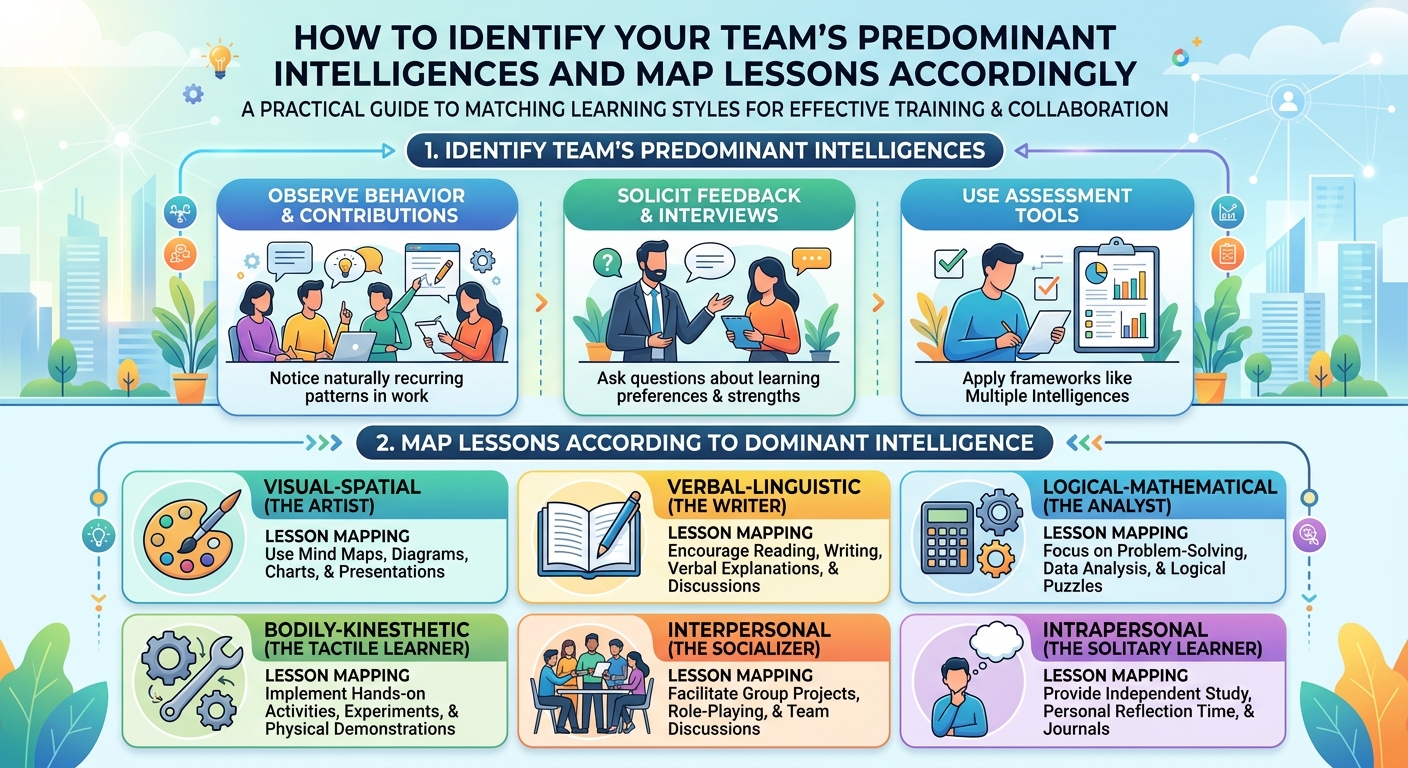
- Observation in Action: Pay attention to how team members solve problems, communicate, and collaborate during daily tasks, projects, and meetings. Does someone always volunteer to present (linguistic/interpersonal)? Do others prefer to build prototypes or models (spatial/bodily-kinesthetic)?
- Surveys and Self-Assessments: Deploy questionnaires designed to gauge learning preferences and cognitive strengths. These can be simple self-reporting tools or more structured assessments.
- Performance Reviews and Feedback: Analyze past performance reviews and peer feedback for recurring patterns. How do individuals naturally excel? What kind of tasks do they gravitate towards and perform best?
- Informal Conversations and Interviews: Engage team members in casual discussions about how they best learn, what challenges them, and what types of content they find most compelling.
- Team Activities and Workshops: Design team-building exercises or problem-solving workshops that inherently require different intelligences to shine, offering insights into individual strengths.
Question: How can technology assist in gathering individual learning preferences and cognitive strengths?
Answer: Modern LMS platforms and specialized assessment tools leverage artificial intelligence and advanced analytics to gather and interpret data from quizzes, interactive modules, and behavioral patterns. This allows L&D leaders to create detailed profiles of each learner's preferred intelligence types, offering insights at both the individual and team level. A robust learning management software can track engagement with different content formats, providing objective data on what resonates most with whom.
Mapping Lessons According to Identified Intelligences
Once you have a clearer picture of your team's predominant intelligences, the next step is to strategically map your learning content. This ensures maximum relevance and impact:
- For Linguistic Learners: Focus on storytelling, detailed case studies, expert-led webinars, written assignments, and vibrant discussions. Utilize a Microlearning LMS that allows for quick access to articles, blogs, and concise summaries.
- For Logical-Mathematical Learners: Emphasize problem-solving scenarios, data analysis exercises, simulations, strategic games, and logic puzzles. A Gamified LMS can be highly effective here, providing clear rules, measurable outcomes, and challenging objectives.
- For Spatial Learners: Incorporate rich visual content like infographics, detailed diagrams, videos, interactive 3D models, and virtual reality (VR) simulations. These learners benefit from seeing concepts unfold visually.
- For Bodily-Kinesthetic Learners: Design hands-on activities, role-playing scenarios (especially vital in Sales and Hospitality training), practical exercises, and interactive simulations. An AI Powered Authoring Tool can help create dynamic, scenario-based learning modules rapidly.
- For Interpersonal Learners: Foster collaborative projects, group discussions, peer coaching, mentorship programs, and team-based problem-solving. A cloud based learning management system facilitates easy group formation and communication.
- For Intrapersonal Learners: Provide opportunities for self-reflection, personalized learning paths, individual projects, and access to self-paced modules. Adaptive Learning technologies are particularly powerful for these individuals, adjusting content difficulty and pace based on individual progress.
- For Naturalistic Learners: Frame learning within real-world contexts, use case studies that reflect environmental or systemic patterns, and encourage fieldwork or practical application in their immediate work environment.
Question: What digital tools are most effective for training teams with a high visual-spatial intelligence?
Answer: For individuals with strong visual-spatial intelligence, digital tools such as virtual reality (VR) and augmented reality (AR) offer immersive, experiential learning. Interactive simulations, 3D modeling software, and advanced infographic design tools are also highly effective, allowing these learners to visualize complex processes, systems, or products in a detailed and engaging manner, which is crucial in industries like Pharma or Oil and Gas for understanding complex machinery or procedures.
Implementing an Intelligent Learning Strategy with Technology
Adopting an intelligence-based learning strategy is significantly enhanced by modern eLearning technology. A robust learning management system (LMS) acts as the backbone, providing the tools to deliver, track, and manage diverse content formats. An enterprise learning management solution, such as a MaxLearn LMS, offers the scalability and features needed to support this nuanced approach across large organizations.
By utilizing a comprehensive LCMS (Learning Content Management System), you can not only store a wide array of content types – from interactive videos to detailed compliance documents – but also tag and organize them for specific learning profiles. This capability allows L&D teams to easily curate personalized learning paths, ensuring that a sales team member with high interpersonal intelligence receives more role-playing scenarios, while a finance analyst strong in logical-mathematical intelligence gets more data-driven case studies.
A sophisticated learning management solution offers features like personalized dashboards, progress tracking, and detailed analytics. This data provides invaluable insights into which learning methods are most effective for different intelligence profiles, allowing for continuous refinement of your strategy. This is especially crucial for compliance training, where understanding and retention are paramount for mitigating Risk-focused Training effectively.
Question: Can artificial intelligence help in dynamically adapting learning content based on an individual's intelligence profile?
Answer: Absolutely. Advanced AI algorithms within an lms learning management system can analyze learner interactions, performance data, and even inferred intelligence profiles to dynamically recommend or adjust content. For instance, if a learner struggles with a text-heavy module but excels in simulations, the AI can automatically suggest more visual or interactive alternatives, ensuring a truly personalized and effective learning journey, regardless of where the learner is located or their specific role within the organization. This capability pushes the boundaries of personalized education, ensuring that the right content reaches the right learner in the most impactful format.
Conclusion
Identifying your team’s predominant intelligences and strategically mapping your lessons accordingly is no longer a luxury but a strategic imperative for modern L&D leaders. It moves your organization from generic training to precision learning, fostering a culture of continuous growth and peak performance. By embracing this nuanced approach, supported by powerful tools like a MaxLearn LMS, you can create highly engaged teams, drive significant business outcomes across all industries, and elevate your L&D function to a true strategic partner. It's time to unlock the full potential of your workforce by tailoring the learning experience to their unique cognitive blueprints.


