

Flashcards, Infographics, and Drills: Building a 4-Tier Learning Reinforcement System
In today's fast-paced corporate environment, where knowledge acquisition is paramount and forgetting is a costly luxury, Learning & Development (L&D) leaders face a persistent challenge: ensuring that critical training translates into lasting competence. From navigating complex compliance landscapes in finance and healthcare to mastering intricate sales methodologies or operational procedures in oil and gas, mere content delivery is no longer sufficient. The notorious "Forgetting Curve" looms large, threatening to erode up to 70% of new information within days if not actively reinforced.
This article unveils a powerful, professional, and practical 4-Tier Learning Reinforcement System, designed to combat information decay and embed essential knowledge deep within your workforce. By strategically integrating flashcards, infographics, and interactive drills, L&D VPs, Directors, and Senior Managers can cultivate a culture of continuous learning and achieve unparalleled training ROI across all industries, from retail to pharma and hospitality.
Understanding the Forgetting Curve: Why Reinforcement is Non-Negotiable
The work of Hermann Ebbinghaus in the late 19th century highlighted a fundamental truth about human memory: without active recall and reinforcement, newly learned information rapidly fades. For your organization, this means that significant investments in training—be it for new product launches, regulatory updates, or safety protocols—can yield diminishing returns if a robust reinforcement strategy isn't in place. A comprehensive Microlearning LMS understands this challenge, providing tools to counter this natural memory decay.
Effective reinforcement isn't about repeating the same content; it's about employing varied, targeted, and spaced interventions that consolidate learning and promote retrieval practice. Our 4-tier system offers just that.
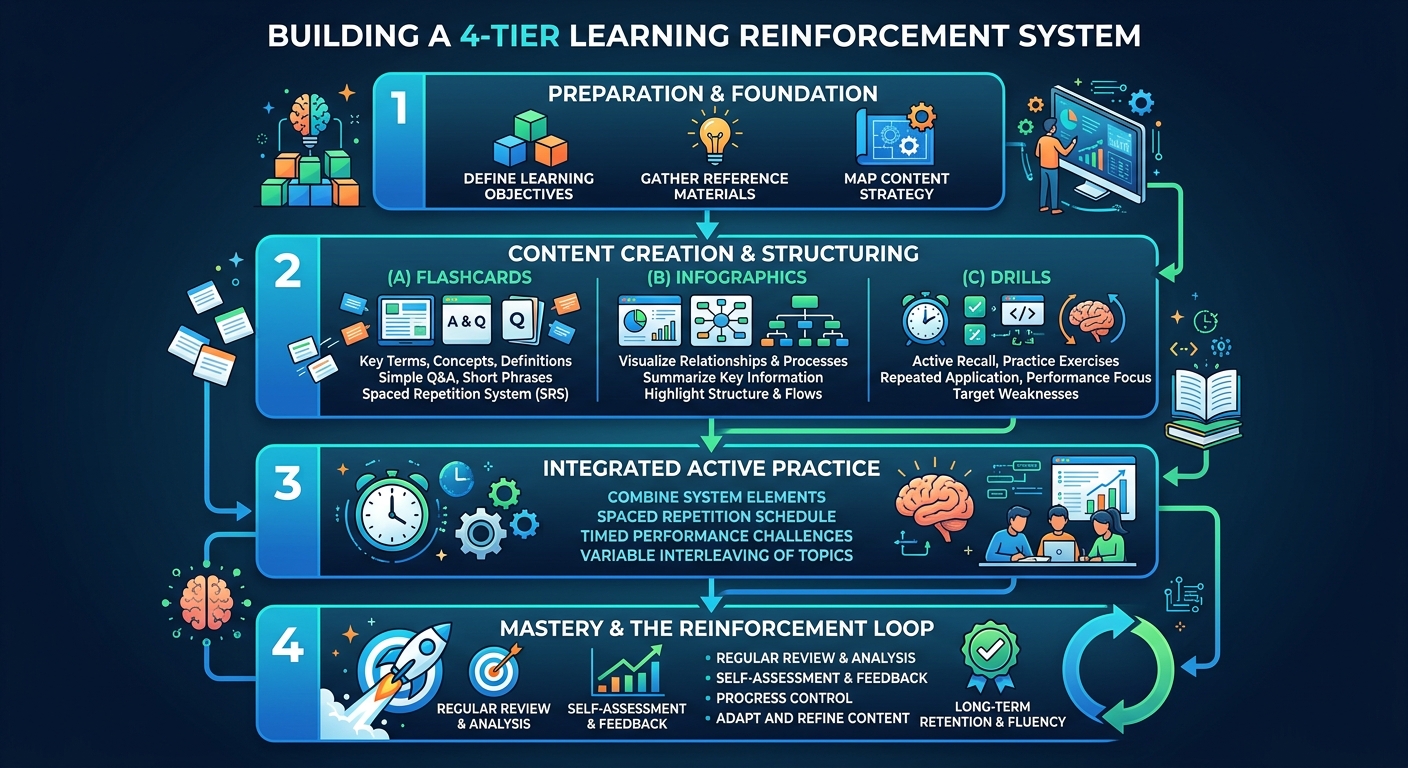
Tier 1: Foundational Learning - The "Why" and "What"
The initial tier focuses on the core concepts, definitions, and foundational knowledge. This is where learners encounter the 'why' behind the training and the fundamental 'what' they need to know. Flashcards, often underestimated in their simplicity, are incredibly effective here. They promote active recall, breaking down complex information into digestible, memorable chunks. Ideal for:
- Key terminology and definitions (e.g., banking regulations, medical terms, compliance jargon)
- Core principles and policies
- Step-by-step procedures (e.g., initial sales call scripts, basic machine operation)
Applying Flashcards for Maximum Impact
Flashcards excel at reinforcing short, precise pieces of information. When integrated into a modern learning content management system, they can be dynamic, multimedia-rich, and tailored to individual learning styles.
Organizations often inquire about how technology can personalize the flashcard experience for diverse employee needs. Advanced algorithms, for example, can analyze individual learning patterns, adjusting the frequency and difficulty of flashcard presentation to optimize recall for each learner. This ensures content mastery at a personal pace, whether in insurance underwriting or mining safety.
Tier 2: Visual Consolidation - The "How"
Once foundational knowledge is established, the second tier moves to contextualizing and visualizing more complex processes and relationships. Infographics are the ideal tool for this stage. They transform dense data, intricate workflows, and abstract concepts into visually engaging and easily digestible formats.
- Process flows (e.g., customer onboarding in retail, claims processing in insurance)
- Hierarchical structures (e.g., organizational charts, product families)
- Data visualizations (e.g., market trends in finance, incident rates in oil and gas)
Leveraging Infographics for Deeper Understanding
Infographics enhance comprehension and long-term retention by engaging both visual and cognitive pathways. They make complex information less intimidating and more accessible, crucial for industries like healthcare or pharmaceuticals where information density is high. A robust Adaptive Learning platform can even present these visuals at the optimal moment in a learner's journey.
A common question is what role modern technology plays in generating engaging infographics tailored to specific industry regulations. Intelligent systems can process vast amounts of compliance data to automatically generate visually appealing infographics, simplifying complex rules and procedures relevant to sectors like banking or healthcare, ensuring clear understanding across distributed teams.
Tier 3: Active Application - The "Do"
This tier is where learners actively apply what they've learned through various forms of drills. Moving beyond passive consumption, this stage fosters practical skill development and reinforces knowledge through immediate feedback. Drills can take many forms:
- Quizzes and Assessments: Testing recall and comprehension.
- Simulations: Replicating real-world scenarios (e.g., customer service interactions, machine diagnostics).
- Scenario-Based Training: Presenting dilemmas and requiring decision-making (e.g., ethical conduct in finance, safety incident response in mining).
Designing Effective Drills
Effective drills bridge the gap between knowing and doing. They allow learners to make mistakes in a safe environment and learn from them. The feedback loop is critical here; a sophisticated Gamified LMS can provide instant, constructive feedback, guiding the learner towards mastery. This active practice is vital for building confidence and competence in critical areas like Risk-focused Training.
Leaders frequently ask how intelligent analytics from drills can identify critical skill gaps across a global workforce. By tracking performance data from interactive drills, analytics engines can pinpoint common areas of difficulty, not just within a single team but across various regional offices or international divisions, enabling targeted intervention and localized training adjustments for improved global competency in retail or hospitality.
Tier 4: Strategic Reinforcement - The "Sustain"
The final tier ensures long-term retention and continuous mastery. This involves strategically spaced repetitions of flashcards, revisiting infographics, and periodic drills, all orchestrated to combat the forgetting curve over time. This continuous engagement is critical for high-stakes industries like compliance, health care, and pharma.
Building a Continuous Reinforcement Loop
- Spaced Repetition: Re-presenting information at increasing intervals based on a learner's performance.
- Microlearning Modules: Delivering bite-sized content updates and refreshers.
- Personalized Learning Paths: Adapting content delivery based on individual progress and identified gaps, often powered by an AI Powered Authoring Tool.
This tiered approach doesn't just deliver training; it cultivates sustainable expertise. The entire system is most effective when managed by an efficient enterprise learning management solution. Modern learning management software, or LMS, provides the infrastructure to deploy, manage, and track this multi-faceted reinforcement strategy. A robust lms learning management system becomes the backbone for your entire learning content management system, ensuring seamless delivery and analytics.
What's the best way to leverage modern tech for training effectiveness when implementing a multi-tiered reinforcement system across diverse industries? An integrated cloud based learning management system acts as a central hub, enabling dynamic content delivery, real-time progress tracking, and personalized adaptive pathways for learners globally, ensuring that every employee, from sales to oil and gas operations, benefits from an optimized learning experience. MaxLearn LMS provides such capabilities.
The Benefits for L&D Leaders
Implementing this 4-tier reinforcement system with a powerful LMS brings tangible benefits to L&D leadership:
- Higher Retention Rates: Dramatically reduces knowledge decay, ensuring critical information sticks.
- Improved Performance: Translates learned knowledge into applied skills, enhancing on-the-job effectiveness.
- Demonstrable ROI: Provides clear metrics on learning efficacy, justifying training investments.
- Enhanced Compliance & Reduced Risk: Crucial for sectors like banking and finance, this system ensures consistent understanding of regulations, mitigating potential liabilities.
- Scalability & Consistency: Delivers consistent, high-quality training reinforcement across diverse departments and global workforces, be it in pharma, retail, or mining.
Conclusion
The journey from initial training to sustained expertise is often fraught with challenges, but with a well-structured 4-tier learning reinforcement system, L&D leaders can transform their approach. By strategically leveraging flashcards for foundational knowledge, infographics for visual consolidation, and drills for active application, all within a continuous, adaptive framework powered by a cutting-edge learning management solutions platform, your organization can foster a truly knowledgeable, competent, and resilient workforce. Embrace this strategic framework to elevate your training impact and secure lasting success across every segment of your enterprise.


