

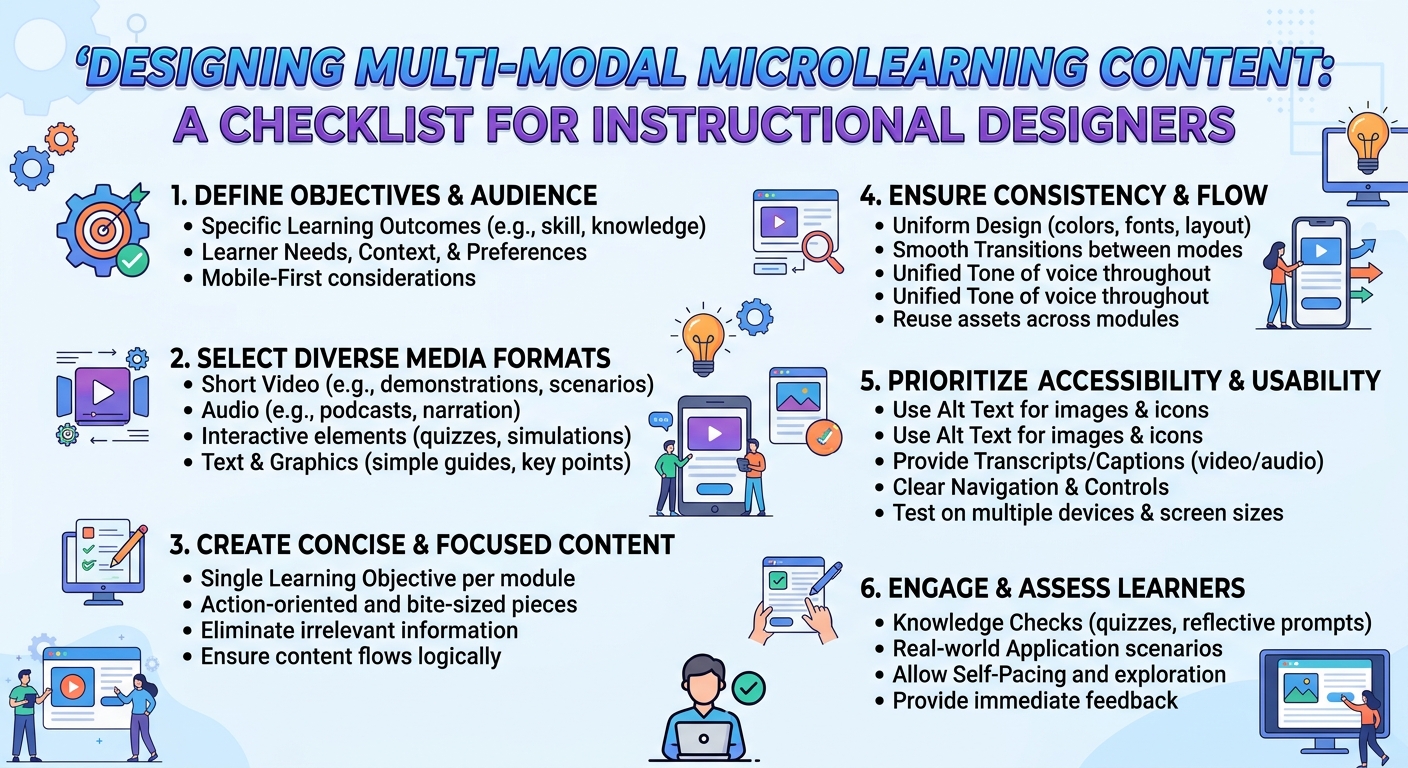
Designing Multi-Modal Microlearning Content: A Checklist for Instructional Designers
In today's dynamic corporate landscape, where information overload is a constant and attention spans are shrinking, effective learning and development strategies are paramount. For Vice Presidents, Directors, and Senior Managers in L&D, the challenge is to deliver impactful training that resonates across diverse industries—from compliance and banking to healthcare and retail. This is where multi-modal microlearning shines, offering a flexible, engaging, and highly effective approach. But how do you design it right? This article provides a comprehensive checklist to guide instructional designers in creating stellar multi-modal microlearning content.
The imperative for continuous learning has never been stronger. Whether it's ensuring compliance in finance, upskilling sales teams, or mastering new protocols in pharma, a robust learning management system that supports agile content delivery is crucial. Multi-modal microlearning, by its very nature, breaks down complex topics into bite-sized, digestible formats delivered through various media, catering to different learning preferences and optimizing knowledge retention.
Why Multi-Modal Microlearning is Indispensable for Modern L&D
Consider the varying demands of different sectors. A financial institution might require Risk-focused Training delivered through interactive simulations, while a retail giant might prefer short video tutorials for new product launches. Multi-modal microlearning accommodates these needs by leveraging text, video, audio, infographics, quizzes, and even VR/AR snippets to create a rich, immersive, and effective learning experience. It's not just about delivering content; it's about delivering the right content, in the right format, at the right time.
A well-implemented Microlearning LMS can transform how organizations approach training. It enhances engagement, boosts recall, and provides just-in-time support, leading to tangible improvements in performance and productivity. For leaders seeking a powerful learning management software, understanding the design principles behind its content is key.
The Instructional Designer's Checklist for Multi-Modal Microlearning
Phase 1: Foundation and Strategy
- Define Clear Learning Objectives: What specific, measurable outcomes do you want learners to achieve? Each micro-module should address a single, focused objective. This is critical for everything from compliance to sales training.
- Understand Your Audience Deeply: Who are your learners? What are their roles (e.g., banking tellers, healthcare professionals, oil rig operators)? What are their existing knowledge levels, preferred learning styles, and technological access? This informs modality choices and content complexity.
- Chunk Content Effectively: Break down larger topics into small, independent learning units, typically 3-7 minutes in duration. Each unit should be self-contained but contribute to a larger learning goal.
- Select Appropriate Modalities:
- Text: Quick facts, summaries, policy snippets (e.g., for legal or finance compliance).
- Video: Demonstrations, interviews, role-plays (e.g., sales techniques, hospitality procedures).
- Audio/Podcasts: Expert insights, scenario narrations (e.g., soft skills, field insights for mining).
- Infographics/Images: Data visualization, process flows (e.g., healthcare protocols, technical diagrams).
- Interactive Quizzes/Simulations: Application of knowledge, decision-making practice (e.g., safety in oil and gas, customer service in retail).
Phase 2: Design and Development
- Prioritize Visual Consistency and UX: Ensure a cohesive brand identity and intuitive user experience across all modalities. Use clear fonts, consistent color palettes, and logical navigation.
- Craft Engaging Narratives: Storytelling can significantly enhance engagement, especially in multi-modal content. Frame content within relevant real-world scenarios for industries like insurance or hospitality.
- Ensure High-Quality Audio and Video: Poor production quality undermines credibility. Invest in clear audio, professional narration, and high-resolution visuals.
- Incorporate Interactivity: Beyond simple quizzes, integrate drag-and-drop activities, clickable scenarios, branching paths, and mini-games to boost engagement. A Gamified LMS can significantly enhance this aspect.
- Design for Accessibility: Include captions for videos, transcripts for audio, and ensure content is navigable for users with disabilities. This is non-negotiable for enterprise learning management.
- Provide Immediate Feedback: For assessments, ensure instant and constructive feedback to reinforce learning and correct misconceptions.
Phase 3: Technology and Implementation
- Leverage a Robust Learning Content Management System (LCMS): An effective LCMS is vital for authoring, managing, and deploying diverse content types. Look for a cloud based learning management system that offers flexibility and scalability.
- Ensure Platform Compatibility: Confirm that your multi-modal content renders seamlessly across various devices and browsers, integrating smoothly with your chosen lms learning management system.
- Implement Tracking and Analytics: Utilize the analytics capabilities of your learning management solutions to monitor learner progress, engagement, and completion rates. This data is invaluable for iterative improvement.
- Plan for Scalability and Updates: Content needs to be easily updatable and scalable across the organization, especially in fast-changing sectors like pharma or tech.
Elevating Multi-Modal Microlearning with Artificial Intelligence
The synergy between multi-modal microlearning and AI offers unprecedented opportunities for L&D leaders. Let's explore some key considerations:
How can we ensure our microlearning content surfaces relevant information quickly for learners?
AI-driven search capabilities within an advanced LMS can revolutionize how learners find specific knowledge snippets. By analyzing past searches, content consumption patterns, and learner profiles, AI algorithms can present the most relevant text, video, or infographic modules instantaneously. This not only boosts efficiency but also personalizes the learning journey, making it a powerful tool for sectors requiring rapid access to information, such as emergency protocols in healthcare or compliance updates in finance.
What challenges arise when deploying multi-modal microlearning across diverse geographical locations and cultures?
Global teams, common in industries like oil and gas or multi-national retail, require culturally sensitive and linguistically accurate content. AI can significantly streamline this process. It can offer rapid translation services for text and voiceovers for audio/video content, ensuring localization without extensive manual effort. Furthermore, AI tools can help instructional designers identify and adapt content to resonate with specific cultural nuances, improving engagement and understanding for a truly global audience.
Beyond basic personalization, how can artificial intelligence truly elevate the learning experience?
AI moves beyond simple recommendations to truly transform learning. An AI Powered Authoring Tool can assist instructional designers in generating initial content drafts, suggesting optimal modalities based on learning objectives, and even analyzing content for clarity and engagement. Moreover, AI can drive Adaptive Learning paths, dynamically adjusting the sequence and difficulty of micro-modules based on a learner's performance and learning style. Imagine an AI tutor providing personalized feedback or tailoring future content to address specific skill gaps, a game-changer for complex roles in banking or mining where precise skill development is paramount. An advanced platform like MaxLearn LMS is at the forefront of integrating these intelligent capabilities.
Conclusion
Designing effective multi-modal microlearning content is a strategic endeavor that requires meticulous planning, creative execution, and the right technological infrastructure. By following this comprehensive checklist, instructional designers can craft engaging, impactful, and memorable learning experiences that drive real business outcomes across all industries—from compliance to hospitality. Investing in a cutting-edge LMS that supports diverse modalities, offers advanced analytics, and leverages AI is no longer a luxury but a necessity for L&D leaders aiming to stay ahead in the competitive corporate landscape. Embrace multi-modal microlearning to empower your workforce and build a culture of continuous, effective learning.


