

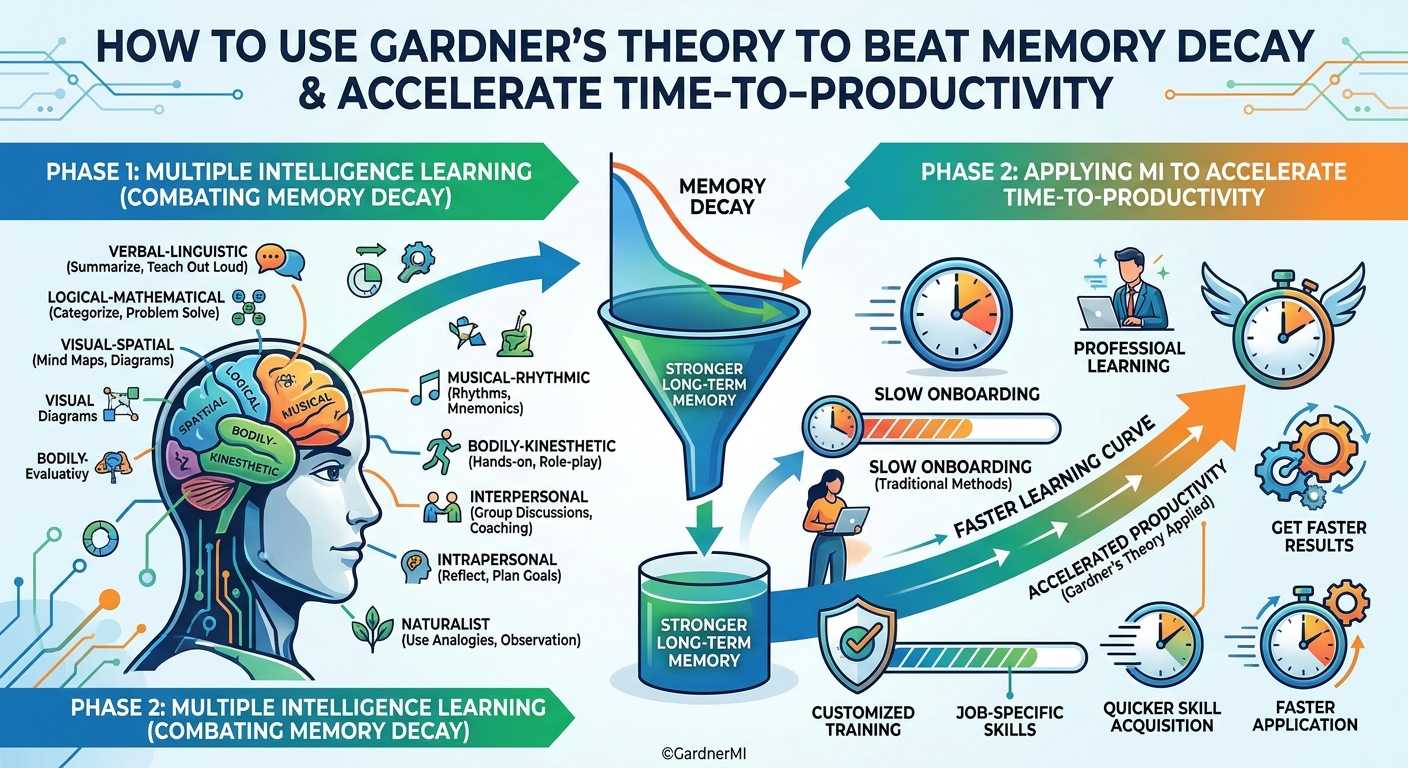
How to Use Gardner’s Theory to Beat Memory Decay and Accelerate Time-to-Productivity
In the fast-paced corporate world, where continuous learning is not just an advantage but a necessity, L&D leaders face a constant battle against two formidable foes: memory decay and sluggish time-to-productivity. Employees forget up to 70% of new information within 24 hours if not reinforced, leading to wasted training investments and delayed skill application. Imagine a learning strategy that not only counters this inherent human challenge but also drastically shrinks the time it takes for new knowledge to translate into tangible productivity gains. This is where Dr. Howard Gardner’s groundbreaking Theory of Multiple Intelligences offers a powerful, often underutilized, framework for revolutionizing corporate learning.
For Vice Presidents, Directors, and Senior Managers in L&D across diverse sectors like Banking, Pharma, Retail, or Oil and Gas, understanding and applying Gardner's insights can transform how your organization approaches skill development, compliance training, and performance improvement. By moving beyond a one-size-fits-all approach, you can craft more engaging, effective, and sticky learning experiences that resonate with the unique cognitive strengths of every individual.
Understanding Gardner’s Theory of Multiple Intelligences
Traditional education often prioritizes linguistic and logical-mathematical abilities. However, Gardner proposed that human intelligence is far more multifaceted. He identified several distinct intelligences, suggesting that individuals possess a unique blend and varying strengths across these domains. By designing training that appeals to these diverse intelligences, we can significantly enhance knowledge retention and accelerate the application of learned skills.
The core intelligences include:
- Linguistic Intelligence: The ability to think in words and to use language to express and appreciate complex meanings. Think writers, poets, lawyers, and speakers.
- Logical-Mathematical Intelligence: The ability to carry out mathematical operations and to analyze problems logically. Scientists, engineers, and accountants often exhibit this.
- Spatial Intelligence: The ability to think in three dimensions. Capacity to perceive the external and internal imagery, to recreate, transform, or modify images, to navigate oneself and objects through space. Architects, artists, and navigators.
- Bodily-Kinesthetic Intelligence: The capacity to manipulate objects and use a variety of physical skills. Dancers, athletes, surgeons, and craftspeople.
- Musical Intelligence: The capacity to discern pitch, rhythm, timbre, and tone. Composers, musicians, and sensitive listeners.
- Interpersonal Intelligence: The ability to understand and interact effectively with others. Salespeople, teachers, and leaders.
- Intrapersonal Intelligence: The capacity to understand oneself—one's feelings, motivations, and desires. Psychologists, theologians, and entrepreneurs.
- Naturalistic Intelligence: The ability to recognize and categorize plants, animals, and other objects in nature. Biologists, naturalists, and farmers.
The Challenge: Memory Decay and Productivity Gaps
In industries like Finance, Healthcare, or Compliance, where accuracy and adherence to protocols are paramount, memory decay poses significant risks. A forgotten procedure in a banking transaction or a misremembered safety protocol in Oil and Gas can lead to financial losses, regulatory non-compliance, or even catastrophic incidents. Traditional learning methods—long lectures, dense manuals, or generic e-learning modules—often fail because they primarily cater to only one or two intelligences, leaving the majority of learners disengaged and information vulnerable to rapid decay.
The result is a frustratingly slow time-to-productivity. Employees take longer to master new tools, adapt to evolving regulations, or confidently apply new sales techniques. This translates directly to increased operational costs, decreased efficiency, and a competitive disadvantage. An effective learning management software should address these challenges head-on.
Leveraging Multiple Intelligences for Enhanced Learning
By consciously integrating Gardner's framework into your learning content management system design, you can create a robust defense against memory decay and dramatically accelerate skill acquisition:
Linguistic Intelligence: Crafting Compelling Narratives
For employees strong in linguistic intelligence, learning thrives through clear, concise written materials, engaging storytelling, case studies, and interactive discussions. In sales training, this could involve role-playing scenarios with detailed scripts and feedback on communication style. For compliance, it means breaking down complex legal jargon into understandable narratives and real-world impact stories. Consider leveraging an Microlearning LMS that delivers digestible, narrative-driven content snippets.
Logical-Mathematical Intelligence: Structured Problem-Solving
These learners excel with data, logic, and problem-solving. Training should incorporate analytics, decision-making frameworks, flowcharts, simulations, and quantitative analysis. In banking, this might involve interactive modules on financial modeling or risk assessment with immediate feedback on calculations. For pharma, it could be understanding drug interaction probabilities or statistical trial results. Adaptive Learning platforms can tailor challenges based on their progress and analytical performance.
Spatial Intelligence: Visualizing Concepts and Processes
Visual learners benefit from infographics, diagrams, mind maps, virtual reality (VR) simulations, and interactive 3D models. This is particularly powerful for industries like Oil and Gas (visualizing complex machinery) or Healthcare (understanding anatomical structures or surgical procedures). Even in retail, visualizing store layouts for optimal product placement or customer flow can be highly effective. A robust enterprise learning management system should support rich multimedia content.
Bodily-Kinesthetic Intelligence: Learning by Doing
Practical, hands-on experiences are crucial. This includes simulations, interactive labs, role-playing, virtual reality training for equipment operation (e.g., in mining), or procedural walkthroughs. For sales training, interactive pitches and objection handling exercises are key. In healthcare, simulated patient encounters can build confidence and competence. A Gamified LMS can transform routine tasks into engaging, kinesthetic challenges with immediate feedback.
Interpersonal Intelligence: Collaborative Learning
These individuals learn best through group activities, peer coaching, mentorship programs, and collaborative projects. In any industry, fostering team-based problem-solving or cross-departmental projects can be invaluable. For insurance sales, this could be collaborative strategy sessions to tackle complex client needs. Leveraging social learning features within your learning management software can connect learners and facilitate knowledge sharing.
Intrapersonal Intelligence: Reflective and Self-Directed Learning
Learners with strong intrapersonal intelligence thrive with opportunities for self-reflection, journaling, goal setting, and personalized learning paths. Providing access to a rich library of resources and allowing them to choose how and when they engage with content empowers them. A flexible cloud based learning management system supports this autonomy, offering resources for deeper dives and reflective practice.
While musical and naturalistic intelligences might seem less directly applicable to corporate L&D, creative designers can still find ways to incorporate them, such as using specific background music to set the tone for learning environments or drawing analogies from natural systems to explain complex organizational structures.
Integrating Gardner into Modern eLearning Design
Modern eLearning solutions provide the perfect infrastructure to implement Gardner's theory at scale. An advanced Microlearning LMS can deliver diverse content types tailored to different intelligences, ensuring that learners receive information in their most receptive format. For instance, a compliance module on data privacy could include a narrative video (linguistic), a flowchart of data flow (logical-mathematical), an interactive scenario (bodily-kinesthetic), and a group discussion forum (interpersonal).
Furthermore, an Adaptive Learning system can dynamically adjust content and pathways based on a learner's identified strengths and areas for improvement, effectively personalizing the experience. This not only optimizes engagement but also ensures that critical information is reinforced through multiple modalities, severely limiting memory decay.
For developing engaging content that addresses unique risks in your sector, consider Risk-focused Training, which can be designed using various intelligence types. An AI Powered Authoring Tool can dramatically speed up the creation of diverse content formats, from interactive simulations to dynamic quizzes, making it feasible to cater to all intelligences without prohibitive development costs.
AI-Driven Personalization: The Future of Learning
The advent of artificial intelligence is supercharging our ability to leverage Gardner's theory. L&D leaders are increasingly asking:
"How can I ensure my compliance training reaches every employee effectively, regardless of their preferred learning style?"
AI-driven learning management solutions can analyze learner engagement patterns, completion rates, and assessment scores to infer preferred learning styles and dominant intelligences. This allows the system to automatically recommend or prioritize content formats – be it video, interactive simulations, text-based guides, or collaborative projects – that best suit each individual. This hyper-personalization ensures higher engagement and significantly improved knowledge retention in critical areas like regulatory compliance in finance or safety protocols in mining.
"What advanced platforms are available to automatically tailor content for my global sales team?"
Platforms equipped with advanced machine learning capabilities can dynamically adapt content based on a sales professional's past performance, regional market nuances, and even their current project requirements. If an individual struggles with objection handling, the system can automatically serve up more role-playing simulations and peer coaching opportunities (bodily-kinesthetic, interpersonal intelligence). If they excel in data analysis, they might receive modules focused on market trend interpretation (logical-mathematical intelligence). A modern learning management system with these features can be a game-changer for accelerating sales productivity across diverse territories.
"Are there tools that can automatically identify skill gaps and create personalized learning paths for enterprise employees?"
Yes, sophisticated learning management solutions now integrate AI to perform granular skill gap analyses based on job roles, performance reviews, and even project assignments. Once gaps are identified, the AI can construct personalized learning paths, drawing from a vast library of content. This content is then presented in formats optimized for the individual's dominant intelligences, ensuring efficient and effective upskilling. This capability is critical for sectors like healthcare, where continuous professional development is vital, and for managing large-scale talent development programs.
Conclusion
By consciously integrating Gardner’s Theory of Multiple Intelligences into your eLearning strategy, L&D leaders can move beyond generic training and create truly impactful learning experiences. This approach not only combats memory decay by engaging multiple cognitive pathways but also dramatically accelerates time-to-productivity by making learning more relevant, engaging, and personal. Leveraging powerful tools like an intelligent LMS with adaptive learning capabilities and AI-powered authoring transforms the learning landscape, ensuring your workforce is not just trained, but truly capable and consistently performing at their peak.


