

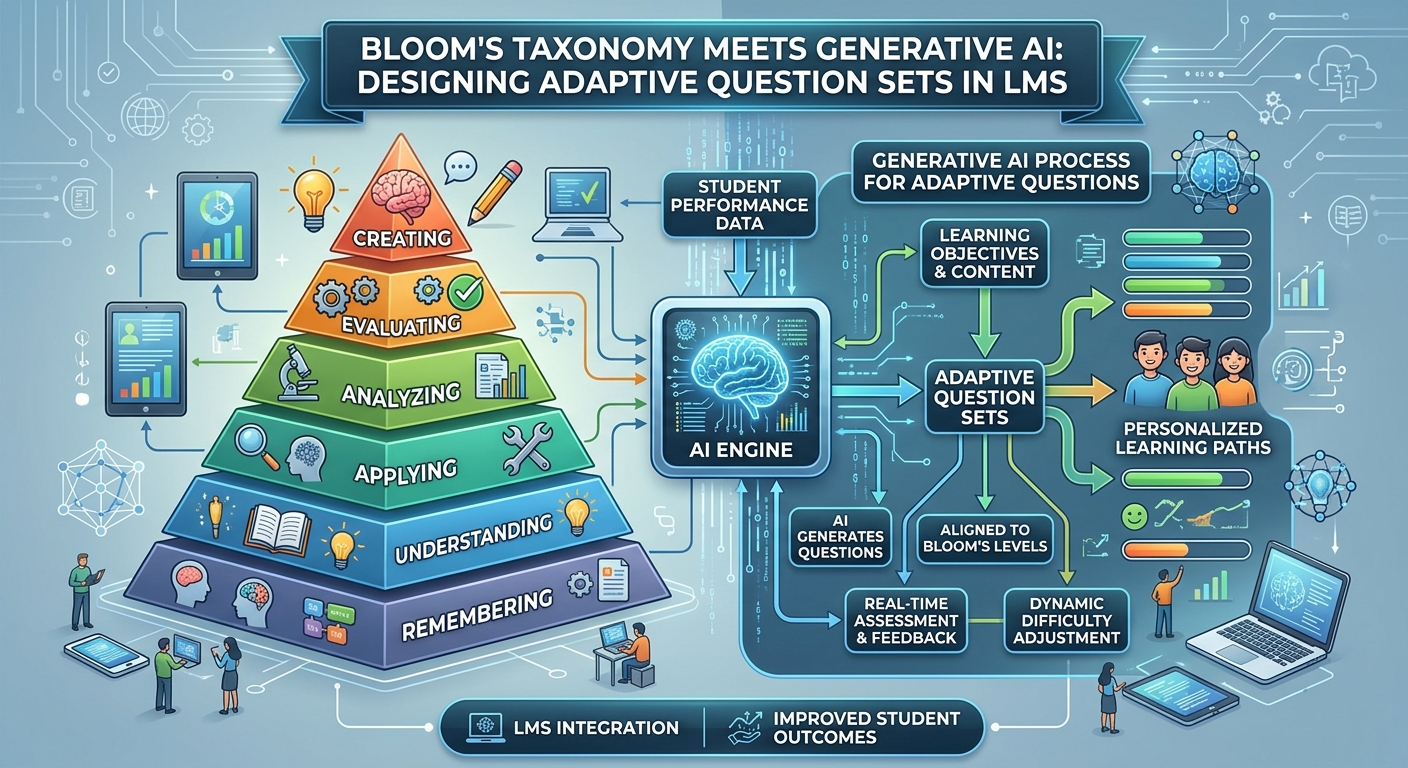
Bloom’s Taxonomy Meets Generative AI: Designing Adaptive Question Sets in LMS
In the rapidly evolving landscape of corporate learning and development, L&D leaders face the perennial challenge of designing assessments that truly measure comprehension, critical thinking, and application, not just rote memorization. Traditional, static question sets often fall short, failing to adapt to individual learner needs or provide insights into higher-order cognitive skills. Enter a powerful synergy: Bloom’s Taxonomy and Generative AI, transforming how we design adaptive question sets within a modern LMS.
For VPs, Directors, and Managers across industries like Compliance, Sales, Banking, Finance, Insurance, Retail, Pharma, Health care, Hospitality, Oil and Gas, and Mining, the stakes are high. Effective training directly impacts performance, compliance, and ultimately, the bottom line. This article explores how combining the pedagogical depth of Bloom’s Taxonomy with the dynamic capabilities of Generative AI can create unparalleled learning experiences and measurable outcomes through intelligent learning management solutions.
The Enduring Relevance of Bloom’s Taxonomy
Developed by Benjamin Bloom in the 1950s, Bloom’s Taxonomy provides a hierarchical framework for categorizing educational learning objectives. It delineates cognitive processes into distinct levels, progressing from basic recall to complex evaluation and creation. The original taxonomy included: Remembering, Understanding, Applying, Analyzing, Evaluating, and Creating (revised in 2001). For L&D professionals, this framework is invaluable for:
- Structuring Learning Objectives: Ensuring objectives move beyond basic knowledge to skill development.
- Designing Varied Assessments: Crafting questions that target different cognitive levels, providing a comprehensive understanding of learner proficiency.
- Promoting Deeper Learning: Guiding learners to engage with content in more meaningful ways, fostering critical thinking rather than surface-level understanding.
While foundational, manually designing diverse question sets that consistently hit all Bloom’s levels for every topic can be time-consuming and resource-intensive, especially when scaling across an entire organization using an enterprise learning management system. This is where Generative AI steps in.
Generative AI: The New Frontier in Content Creation
Generative AI refers to artificial intelligence models capable of producing novel content—text, images, code, and more—based on vast datasets. In the context of learning, its power lies in its ability to:
- Create Diverse Content: From multiple-choice questions to open-ended prompts, case studies, and simulations.
- Contextual Understanding: Analyze learning materials and generate relevant, context-specific questions.
- Personalize Learning: Adapt content and questions based on individual learner performance and preferences.
Imagine a learning management system where assessment questions are not fixed, but dynamically generated, evolving with the learner's progress. This is the promise of Generative AI.
The Synergy: Bloom’s Taxonomy and Generative AI
Combining Bloom’s Taxonomy with Generative AI offers a revolutionary approach to assessment design. AI can be trained on the principles of Bloom’s Taxonomy to generate questions precisely calibrated to each cognitive level. For instance:
- Remembering & Understanding: AI can quickly generate factual recall questions or prompts requiring summarization based on training modules.
- Applying & Analyzing: Given a scenario, AI can formulate questions that ask learners to apply learned principles or break down complex situations. This is particularly valuable for Risk-focused Training in financial services or compliance.
- Evaluating & Creating: AI can craft open-ended prompts for learners to critique a business strategy, propose solutions to a sales challenge, or design a new process, pushing them to the highest levels of cognitive engagement.
Designing Adaptive Question Sets with AI in an LMS
How does AI integration enhance the functionality of a learning management system? Integrating AI transforms a traditional lms learning management system by automating content creation, personalizing learning paths, offering intelligent feedback, and enabling predictive analytics, leading to a more dynamic and effective learning ecosystem. Here’s a practical look at how this fusion creates adaptive question sets within a robust learning content management system or modern LCMS:
- Initial Baseline Assessment: An AI Powered Authoring Tool can generate a quick diagnostic assessment with questions at the 'Remembering' and 'Understanding' levels. This gauges the learner's foundational knowledge.
- Dynamic Progression: Based on performance, the AI system within the learning management software dynamically adjusts the difficulty. If a learner performs well, the next set of questions will target 'Applying' or 'Analyzing'. If they struggle, the system might offer remedial questions or suggest specific Adaptive Learning modules from a Microlearning LMS.
- Scenario-Based & Case Study Generation: What are the capabilities of generative AI in creating complex scenarios for compliance training? Generative AI excels at constructing intricate, context-rich scenarios and case studies that mirror real-world challenges in regulated industries, prompting learners to apply critical thinking and decision-making skills at higher Bloom's levels. This is invaluable for industries like healthcare, banking, and oil & gas where practical application is paramount.
- Personalized Feedback and Remediation: Post-assessment, the AI can provide immediate, highly personalized feedback that goes beyond just 'right' or 'wrong'. It can explain why an answer was incorrect, suggest alternative approaches, and direct learners to specific sections of the course material for review.
- Continuous Adaptation: The system continuously learns from learner interactions, refining its question generation capabilities and ensuring that each assessment experience is optimally challenging and relevant.
Benefits for L&D Leaders
How can AI personalize learning assessments? AI can analyze learner performance, identify knowledge gaps, and dynamically generate questions tailored to their specific needs and cognitive level, ensuring a truly adaptive experience. This innovative approach offers significant advantages for L&D decision-makers:
- Enhanced Learner Engagement: Learners remain motivated when challenged at their optimal level, preventing boredom from overly simple questions and frustration from overly complex ones.
- Deeper Learning Outcomes: By consistently pushing learners to higher cognitive levels, organizations foster a workforce capable of critical thinking, problem-solving, and innovation.
- Increased Efficiency & Scalability: Automating question generation significantly reduces the manual effort and time typically required for assessment design, freeing L&D teams to focus on strategy and content creation. This is particularly beneficial for large organizations leveraging a cloud based learning management system.
- Granular Data Insights: Adaptive systems provide rich data on individual and group proficiency across various Bloom’s levels, allowing L&D leaders to pinpoint areas needing further attention and demonstrate training ROI.
- Improved Compliance & Performance: In sectors like compliance or sales, ensuring deep understanding and application of rules or techniques is crucial. Adaptive assessments guarantee that learners master necessary skills, reducing risk and boosting performance.
Implementing the Future of Learning
Adopting this powerful combination requires a forward-thinking approach to your LMS. L&D leaders should evaluate Gamified LMS platforms that offer robust AI integration capabilities or consider platforms like MaxLearn LMS which are designed with such advanced features in mind. The future of corporate learning is personalized, dynamic, and deeply effective.
By leveraging Bloom’s Taxonomy as the pedagogical blueprint and Generative AI as the engine for dynamic content creation, L&D professionals can move beyond static assessments to cultivate a genuinely adaptive, engaging, and high-impact learning environment. This is not just about adopting new technology; it’s about fundamentally rethinking how we empower our workforce to learn, grow, and excel in an ever-changing world.


