

Spaced Learning vs. Massed Learning: An Evidence-Based Comparison for Trainers
In the dynamic world of corporate learning and development, the pursuit of effective training methodologies is constant. L&D Vice Presidents, Directors, and Managers are continuously evaluating strategies to enhance knowledge retention, skill application, and ultimately, business performance. At the heart of this evaluation often lies a fundamental pedagogical question: Is it better to deliver training in intense, concentrated bursts (massed learning) or spread it out over time (spaced learning)? This article delves into an evidence-based comparison, offering insights crucial for optimizing your organization's learning initiatives.
Understanding Massed Learning: The "Cramming" Approach
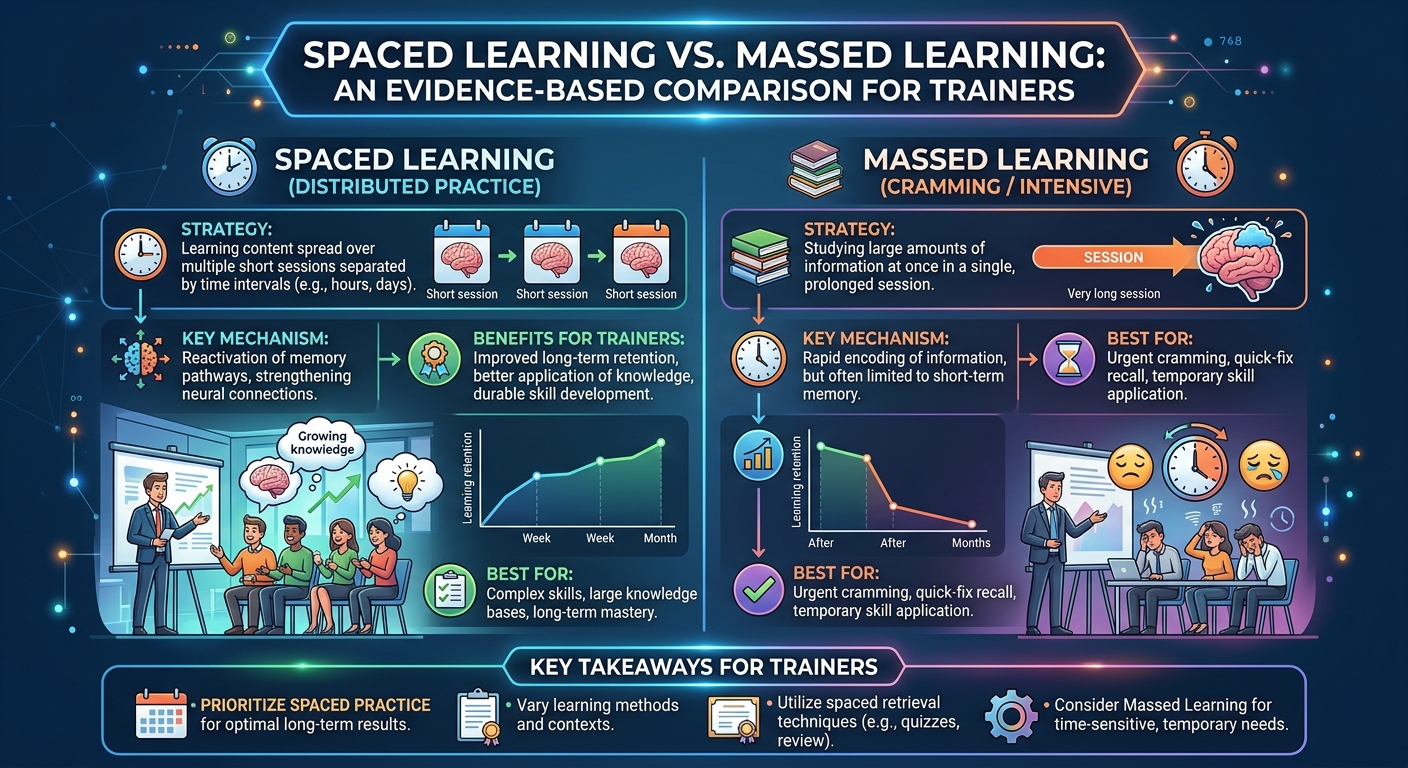
Massed learning, often colloquially known as "cramming," involves delivering a large volume of information or training content within a short, continuous timeframe. Think of a full-day workshop, an intensive week-long certification course, or a mandatory annual compliance training session conducted over several hours. This approach is prevalent in many corporate settings due to its perceived efficiency and convenience for scheduling.
The Allure and Limitations of Massed Learning
The primary appeal of massed learning lies in its apparent efficiency. It allows organizations to cover extensive material quickly, satisfy immediate training requirements, and minimize disruption to daily operations by consolidating learning into a single event. However, cognitive science paints a less optimistic picture regarding its long-term effectiveness. While learners might feel a sense of accomplishment and temporary mastery immediately after a massed session, studies consistently show that much of this information is quickly forgotten. The brain struggles to consolidate and retain large amounts of new information without adequate processing time, leading to a phenomenon known as the "forgetting curve."
Understanding Spaced Learning: The Power of Distribution
In contrast, spaced learning, also known as distributed practice, involves breaking down learning content into smaller, manageable chunks and delivering them over extended periods, with deliberate intervals between sessions. These intervals are not just downtime; they are crucial for allowing the brain to consolidate memories and for learners to engage in retrieval practice, where they actively recall information from memory. This approach directly counters the forgetting curve by reinforcing concepts just as they begin to fade.
The Cognitive Science Behind Spaced Learning's Effectiveness
Research across neuroscience and educational psychology overwhelmingly supports the efficacy of spaced learning. Key cognitive mechanisms at play include:
- Enhanced Consolidation: Spacing provides the brain with time to move information from short-term to long-term memory.
- Retrieval Practice: Each spaced session serves as an opportunity for learners to recall previously learned material, strengthening neural pathways.
- Reduced Cognitive Load: Breaking down content prevents cognitive overload, making learning less daunting and more effective.
- Contextual Variability: Learning in different contexts over time can improve the transferability of knowledge to real-world situations.
Modern solutions often incorporate these principles. A sophisticated Microlearning LMS, for instance, is designed to deliver bite-sized content repeatedly, aligning perfectly with spaced learning methodologies. Many leading learning management solutions also emphasize this approach.
The Evidence-Based Showdown: Massed vs. Spaced
When we look at the empirical evidence, the comparison heavily favors spaced learning, particularly for long-term retention and skill application. Studies consistently demonstrate that learners who engage with material through spaced practice retain significantly more information over weeks, months, and even years compared to those who experience massed learning.
- Knowledge Retention: Spaced learning leads to superior long-term memory consolidation, ensuring that employees remember critical information when it matters most, whether for compliance, sales, or technical tasks.
- Skill Transfer: The ability to apply learned skills in real-world scenarios is significantly higher with spaced learning. Regular, distributed practice allows learners to internalize skills, making their application more automatic and robust.
- Engagement and Motivation: While a full-day seminar can be draining, short, focused, and recurring learning modules, especially those supported by a Gamified LMS, can maintain higher levels of learner engagement and motivation over time.
- Return on Investment (ROI): For L&D leaders, the ultimate metric is ROI. Investing in training that isn't retained or applied translates to wasted resources. Spaced learning ensures a better return by making learning stick, directly impacting performance and productivity.
The choice between these two methods isn't merely academic; it's a strategic decision that impacts an organization's bottom line. For industries like banking, finance, healthcare, and oil and gas, where stakes are high, reliable knowledge retention facilitated by an effective learning content management system is paramount.
Why Spaced Learning Wins for Modern L&D
The modern corporate environment, characterized by rapid change and continuous upskilling needs, is uniquely suited for spaced learning. Traditional massed training struggles to keep pace, whereas a distributed approach is agile and adaptable. A robust learning management system (LMS) can be the backbone of this strategy, enabling organizations to deploy, manage, and track spaced learning initiatives effectively. Many a MaxLearn LMS empowers this methodology.
Furthermore, the integration of an Adaptive Learning platform within your learning management software allows for personalized learning paths, where content delivery and spacing intervals are tailored to individual learner needs and performance data. This ensures maximum efficiency and effectiveness, moving beyond a one-size-fits-all approach. For example, an AI Powered Authoring Tool can automatically generate microlearning content and recommend optimal spacing, revolutionizing how companies approach enterprise learning management.
This is particularly critical for areas such as compliance and risk management. Implementing Risk-focused Training through a spaced learning approach ensures that critical policies and procedures are reinforced regularly, significantly reducing the likelihood of errors or non-compliance across industries like retail, pharma, and mining. A cloud based learning management system (LCMS) provides the flexibility and scalability needed to implement such comprehensive and continuous training.
Implementing Spaced Learning in Your Organization
Transitioning to a spaced learning model requires thoughtful planning and the right technological infrastructure. Here's how L&D leaders can make the shift:
- Audit Existing Content: Break down large training modules into smaller, digestible microlearning units.
- Leverage Technology: Utilize a powerful learning management system (LMS learning management system) that supports sequencing, scheduling, and tracking of spaced content.
- Incorporate Retrieval Practice: Design short quizzes, simulations, and interactive exercises at the beginning of each spaced session to prompt recall.
- Provide Regular Feedback: Timely and constructive feedback is essential for reinforcing correct understanding and addressing misconceptions.
- Communicate the Benefits: Educate learners and stakeholders on the science behind spaced learning to foster buy-in and encourage participation.
Intelligent Insights for Optimal Learning Design
The future of learning is increasingly informed by data and advanced analytics. As L&D leaders, leveraging smart systems can dramatically enhance the impact of your spaced learning initiatives.
How can intelligent algorithms help personalize learning paths for maximum retention?
Advanced analytical systems can process vast amounts of learner data, including performance metrics, engagement levels, and previous learning history. By identifying individual strengths and weaknesses, these algorithms can dynamically adjust the pace, content, and frequency of learning modules. This ensures that each employee receives optimal learning experiences, precisely spaced and tailored to their unique needs, maximizing their knowledge absorption and long-term recall. This adaptability is a hallmark of truly effective learning management software.
What role does advanced analytics play in ensuring training content is relevant to specific business challenges and regional nuances?
Intelligent platforms can analyze external data—such as market trends, regulatory changes, regional sales performance, or specific operational incidents—and cross-reference it with internal learning data. This allows L&D teams to proactively identify emerging skill gaps or knowledge deficiencies pertinent to particular business units or geographical locations. Training content can then be dynamically updated or specifically targeted to address these precise challenges, ensuring that learning is always current, contextually relevant, and impactful across diverse operational landscapes.
How can intelligent systems measure the long-term effectiveness of different training methodologies on employee performance and business outcomes?
Sophisticated analytics tools can track the entire learning journey and beyond. By correlating training completion rates and assessment scores with real-world performance indicators—such as sales figures, compliance adherence rates, customer satisfaction scores, or safety incident reports—intelligent systems provide concrete evidence of training ROI. These insights allow L&D to continuously refine methodologies, proving which spaced learning strategies are most effective in driving tangible business improvements and making a compelling case for continued investment in talent development.
Conclusion
The evidence is clear: for enduring knowledge retention and effective skill application, spaced learning significantly outperforms massed learning. While massed training might offer superficial convenience, it often falls short in delivering lasting impact. For L&D leaders striving to build a truly effective, future-ready workforce, embracing spaced learning—supported by modern learning management solutions like a robust cloud based learning management system or LCMS—is not just an option, but a strategic imperative. By leveraging technology and adopting an evidence-based approach, you can transform your organization's learning landscape, ensuring that every training dollar invested yields maximum returns in performance and growth.
.jpg)


