

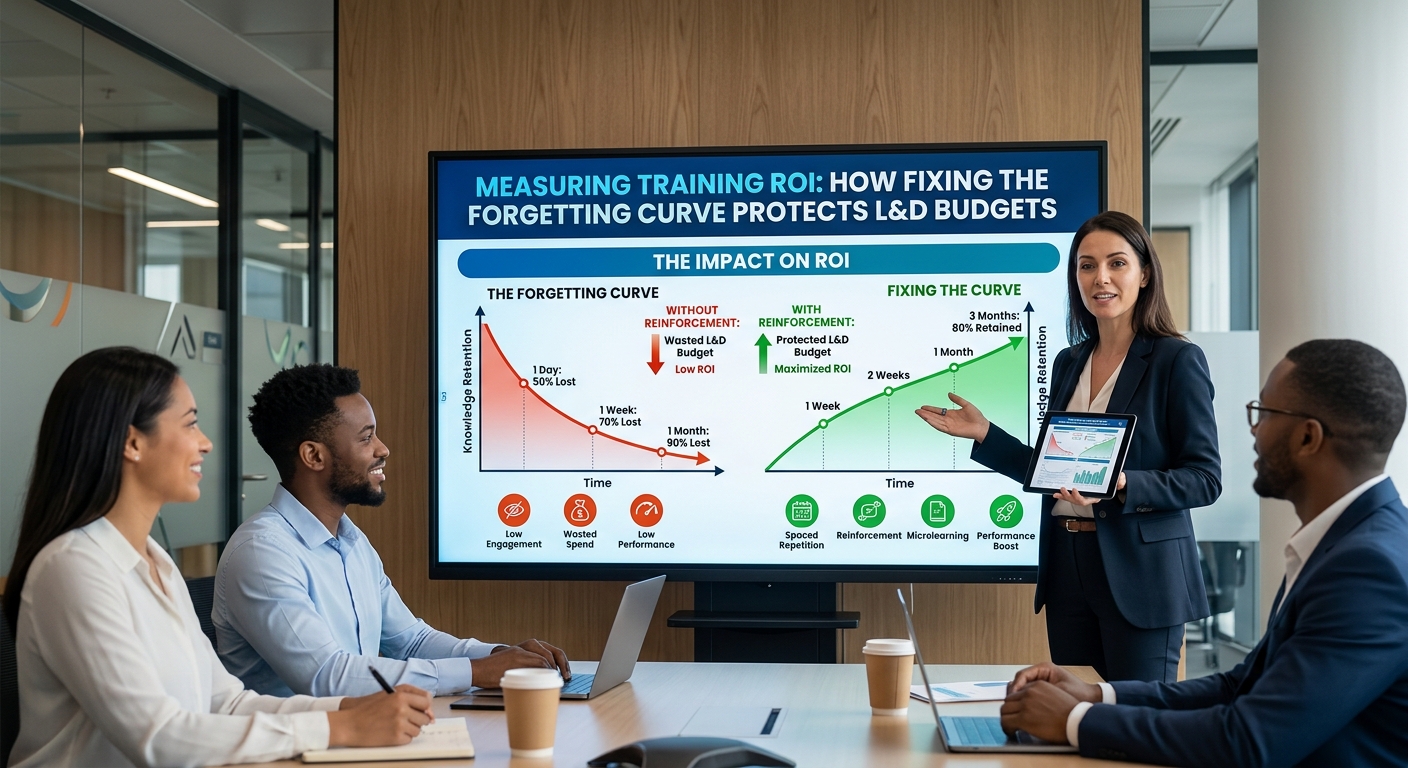
Measuring Training ROI: How Fixing the Forgetting Curve Protects L&D Budgets
For Learning and Development (L&D) leaders, proving the tangible return on investment (ROI) for training initiatives is an ongoing imperative. In an era of increasing fiscal scrutiny, every dollar spent on employee development must demonstrate clear value. Yet, a silent saboteur often undermines even the most well-designed programs: the forgetting curve. This natural decline in memory retention can erode training effectiveness, lead to wasted budgets, and ultimately hinder organizational performance across all industries, from Compliance and Sales to Banking, Finance, Insurance, Retail, Pharma, Healthcare, Hospitality, Oil and Gas, and Mining.
Understanding and actively combating the forgetting curve isn't just about better learning outcomes; it's about protecting your L&D budget and demonstrating undeniable business impact. This article explores how L&D leaders can strategically address this challenge to maximize their training ROI.
The Silent Budget Drain: Understanding the Forgetting Curve
First articulated by psychologist Hermann Ebbinghaus in 1885, the forgetting curve illustrates the rapid rate at which newly acquired knowledge is lost if not reinforced. Within hours, a significant portion of information can vanish, and after just a few days, retention often plummets to a mere fraction of what was initially learned. For L&D professionals, this isn't just an academic concept; it's a critical budget drain.
Imagine investing heavily in a comprehensive new product training for your sales team, or a vital compliance update for your entire workforce. If the majority of that knowledge is forgotten within a week, the time, resources, and effort — not to mention the potential business gains — are significantly diminished. The cost isn't just the initial training expense; it extends to:
- Reduced productivity and performance.
- Increased errors and rework.
- Higher risks of non-compliance.
- The need for costly retraining.
Question for L&D Leaders: How does the rapid decline of learned information impact the operational efficiency of a geographically dispersed team following a critical safety training?
Answer: When critical safety knowledge fades quickly across various sites or branches, it leads to inconsistent application of protocols, increased incident rates, and potentially severe compliance breaches. This necessitates immediate and costly interventions, undermining the initial investment and posing significant operational risks across all locations.
The Mandate for Measurable ROI in L&D
L&D is no longer just a cost center; it's a strategic partner. Vice Presidents, Directors, and Senior Managers of L&D are increasingly expected to demonstrate how their initiatives directly contribute to revenue, mitigate risk, and enhance employee capability. Protecting the L&D budget means showing that training dollars are wisely spent and yield measurable results.
If training is failing to stick due to the forgetting curve, the perceived ROI will be low, making it harder to secure future funding. By focusing on retention strategies, L&D can transform training from a fleeting event into a sustained development process that delivers long-term value and robust ROI.
Strategic Interventions: Building a Resilient Learning Ecosystem
Overcoming the forgetting curve requires a proactive, multi-faceted approach, often powered by modern elearning technologies and methodologies. A sophisticated learning management system (LMS) can be central to this strategy, providing a framework for continuous learning.
Microlearning: The Power of Bite-Sized Reinforcement
One of the most effective antidotes to the forgetting curve is Microlearning LMS. Instead of lengthy, information-dense sessions, microlearning delivers content in short, focused bursts. These bite-sized modules are easier to digest, retain, and recall. They can be used for pre-training preparation, in-the-moment support, or, crucially, for post-training reinforcement via spaced repetition. This strategy is particularly effective for complex topics in industries like healthcare or finance, where precise, timely information is paramount.
Gamification: Engaging for Enduring Knowledge
Engagement is a powerful ally against forgetting. Gamified LMS elements introduce competition, rewards, and interactive challenges into the learning process. By making learning fun and engaging, gamification encourages repeated interaction with content, solidifying memory retention. Whether it's quizzes, leaderboards, or simulation-based scenarios, gamification motivates learners to revisit material, thus naturally combating the decline of the forgetting curve.
Adaptive Learning: Personalizing the Path to Retention
Not all learners are the same, nor do they forget at the same rate. Adaptive Learning tailors the learning experience to individual needs, strengths, and weaknesses. Utilizing data on a learner's performance, an adaptive system can automatically identify knowledge gaps and deliver personalized reinforcement. This ensures that learners spend more time on topics they struggle with and less on what they already know, optimizing their path to mastery and ensuring better retention. This approach is highly effective in diverse environments, from sales teams needing specific product knowledge to healthcare professionals requiring precise procedural training.
AI-Powered Reinforcement and Content Creation
Artificial intelligence is revolutionizing how we tackle the forgetting curve. An AI Powered Authoring Tool can not only streamline content creation but also enable intelligent delivery. AI can analyze learning data to determine the optimal timing for spaced repetition, suggesting relevant microlearning modules or quizzes just before knowledge is likely to be forgotten. This smart, automated reinforcement ensures that employees consistently revisit critical information.
Question for L&D Leaders: Beyond basic content, how can an intelligent learning platform ensure knowledge sticks for diverse roles and skill levels?
Answer: An intelligent learning platform leverages sophisticated algorithms to personalize learning paths, recommend resources based on individual performance and job roles, and provide adaptive feedback. This ensures that content is always relevant and appropriately challenging, fostering deeper engagement and more effective, sustained knowledge retention across a varied workforce.
Risk-Focused Training: Prioritizing Critical Knowledge
For industries with high stakes, like Compliance, Banking, Pharma, or Oil & Gas, the cost of forgotten knowledge can be catastrophic. Risk-focused Training strategies prioritize critical information that, if forgotten, could lead to significant financial loss, legal penalties, or harm. By applying microlearning, gamification, and adaptive reinforcement specifically to these high-risk areas, L&D leaders can ensure that the most crucial knowledge remains front-of-mind, directly protecting the organization's bottom line and reputation.
Leveraging Technology: The Modern Learning Management System
Implementing these strategies effectively hinges on a robust learning management software. A modern LMS goes beyond content delivery; it's a strategic platform for managing, tracking, and optimizing the entire learning lifecycle. An enterprise learning management system, especially a cloud based learning management system, offers the scalability, accessibility, and analytical capabilities needed to fight the forgetting curve across an entire organization.
A comprehensive learning content management system (LCMS) integrated within an LMS allows for easy creation, management, and deployment of microlearning modules and adaptive content. Platforms like MaxLearn LMS provide the features necessary to build a continuous learning environment that proactively addresses knowledge decay, making every training dollar count.
Question for L&D Leaders: How can AI help us ensure training knowledge sticks for employees in highly regulated industries who often face tight deadlines?
Answer: AI can intelligently schedule microlearning bursts and targeted quizzes during employees' low-demand periods, ensuring critical compliance information is reinforced without disrupting workflows. It can also identify topics where individual learners struggle and provide just-in-time refreshers, making knowledge retention efficient and less burdensome even under pressure.
Quantifying the Return: Measuring the ROI of Retention
The true measure of success for L&D leaders lies in demonstrating quantifiable ROI. By actively combatting the forgetting curve, you can directly impact key business metrics:
- Reduced Retraining Costs: Less need for repeat training sessions saves significant budget.
- Improved Performance Metrics: Higher sales conversion rates, fewer errors in manufacturing or service, faster customer issue resolution, and better compliance adherence directly correlate with retained knowledge.
- Mitigated Risk: In regulated industries, consistent knowledge retention reduces fines, legal issues, and safety incidents.
- Enhanced Employee Engagement and Retention: Employees feel more competent and valued when their learning is supported, leading to higher morale and lower turnover.
- Faster Time-to-Proficiency: New hires or those taking on new roles become productive faster when knowledge sticks.
Utilize your LMS analytics to track pre and post-training assessments, performance metrics, and even employee feedback. By comparing these against a baseline, L&D can present a clear picture of how investing in retention strategies protects budgets and drives business success.
Conclusion
The forgetting curve represents a significant challenge to L&D effectiveness and budget allocation. However, with strategic implementation of modern elearning methodologies like microlearning, gamification, and adaptive learning, supported by powerful learning management solutions and AI, L&D leaders can transform this challenge into an opportunity. By proactively addressing knowledge retention, you not only improve learning outcomes but also safeguard your L&D budget, prove tangible ROI, and ultimately drive greater organizational success. It's time for L&D to lead the charge in making knowledge stick, ensuring every training dollar delivers its full potential.
.jpg)


