

Cognitive Load Theory Meets the Forgetting Curve: Optimizing Content Delivery for Modern L&D
In today's fast-paced corporate environment, Learning & Development (L&D) leaders face a perpetual challenge: how to deliver complex information effectively, ensure long-term retention, and drive meaningful behavior change across diverse workforces. From critical compliance training in banking and healthcare to advanced sales methodologies in retail and pharma, the stakes are high. The answer lies not just in cutting-edge technology, but in a profound understanding of how the human brain learns and forgets. This article delves into the powerful intersection of Cognitive Load Theory and the Forgetting Curve, offering L&D professionals a strategic roadmap to revolutionize content delivery and maximize learning outcomes.
Understanding the Pillars of Learning Science
Cognitive Load Theory: The Brain's Bandwidth
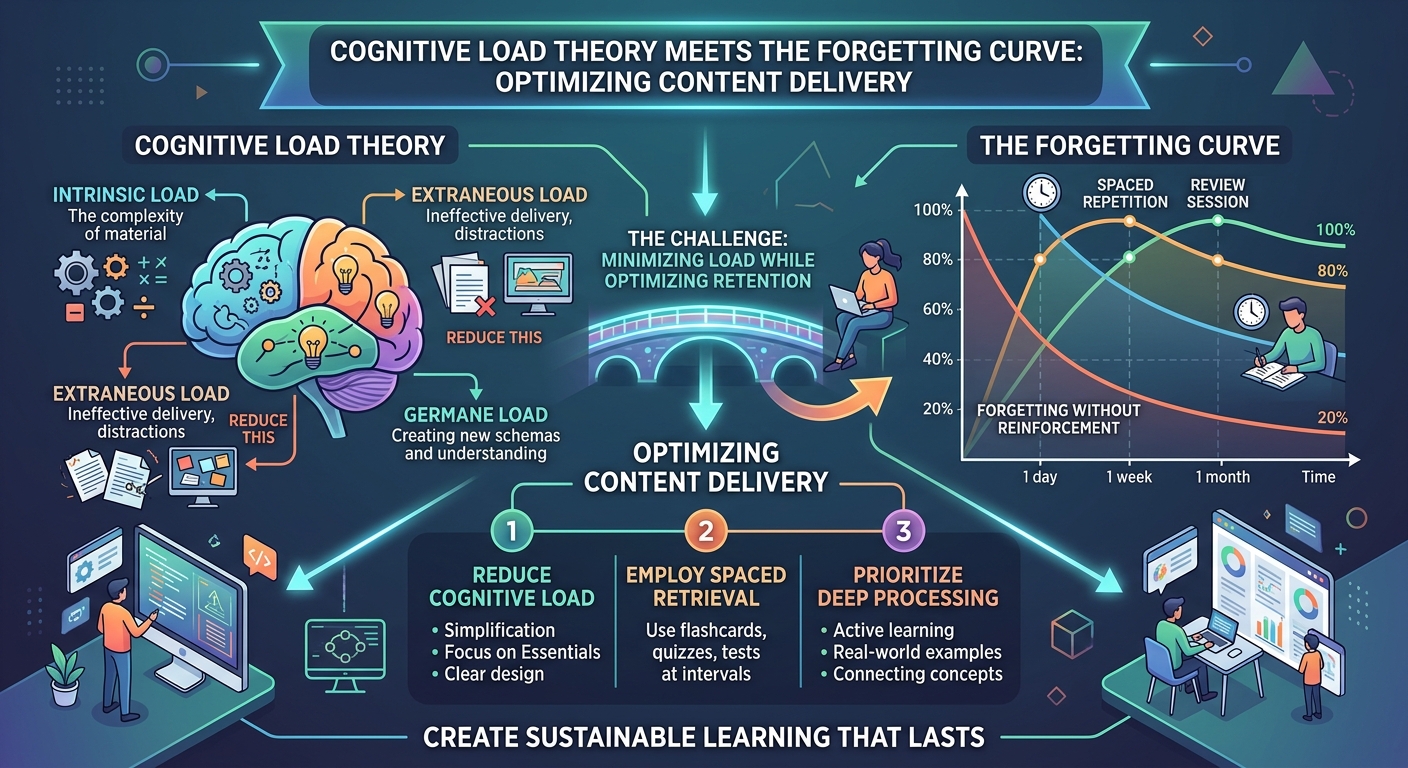
Developed by educational psychologist John Sweller, Cognitive Load Theory (CLT) posits that our working memory has a limited capacity. When instructional materials demand too much mental effort, learning becomes inefficient. CLT identifies three types of cognitive load:
- Intrinsic Load: The inherent difficulty of the learning material itself. Complex topics naturally have higher intrinsic load.
- Extraneous Load: Unnecessary mental effort imposed by the design of the instruction. Poorly structured content, irrelevant information, or confusing navigation contribute to this.
- Germane Load: The mental effort devoted to processing information and constructing schemas (mental models) – this is the desirable load that leads to deep learning.
For L&D, the goal is clear: minimize extraneous load through thoughtful design, manage intrinsic load by breaking down complexity, and maximize germane load to foster robust understanding. An effective learning management system (LMS) can significantly aid in this by providing tools for structured content delivery and clear learner pathways.
The Forgetting Curve: The Challenge of Retention
In the late 19th century, German psychologist Hermann Ebbinghaus conducted groundbreaking research revealing a startling truth about human memory: we forget most new information rapidly. His "Forgetting Curve" illustrates that within days – sometimes even hours – a significant portion of what we learn is lost if it's not reinforced. This phenomenon is a major impediment to the effectiveness of traditional, one-off training sessions.
The implications for corporate learning are profound. A one-day workshop, no matter how engaging, will likely yield diminishing returns without strategic reinforcement. Countering the Forgetting Curve requires deliberate strategies like spaced repetition, retrieval practice, and ongoing engagement to move information from short-term to long-term memory.
The Intersection: Where Theory Meets Practice
The combined insights of Cognitive Load Theory and the Forgetting Curve present a dual challenge for L&D leaders: how do we deliver complex, high-stakes content (e.g., in finance, oil and gas, or healthcare compliance) without overwhelming learners, AND ensure that this vital information is retained long enough to impact performance and mitigate risk? This intersection is where intelligent instructional design and advanced learning technologies become indispensable.
To truly optimize content delivery, L&D professionals must design learning experiences that inherently manage cognitive load while simultaneously building in mechanisms to combat forgetting. This means moving beyond static content repositories and embracing dynamic, learner-centric approaches.
Strategies for Optimized Content Delivery
Microlearning: The Antidote to Overload
Microlearning, characterized by short, focused learning units, is a powerful strategy that addresses both cognitive load and the forgetting curve. By breaking down complex topics into bite-sized modules, it reduces intrinsic and extraneous cognitive load, making information easier to digest and process. Crucially, a well-implemented Microlearning LMS facilitates the spaced repetition necessary to counter the Forgetting Curve, allowing learners to revisit key concepts frequently without feeling overwhelmed.
Adaptive Learning Paths: Personalized Retention
Adaptive Learning systems adjust the learning path based on an individual's performance, preferences, and prior knowledge. This personalization is critical for managing cognitive load, as learners receive content at their optimal pace and difficulty level. By identifying knowledge gaps, adaptive platforms can automatically trigger reinforcements, quizzes, or additional resources, effectively tailoring spaced repetition to each learner's unique forgetting curve. This capability is especially vital for industries like banking and pharma, where nuanced understanding is paramount.
Gamification: Engaging the Learner's Mind
Engaging learners is not just about fun; it’s about optimizing germane cognitive load and encouraging repeated interaction. A Gamified LMS employs elements like points, badges, leaderboards, and challenges to transform learning into an immersive experience. This can significantly reduce extraneous cognitive load by making the learning process itself more intuitive and motivating. The interactive nature of gamification naturally encourages learners to revisit content, practice skills, and engage in retrieval practice, thereby actively combating the Forgetting Curve.
AI-Powered Authoring: Smart Content Creation
Creating learning content that adheres to CLT and counters the Forgetting Curve can be a resource-intensive process. This is where an AI Powered Authoring Tool becomes invaluable. AI can assist in automatically chunking content, identifying key concepts for emphasis, suggesting optimal intervals for spaced repetition, and even generating personalized practice questions. By streamlining content creation, L&D teams can focus more on strategic design and less on manual formatting, ensuring that all learning materials are inherently optimized for both cognitive efficiency and retention.
Risk-Focused Training: Prioritizing Critical Knowledge
In industries like compliance, healthcare, and finance, not all information carries the same weight. Risk-focused Training strategically directs learning efforts to areas that pose the highest risk to the organization or the learner. This approach inherently manages cognitive load by preventing learners from being overwhelmed with low-priority information. By concentrating on critical competencies, L&D can ensure that the most important knowledge is delivered efficiently and reinforced systematically, directly combating the Forgetting Curve in areas that matter most for business growth and regulatory adherence.
The Role of Advanced Learning Management Solutions
A modern learning management system is no longer just a digital filing cabinet for courses. It is a sophisticated platform that can be a powerful ally in applying cognitive load theory and battling the forgetting curve. An advanced learning management software, especially a cloud based learning management system, offers features like robust analytics to identify areas of struggle, automated scheduling for spaced repetition, and personalized content delivery based on learner performance. An enterprise learning management system, or a comprehensive LCMS (learning content management system), can orchestrate these strategies, providing the infrastructure for a truly optimized learning ecosystem. MaxLearn LMS exemplifies how a cutting-edge lms learning management system can integrate these principles into a seamless learning management solution.
Strategic Questions for L&D Leaders
How can we ensure our learning content truly resonates with our diverse global workforce?
Focus on contextual relevance and localization. By offering content that reflects specific regional nuances, cultural contexts, and real-world scenarios applicable to different geographic locations, you minimize extraneous load and increase germane load. A flexible, cloud-based platform enables easy customization and deployment of localized content, ensuring that training is not just universally available, but universally understood and applied.
What's the most effective way to help our employees retain critical compliance information long-term?
Implement a layered approach combining microlearning for initial understanding with ongoing, spaced repetition reinforced by practical scenarios and assessments. Leverage an advanced learning management system to schedule timely reminders and short quizzes that test recall and application. This systematic reinforcement combats the rapid decay shown by the forgetting curve, ensuring critical knowledge stays front of mind.
In an age of constant information, how do we make our training memorable and impactful?
Blend scientific principles with engaging design. Design learning experiences that are bite-sized, interactive, and relevant to the learner's role, thus managing cognitive load. Incorporate gamification and real-world simulations to foster active learning and emotional connection. Crucially, integrate mechanisms for regular recall and application of knowledge to engrain it deeply, ensuring enduring impact beyond the initial training session.
Conclusion
For L&D Vice Presidents, Directors, and Managers, mastering the principles of Cognitive Load Theory and the Forgetting Curve is not merely academic; it's a strategic imperative. By consciously designing learning experiences that manage cognitive load and actively counteract forgetting, organizations can unlock unprecedented levels of engagement, retention, and performance. Embracing intelligent instructional design, powered by advanced learning management solutions like a robust learning management system, is the key to transforming corporate learning from a necessary expense into a powerful driver of business success across all industries.
.jpg)


