

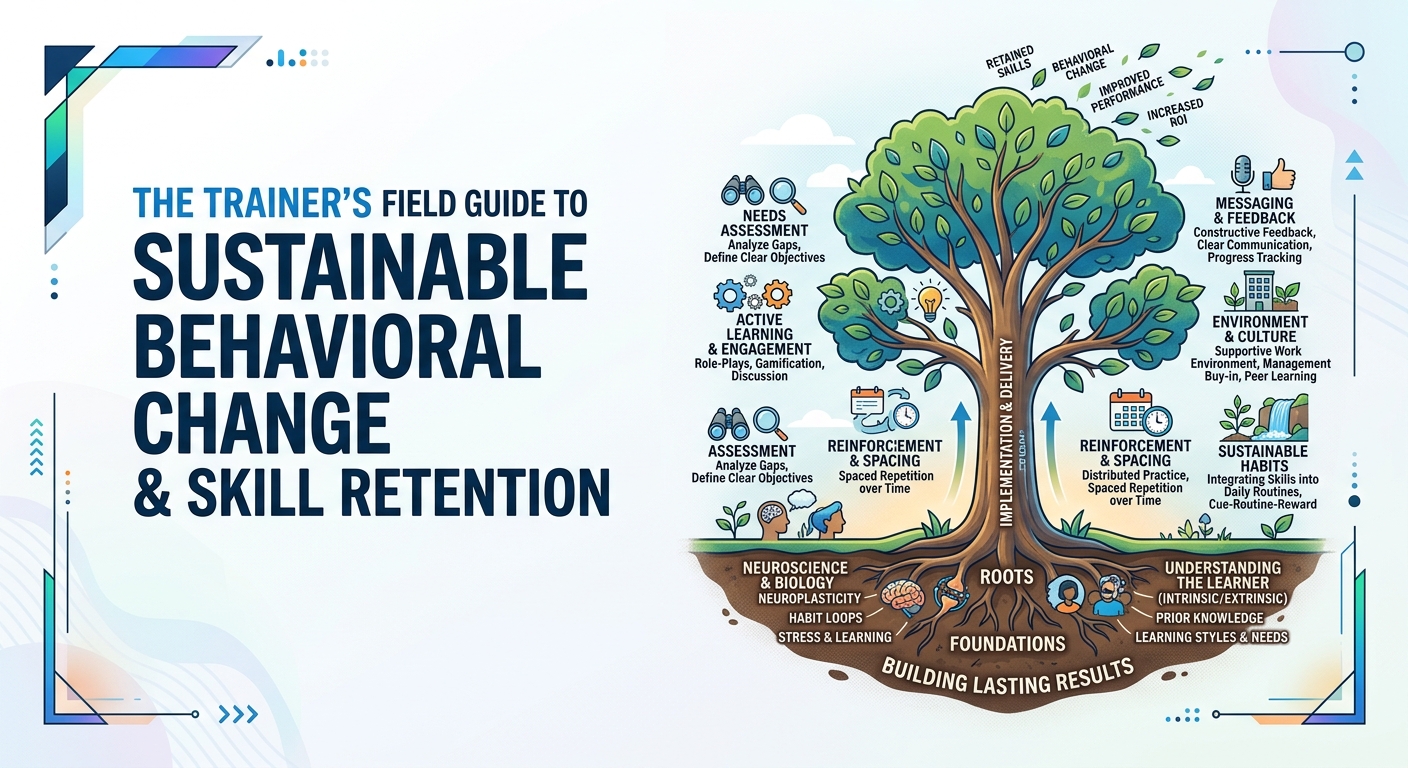
The Trainer’s Field Guide to Sustainable Behavioral Change and Skill Retention
For Vice Presidents, Directors, and Senior Managers of Learning & Development, the quest for truly impactful training programs is perpetual. It’s not enough to merely deliver content; the ultimate goal is fostering lasting behavioral change and ensuring critical skills are not only acquired but retained and applied in real-world scenarios. In dynamic sectors like Compliance, Sales, Banking, Finance, Insurance, Retail, Pharma, Health care, Hospitality, Oil and Gas, and Mining, the stakes are incredibly high. The challenge lies in moving beyond one-off training events to embed a culture of continuous learning and measurable transformation. This guide delves into the strategies and modern tools that empower L&D leaders to achieve precisely that, ensuring every training investment yields a significant, enduring return.
Why Traditional Approaches Often Fall Short
Despite significant investments, many organizations struggle with the efficacy of their training initiatives. The reasons are often systemic, deeply rooted in outdated methodologies that fail to acknowledge how the human brain truly learns and retains information.
The Forgetting Curve: A Persistent Challenge
The infamous "Forgetting Curve" illustrates a stark reality: without reinforcement, learners can forget up to 70% of new information within 24 hours. Traditional classroom sessions or lengthy e-learning modules, while informative, often lack the mechanisms for sustained retention. They deliver a burst of information, but without subsequent reinforcement, that knowledge quickly erodes.
Lack of Context and Reinforcement
Training disconnected from daily work contexts or without immediate opportunities for application often results in minimal skill transfer. Learners struggle to connect theoretical knowledge to practical scenarios, leading to a gap between knowing and doing. Furthermore, the absence of ongoing reinforcement and practice means that even well-understood concepts fade when not actively used or revisited.
The Pillars of Sustainable Behavioral Change
To counteract the challenges of the Forgetting Curve and ensure skill retention, a strategic, multi-faceted approach is essential. Here are the core principles:
Principle 1: Relevance and Personalization
One-size-fits-all training rarely sticks. Learners are more engaged and retain information better when it is directly relevant to their roles, challenges, and career aspirations. Modern learning content management systems allow for content curation that speaks directly to individual needs. How can we ensure training modules resonate deeply with each learner, providing information that feels custom-tailored to their immediate needs and long-term career path? By intelligently analyzing learner roles, performance data, and expressed interests, a sophisticated Microlearning LMS can deliver highly personalized learning paths, ensuring maximum engagement and applicability.
Principle 2: Spaced Repetition and Reinforcement
The most effective way to combat the Forgetting Curve is through spaced repetition – revisiting information at increasing intervals. Instead of long, intensive sessions, break down complex topics into digestible, bite-sized modules. A robust Microlearning LMS facilitates this by delivering short, focused learning bursts over time, reinforcing key concepts without overwhelming learners. This steady drip of knowledge ensures long-term memory consolidation and skill mastery. This approach is particularly effective for high-stakes Risk-focused Training in regulated industries.
Principle 3: Active Practice and Application
Learning is not a spectator sport. For skills to become ingrained behaviors, learners must actively practice and apply what they've learned. This means moving beyond passive consumption of content to interactive exercises, simulations, and real-world scenarios. A Gamified LMS can transform this practice into an engaging, competitive, and rewarding experience, making learners eager to apply their knowledge and sharpen their abilities in a safe environment. From sales pitches to compliance procedures, interactive challenges foster true competence.
Principle 4: Feedback and Coaching
Timely and constructive feedback is crucial for behavioral adjustment and skill refinement. Learners need to understand not just what they did wrong, but why, and how to improve. This can come from automated assessments, peer reviews, or direct manager coaching. Establishing clear feedback loops within your enterprise learning management framework ensures continuous improvement and prevents bad habits from forming.
Principle 5: Measurement and Adaptation
What gets measured gets managed. Comprehensive analytics on learner progress, engagement, and performance are vital. By tracking key metrics, L&D teams can identify knowledge gaps, assess program effectiveness, and make data-driven decisions to optimize future training. Adaptive Learning platforms are instrumental here, adjusting content and pathways based on individual performance, ensuring each learner receives the most impactful learning experience possible.
Leveraging Technology for Lasting Impact
The digital revolution has provided L&D professionals with unprecedented tools to drive sustainable change. A modern learning management system is no longer just a content repository; it's a strategic partner.
The Role of Intelligent Platforms
How can technology guide learners through complex content, ensuring they focus on areas most relevant to their individual skill gaps and job roles? Advanced learning management software, particularly a cloud based learning management system, can leverage sophisticated algorithms to analyze learning patterns and suggest optimal pathways. An AI Powered Authoring Tool, for instance, can help create dynamic content that adapts to learner interactions, making the learning experience truly responsive. This is particularly vital for sales training where understanding diverse customer profiles is key.
Building a Culture of Continuous Learning
Implementing a comprehensive LMS (Learning Management System) is foundational. It transforms training from a sporadic event into an ongoing journey. A robust learning management system facilitates access to a vast library of resources, encourages self-directed learning, and provides tools for collaborative knowledge sharing. This fosters a continuous learning environment, where upskilling and reskilling become an integral part of professional development, managed efficiently through an advanced MaxLearn LMS solution.
Addressing Critical Compliance and Risk Training
In industries like Banking, Finance, Pharma, and Oil and Gas, non-compliance can have catastrophic consequences. This is where Risk-focused Training becomes paramount. How can training be tailored to address the unique regulatory landscapes and operational hazards of specific regions or departments within a global organization? An effective Learning content management system or LCMS can segment content by regional regulations, job roles, and specific risk exposures, ensuring that every employee receives precise, compliant, and actionable training. This targeted approach helps mitigate risks and ensures organizational integrity.
Actionable Steps for L&D Leaders
To translate these principles into practice, L&D leaders should consider the following:
- Audit Current Programs: Identify areas where retention and application are weakest.
- Embrace Microlearning: Break down long courses into short, focused modules.
- Integrate Gamification: Make learning engaging through points, badges, and leaderboards.
- Leverage Adaptive Technology: Utilize platforms that personalize learning paths based on performance.
- Prioritize Feedback Loops: Implement structured mechanisms for immediate and constructive feedback.
- Invest in the Right LMS: Choose a comprehensive learning management system that supports modern learning methodologies and offers powerful analytics.
- Champion Continuous Learning: Foster a culture where learning is an ongoing process, not a one-time event.
Conclusion
Achieving sustainable behavioral change and robust skill retention is the hallmark of an effective L&D strategy. It requires moving beyond traditional training models to embrace a holistic approach rooted in personalization, spaced repetition, active practice, feedback, and data-driven adaptation. By strategically deploying advanced learning management solutions and leveraging technologies like AI and gamification, L&D Vice Presidents, Directors, and Managers can transform their organizations, ensuring that every employee not only learns but truly applies and retains critical skills. This leads to enhanced performance, reduced risks, and a tangible competitive advantage across all industries. Explore how a powerful MaxLearn LMS can be your strategic partner in this transformative journey.
.jpg)


