

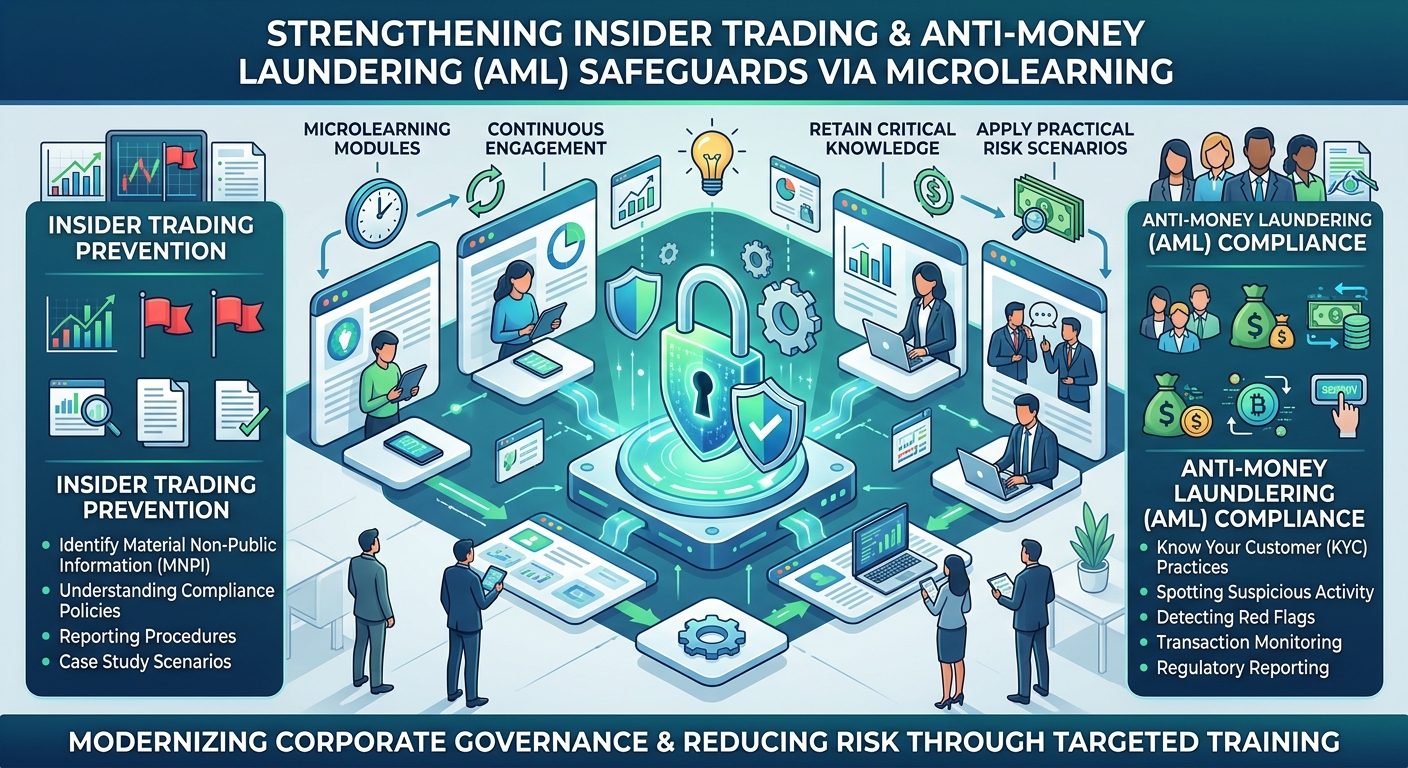
Strengthening Insider Trading & Anti-Money Laundering Safeguards via Microlearning
In today's intricate and heavily regulated business environment, the integrity of financial systems and the trust of stakeholders hinge significantly on an organization's ability to combat financial crime. Insider trading and anti-money laundering (AML) violations pose not only severe legal and financial penalties but also devastating reputational damage. For Vice Presidents, Directors, and Senior Managers in Learning & Development, the challenge lies in crafting compliance training that is not just mandated but truly effective, engaging, and capable of fostering a culture of vigilance across all levels – from banking and finance to retail, healthcare, and even oil and gas.
Traditional, lengthy compliance courses often fall short, struggling to capture attention, embed knowledge, and adapt to the fast-evolving tactics of financial criminals. This is where the strategic implementation of microlearning emerges as a game-changer, offering a powerful, precise, and practical approach to fortifying your organization's defenses.
The Evolving Threat Landscape: Why Traditional Training Falls Short
The sophistication of financial crime schemes continues to escalate. Insider trading rings exploit complex market mechanisms, while money launderers leverage digital currencies, shell corporations, and intricate global networks to obscure illicit funds. Regulatory bodies worldwide are responding with increasingly stringent requirements, placing immense pressure on organizations to not only prevent these activities but also to demonstrate robust training and awareness programs.
The typical annual compliance module, often a lengthy presentation or generic e-learning course, frequently suffers from:
- Information Overload: Too much content delivered at once, leading to cognitive fatigue and poor retention.
- Lack of Engagement: Passive learning experiences that fail to connect with learners on a practical level.
- Irrelevance: Generic content that doesn't resonate with specific roles, departments, or geographical contexts.
- Outdated Information: The slow pace of content updates in traditional models struggles to keep pace with rapid regulatory changes and emerging threats.
These shortcomings create critical vulnerabilities, leaving employees unprepared to identify and report suspicious activities, inadvertently exposing the organization to significant risks across industries such as insurance, pharma, hospitality, and mining.
Microlearning: A Precision Tool for Compliance
Microlearning is an instructional design approach that delivers content in small, focused bursts, typically ranging from 2-10 minutes. When applied to complex topics like insider trading and AML, this methodology offers unparalleled advantages in driving engagement, improving knowledge retention, and ensuring practical application. It shifts the paradigm from 'learning once a year' to 'learning just-in-time' and 'learning continuously.'
By breaking down vast and dense compliance topics into manageable modules, microlearning ensures that learners can consume information efficiently, absorb it deeply, and immediately apply it to their daily tasks. This is particularly effective for busy professionals across diverse industries, who need critical information delivered without disrupting their workflows.
An effective Microlearning LMS can serve as the backbone for such a strategy, providing the platform for delivering these targeted learning experiences.
Key Pillars of Microlearning for AML/Insider Trading Safeguards
- Bite-Sized, Targeted Content: Instead of a 60-minute module on "All AML Regulations," microlearning would offer specific modules like "Identifying Red Flags in Customer Onboarding," "Understanding SAR Filing Requirements," or "Recognizing Potential Insider Trading Signals." This hyper-focused approach enhances clarity and relevance.
- Enhanced Engagement and Retention: Short, interactive modules leverage the power of spaced repetition and active recall, proven methods for improving long-term memory. Incorporating interactive elements, quizzes, and simulations, often found in a Gamified LMS, significantly boosts learner engagement and motivation.
- Real-Time, Adaptive Learning Paths: Not all employees face the same risks or require the same depth of knowledge. Microlearning, especially when combined with Adaptive Learning technologies, allows organizations to tailor learning paths based on an individual's role, previous assessment results, or specific departmental risks. A sales team in retail will have different AML red flags than a finance team in a large bank.
- Scenario-Based and Contextual Training: Moving beyond theoretical concepts, microlearning excels at presenting realistic scenarios that employees might encounter. This hands-on, practical approach helps learners develop critical decision-making skills and strengthens their ability to identify and respond appropriately to suspicious activities.
- Continuous Reinforcement and Updates: Compliance regulations are dynamic. Microlearning facilitates the rapid deployment of updated content or short refreshers whenever new threats emerge or rules change. This ensures that the workforce always has access to the most current information, fostering a culture of continuous learning and vigilance.
Leveraging AI for Smarter Compliance Training
The integration of Artificial Intelligence takes microlearning's effectiveness to an entirely new level, making compliance training more intelligent, personalized, and impactful. For L&D leaders aiming to future-proof their safeguarding measures, AI offers transformative capabilities.
How can advanced technology enhance compliance training effectiveness?
Advanced technology, particularly AI, revolutionizes compliance training by offering personalized learning experiences and optimizing content delivery. AI-driven platforms can analyze learner performance, identify specific knowledge gaps, and automatically recommend targeted microlearning modules to address those deficiencies. Furthermore, an AI Powered Authoring Tool can dramatically speed up the creation and updating of highly relevant, scenario-based content, ensuring that your training remains current and impactful without requiring extensive manual effort.
What's the optimal strategy to ensure our compliance training directly addresses specific departmental risks?
To ensure training directly addresses specific departmental risks, organizations should leverage data analytics and AI to conduct granular risk assessments. This allows for the precise identification of vulnerabilities unique to different roles, teams, or business units. The optimal strategy then involves tailoring microlearning content to these specific risk profiles, creating Risk-focused Training that is highly relevant and impactful. This targeted approach ensures that employees receive the exact knowledge and skills needed to mitigate the risks they are most likely to encounter.
How can large, multi-national organizations ensure consistent and locally relevant compliance training across diverse regions?
For large, multi-national organizations, ensuring consistent yet locally relevant compliance training presents a significant challenge. The solution lies in a robust LMS (learning management system) that supports centralized content management with capabilities for localization. An advanced learning content management system or learning management software platform allows global L&D teams to manage core compliance modules while empowering regional teams to adapt specific scenarios, legal nuances, and language. A cloud based learning management system, especially an enterprise learning management solution like the MaxLearn LMS, is crucial for distributing and tracking these diverse learning management solutions globally, ensuring both consistency in core principles and relevance to local contexts. Such an LCMS provides the flexibility required for truly global compliance.
Implementing a Microlearning Strategy for Compliance
For L&D professionals ready to elevate their organization's safeguards, here’s a structured approach:
Step 1: Conduct a Comprehensive Risk Assessment
Identify specific insider trading and AML risks pertinent to your industry, business units, roles, and geographical locations. This will inform the content and focus of your microlearning modules.
Step 2: Break Down Complex Topics
Work with subject matter experts to deconstruct complex regulations and scenarios into discrete, actionable learning objectives that can be addressed in 3-7 minute micro-lessons.
Step 3: Choose the Right Technology
Select a modern learning management system that supports microlearning, adaptive paths, gamification, and robust analytics. Look for platforms that offer intuitive content authoring and comprehensive reporting to track compliance and identify areas for improvement.
Step 4: Measure and Iterate
Continuously monitor engagement, completion rates, assessment scores, and most importantly, the impact on actual employee behavior and risk reduction. Use this data to refine and update your microlearning content and strategy.
Conclusion
In the relentless battle against insider trading and money laundering, organizations cannot afford static, one-size-fits-all training. The dynamic nature of these threats demands an equally dynamic and intelligent approach to learning. Microlearning, supercharged by AI, provides L&D leaders with the precision tool needed to build truly resilient safeguards. By fostering a culture of continuous learning, vigilance, and proactive risk mitigation, your organization can move beyond mere compliance to genuine protection, safeguarding its reputation, financial stability, and ethical standing in the global marketplace. Embrace microlearning to transform your compliance training from a bureaucratic necessity into a powerful strategic asset.
.jpg)


