

How to Turn One-Day Training Workshops into Long-Term Habit Formation
For Vice Presidents, Directors, and Senior Managers in Learning & Development, the one-day training workshop often presents a paradox. It's a vital tool for imparting knowledge and skills across industries – from critical compliance updates in banking and healthcare to advanced sales techniques in retail and foundational safety protocols in oil and gas. Yet, the question inevitably arises: how much of that intensive, high-value content truly sticks? How do we ensure that a day of concentrated learning translates into sustained behavioral change and tangible improvements in performance?
The stark reality is that without a strategic approach to reinforcement and integration, much of what's learned in a single-day session can dissipate quickly. The initial enthusiasm fades, and old habits, however inefficient, often resurface. The challenge for L&D leaders is to bridge the gap between episodic training events and the continuous cultivation of essential workplace behaviors and skills.
The Fleeting Impact of Standalone Workshops
Why do so many intensive training days fall short of fostering long-term habits? Several factors contribute to this common predicament:
- Information Overload: A full day can overwhelm learners, making retention difficult.
- Lack of Contextual Application: Without immediate opportunities to apply new skills in a relevant work setting, the learning remains abstract.
- Absence of Reinforcement: Habits aren't formed overnight; they require consistent practice and feedback.
- No Follow-Up Support: Learners often return to their daily routines without structured avenues for continued learning or problem-solving.
- Forgetting Curve: Hermann Ebbinghaus's research famously demonstrated how quickly information is forgotten without spaced repetition.
To truly transform knowledge into ingrained habits – whether it's adopting new customer service protocols, mastering advanced financial modeling, or adhering to complex pharmaceutical regulations – a more holistic, sustained approach is essential.
A Strategic Framework for Enduring Change
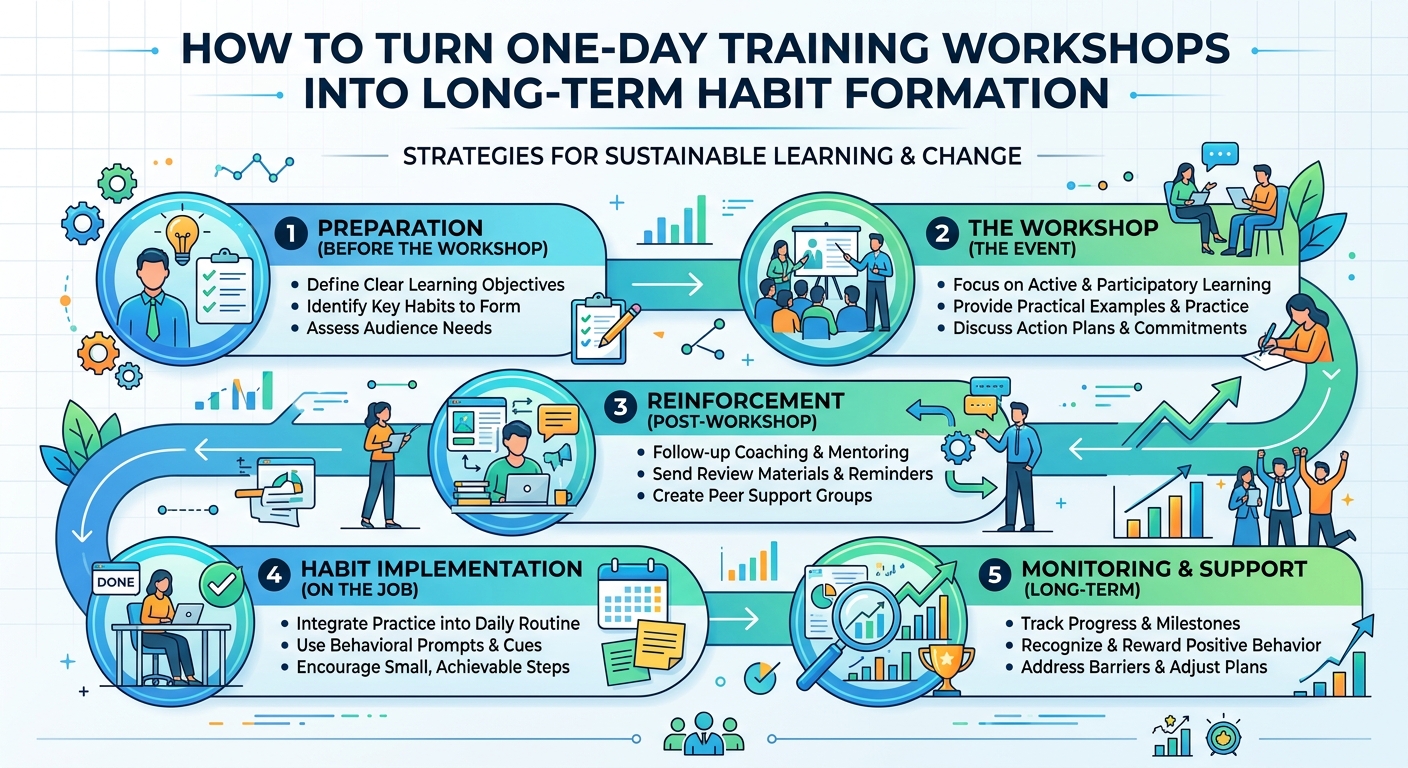
Converting a one-day workshop into a catalyst for lasting habit formation requires a multi-stage strategy that extends before, during, and long after the event itself.
Pre-Workshop Engagement: Setting the Stage for Success
- Needs Assessment & Goal Setting: Clearly define the specific habits or behaviors the workshop aims to cultivate. Communicate these objectives upfront.
- Pre-learning Modules: Introduce core concepts or foundational knowledge using bite-sized content. A Microlearning LMS can deliver engaging videos, quizzes, or short articles that prime learners for the workshop.
- Managerial Buy-in: Equip managers with talking points and expectations so they can support their teams before and after the training.
- Assessment of Current State: Baseline current performance or knowledge to measure future impact.
During the Workshop: Maximizing Engagement and Practical Application
- Interactive & Experiential Learning: Move beyond lectures. Incorporate simulations, role-playing, group discussions, and case studies relevant to your industry (e.g., a simulated compliance audit for banking, a realistic sales negotiation for retail).
- Focus on "Why": Help learners understand the benefits of adopting new habits for themselves and the organization.
- Practice with Feedback: Provide ample opportunities for participants to practice new skills and receive constructive feedback in a safe environment.
- Action Planning: Dedicate time for participants to create personal action plans detailing how they will apply what they've learned in their roles.
How can intelligent systems personalize skill development within a workshop setting? By leveraging an Adaptive Learning approach, an intelligent learning content management system can tailor exercises and feedback in real-time based on a learner's performance and knowledge gaps identified during the workshop, making the experience highly individualized even in a group setting. This ensures each participant focuses on areas where they need the most improvement.
Post-Workshop Reinforcement: The Habit-Building Engine
This is where the real work of habit formation takes place. The post-workshop phase is critical and often overlooked.
- Spaced Repetition & Micro-Challenges: Deliver short, relevant content (e.g., quick quizzes, scenario-based questions, tips) at regular intervals post-training. A Microlearning LMS is ideal for this, helping combat the forgetting curve.
- Peer Support & Community: Foster online forums or discussion groups where learners can share experiences, ask questions, and offer support.
- Managerial Coaching & Accountability: Managers play a crucial role in reinforcing new behaviors through regular check-ins, coaching, and providing opportunities to apply new skills.
- Performance Support Tools: Provide easy access to job aids, checklists, and quick reference guides that learners can consult when applying new skills on the job.
- Gamification: Incorporate elements like points, badges, leaderboards, and challenges. A Gamified LMS can significantly boost engagement and motivate continued practice, especially for complex topics like Risk-focused Training in finance or compliance.
- Feedback Loops & Continuous Improvement: Gather feedback on the effectiveness of new habits and make adjustments to the training and reinforcement strategy as needed.
What are the most effective strategies for contextualizing ongoing training programs for diverse, geographically distributed teams? Utilizing a modern learning management system that supports multi-language content and local case studies is vital. Coupled with a strong "learning management software" platform that allows for localized content delivery and tracking, organizations can ensure relevance whether training is for sales teams across different regions or healthcare professionals in various facilities. A robust LMS with features like an AI Powered Authoring Tool can even help rapidly create and adapt content to specific local contexts, making the information resonate more deeply with learners.
Leveraging Technology for Lasting Impact
The right technology is not just an enabler; it's a fundamental pillar in transforming one-day training into ongoing habit formation. An enterprise learning management solution provides the backbone for this continuous learning journey.
A sophisticated LMS or a dedicated LCMS can orchestrate the entire learning ecosystem. Imagine a "cloud based learning management system" that delivers pre-workshop materials, manages the workshop registration, hosts post-workshop reinforcement modules, tracks progress, and provides analytical insights into behavior change. This is the power of a comprehensive "learning management solutions" platform.
The role of "learning management system" technology extends beyond delivery. With the advancements in "lms learning management system" platforms like MaxLearn LMS, L&D professionals can:
- Automate the delivery of spaced repetition content, ensuring timely reminders and reinforcement.
- Provide interactive quizzes and simulations that mimic real-world scenarios, particularly crucial for compliance and safety training.
- Offer a centralized repository for all learning resources, making performance support readily available.
- Track learner engagement and progress, allowing L&D to identify areas where additional support or intervention might be needed.
- Generate reports that demonstrate the impact of training on key performance indicators, crucial for justifying investment to senior leadership.
How can we measure the long-term return on investment (ROI) for L&D initiatives that focus on behavior change? Advanced analytics capabilities within a modern LMS can correlate learning activity and assessment scores with operational metrics such as reduced error rates in banking, increased sales conversions in retail, improved patient outcomes in healthcare, or enhanced safety records in mining. This data-driven approach allows L&D leaders to demonstrate the tangible benefits of their "learning management system" investments, moving beyond mere completion rates to actual business impact.
Conclusion: Cultivating a Culture of Continuous Growth
For L&D Vice Presidents, Directors, and Managers, the goal isn't just to deliver training; it's to cultivate a workforce that continuously learns, adapts, and performs at its peak. By strategically extending the learning journey beyond the confines of a single-day workshop, embracing a multi-faceted approach to reinforcement, and leveraging the capabilities of a powerful "learning management system" like MaxLearn LMS, organizations can transform fleeting knowledge into deeply ingrained habits. This strategic shift not only maximizes training ROI but also builds a resilient, high-performing culture ready to meet the evolving demands of any industry.
Invest in a learning ecosystem that supports lifelong learning and turns every workshop into a stepping stone towards sustainable excellence.
.jpg)


