

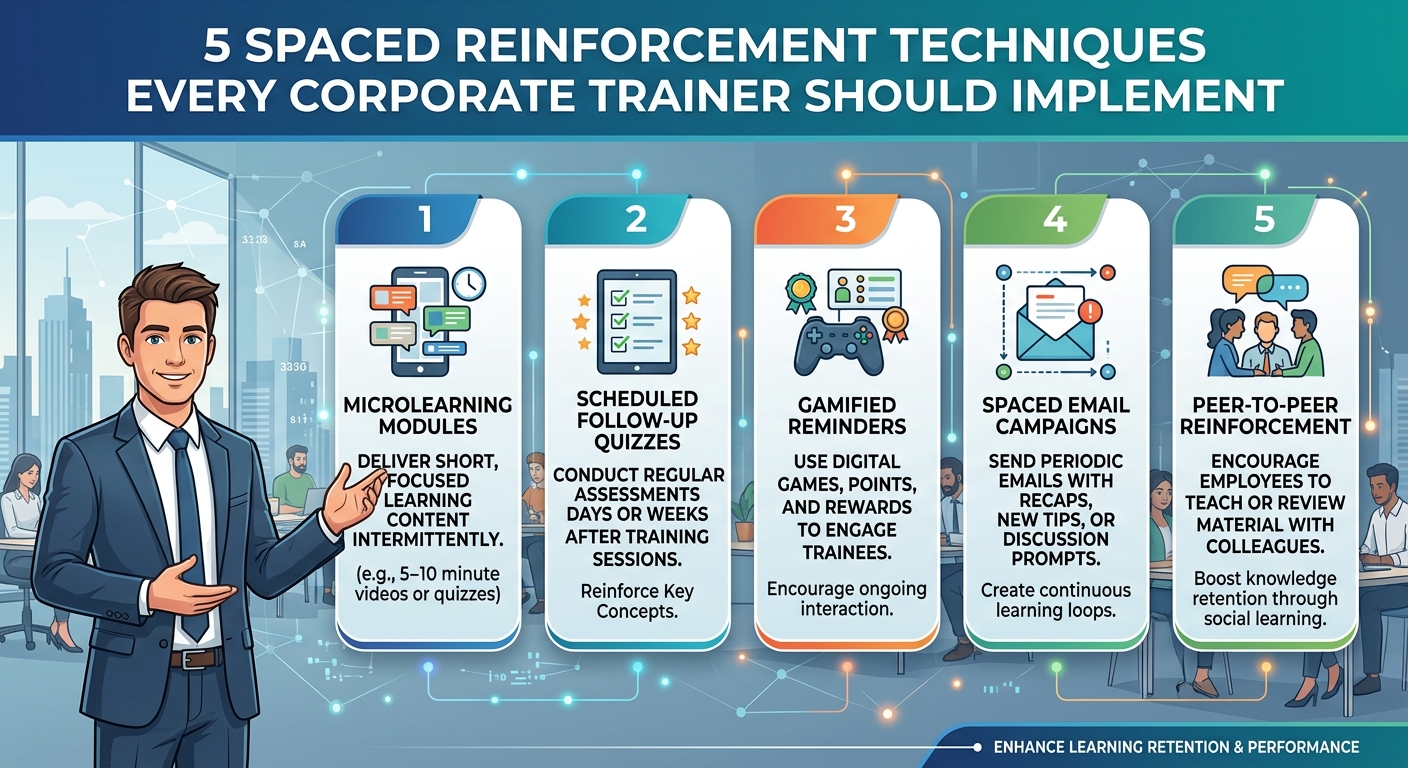
5 Spaced Reinforcement Techniques Every Corporate Trainer Should Implement
In today's fast-paced corporate environment, where information overload is the norm, merely delivering training content is no longer enough. For Vice Presidents, Directors, and Managers of L&D, the ultimate goal is not just completion rates, but demonstrable knowledge retention and application that drives tangible business outcomes. The challenge lies in combating the dreaded 'forgetting curve' – the rapid decline of memory recall after initial learning. This is precisely where spaced reinforcement techniques become indispensable. By strategically revisiting information over time, L&D professionals can dramatically improve long-term retention, foster deeper understanding, and ensure that training investments translate into lasting skill development across critical sectors like Compliance, Sales, Banking, Pharma, and Oil and Gas. This article will delve into five powerful spaced reinforcement techniques that every corporate trainer should integrate into their learning strategy.
Why Spaced Reinforcement is Critical for Modern L&D Leaders
The human brain is wired to forget. Studies show that within just a few days of initial learning, a significant portion of information can be lost if not reinforced. For L&D leaders, this translates to wasted resources, suboptimal performance, and increased risk, especially in high-stakes industries like Finance and Healthcare. Spaced reinforcement, rooted in cognitive science, offers a proactive solution. It’s about delivering timely nudges, practice, and recall opportunities that solidify learning, transforming transient information into ingrained knowledge and practical skills. This approach enhances the effectiveness of any learning management system, leading to better ROI on training programs, whether it's for complex regulatory compliance or aggressive sales targets. Key benefits include:
- Improved Long-term Retention: Combatting the forgetting curve to ensure knowledge sticks.
- Enhanced Performance: Translating learned information into actionable skills and behaviors.
- Greater Training ROI: Maximizing the return on investment for all learning initiatives.
- Reduced Risk: Especially crucial in compliance-heavy sectors like Banking and Pharma, ensuring critical information is recalled.
- Increased Learner Engagement: Breaking down learning makes it less daunting and more interactive.
The 5 Powerful Spaced Reinforcement Techniques
1. Microlearning Modules and Quizzes
Microlearning, characterized by short, focused learning bursts, is perfectly suited for spaced reinforcement. Instead of lengthy, infrequent training sessions, break down complex topics into digestible 5-10 minute modules. These can be delivered daily or weekly, following an initial training. Each module should be accompanied by a quick quiz or assessment to test recall. This iterative exposure keeps the information fresh and actively engages learners without overwhelming them. For instance, in Retail, a daily micro-module on a new product feature or sales technique, followed by a two-question quiz, can significantly boost retention and sales effectiveness. Implementing a robust Microlearning LMS is essential for managing and delivering these bite-sized learning experiences efficiently.
2. Gamified Challenges and Leaderboards
Injecting elements of play into learning can dramatically increase engagement and motivation for spaced practice. Gamification allows learners to revisit content through interactive challenges, simulations, and scenarios, earning points, badges, or climbing leaderboards. This competitive yet fun approach encourages voluntary engagement with refresher content. Consider a banking compliance training where learners periodically engage in a "fraud detection challenge" simulation, competing to identify anomalies. The immediate feedback and public recognition via a Gamified LMS foster a desire to review material and perform better, turning repetitive reinforcement into an enjoyable activity. This is particularly effective for large organizations aiming for enterprise learning management success.
3. Adaptive Learning Paths
One size does not fit all, especially when it comes to spaced reinforcement. Adaptive Learning leverages data analytics to personalize the learning journey, delivering content and reinforcement activities based on an individual's performance, knowledge gaps, and learning style. If a learner consistently struggles with a specific topic, the system can automatically assign additional micro-modules or quizzes focused on that area. Conversely, those who demonstrate mastery can be challenged with advanced content or new topics. This intelligent, tailored approach ensures that reinforcement is efficient and impactful, preventing boredom for advanced learners and providing necessary support for those who need it.
What's the best way to leverage technology to deliver learning content precisely when an employee needs it most for maximum impact?
Implementing an intelligent Adaptive Learning system powered by AI is key. These systems track individual learning progress, identify knowledge gaps, and predict optimal review times based on the forgetting curve. This ensures micro-lessons or refresher quizzes are delivered just before knowledge decay, such as for critical compliance updates in banking or new product features in retail sales, maximizing retention and application. A cloud based learning management system facilitates this seamless delivery.
4. AI-Powered Content Delivery and Recommendations
Artificial intelligence is transforming how L&D teams manage and deliver learning content. AI can analyze vast amounts of data – learner performance, job roles, departmental needs, and even real-time business changes – to recommend the most relevant reinforcement content at the optimal time. Imagine an Insurance agent receiving a notification for a short refresher on a specific policy clause just before meeting a client, or a hospital staff member getting a quick review of a safety protocol before a critical procedure. This predictive capability ensures that spaced reinforcement is not just delivered, but optimized for impact. An AI Powered Authoring Tool can even assist in creating dynamic, responsive content tailored for these intelligent delivery systems, making the entire learning content management system more efficient.
How can artificial intelligence assist L&D leaders in ensuring relevant training reaches geographically dispersed teams effectively?
AI algorithms within a modern Microlearning LMS can analyze user data, roles, and even language preferences to push highly relevant, localized content to employees across different regions. This predictive capability ensures global consistency while maintaining local relevance, drastically improving engagement and compliance in diverse industries like Pharma or Oil and Gas. This is crucial for a global enterprise learning management system.
How can L&D teams optimize vast amounts of learning information and create engaging content efficiently?
An AI Powered Authoring Tool is transformative. It can analyze existing content, suggest improvements for clarity and conciseness, and even auto-generate quiz questions or interactive scenarios. This streamlines content creation, making it easier to produce compelling, up-to-date modules for everything from healthcare protocols to complex financial products, ensuring a consistent and high-quality learning experience within any learning content management system. This efficiency is a game-changer for businesses using a powerful learning management system like MaxLearn LMS.
5. Scenario-Based Practice and Simulations
True reinforcement goes beyond theoretical knowledge; it's about practical application. Scenario-based training and simulations provide a safe environment for learners to apply their knowledge, make decisions, and experience the consequences without real-world risk. For instance, in Hospitality, employees can practice handling difficult guest complaints in a simulated environment, receiving immediate feedback. For Compliance and Risk-focused Training, simulations are invaluable for practicing ethical decision-making or responding to cybersecurity threats. These immersive experiences strengthen neural pathways, making learned behaviors more automatic and durable. Incorporating such practical application into a learning management software strategy solidifies understanding and prepares employees for real-world challenges.
The Indispensable Role of a Robust Learning Management System
Implementing these spaced reinforcement techniques effectively requires a powerful and intuitive learning management system. A modern learning management system serves as the central hub for delivering, tracking, and analyzing all training initiatives. Features such as automated content delivery, progress tracking, comprehensive analytics, and integration capabilities are crucial. Whether you're a Director managing compliance for a global financial institution or a Manager overseeing sales training for a retail chain, a sophisticated learning management software system empowers you to deploy Microlearning LMS modules, manage Gamified LMS experiences, facilitate Adaptive Learning paths, and leverage an AI Powered Authoring Tool. A cloud based learning management system provides the flexibility and scalability needed for enterprise learning management, ensuring your learning content management system is future-proof and your Risk-focused Training is always on point. MaxLearn LMS exemplifies a solution that meets these demanding requirements.
Conclusion
For L&D leaders striving to elevate corporate training beyond mere formality to a true driver of performance and innovation, embracing spaced reinforcement is non-negotiable. By strategically integrating Microlearning, Gamification, Adaptive Learning, AI-powered delivery, and Scenario-based practice, corporate trainers can create a dynamic, engaging, and highly effective learning ecosystem. These techniques not only combat the forgetting curve but also foster a culture of continuous learning and skill mastery. Invest in a cutting-edge learning management system that supports these advanced strategies, and watch your organization achieve unparalleled levels of knowledge retention, operational excellence, and sustained competitive advantage.
.jpg)