

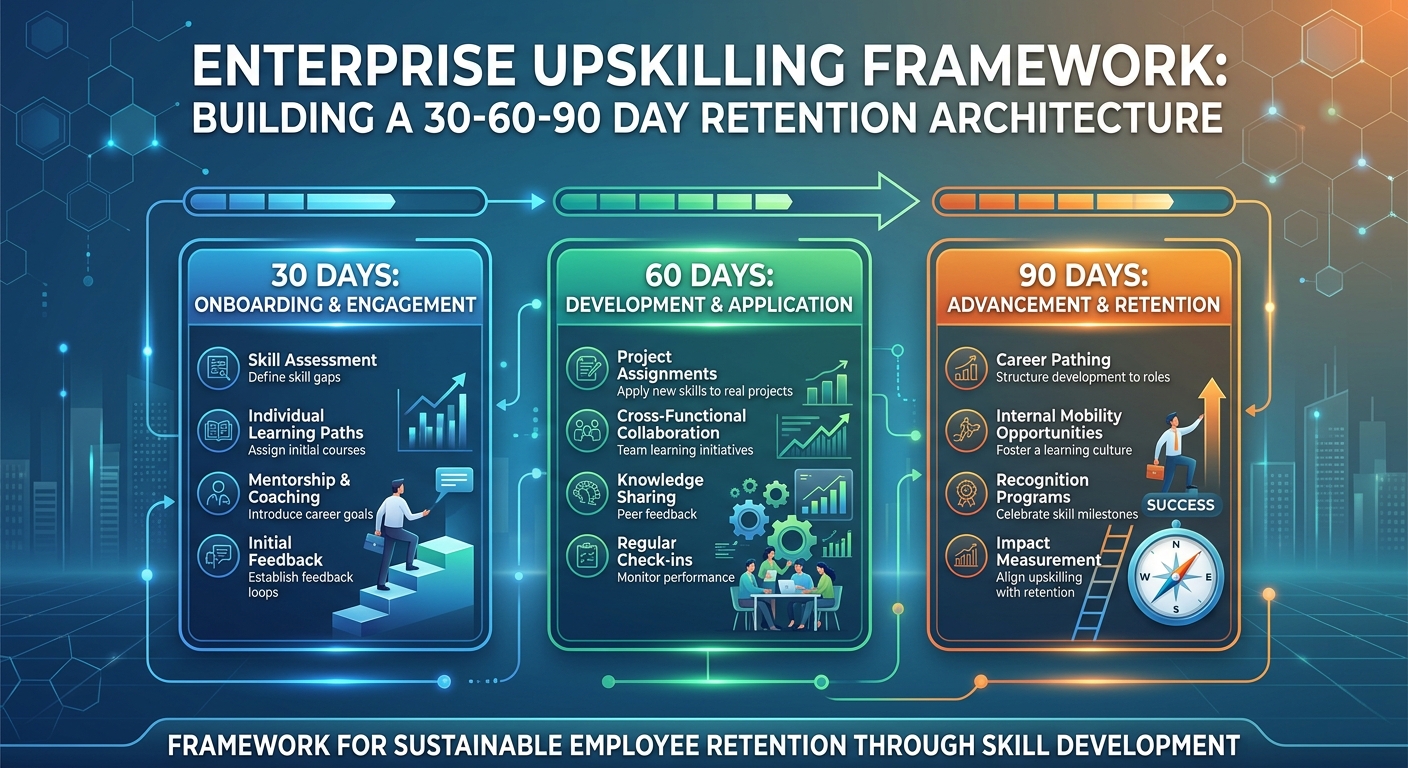
Enterprise Upskilling Framework: Building a 30-60-90 Day Retention Architecture
In today's rapidly evolving business landscape, organizations across industries like Banking, Finance, Insurance, Retail, Pharma, Health care, Hospitality, Oil and Gas, and Mining face a dual challenge: retaining top talent and ensuring their workforce possesses the most relevant skills. The cost of employee attrition, coupled with ever-widening skill gaps, demands a proactive and strategic approach to learning and development. This is where a robust enterprise upskilling framework, particularly a 30-60-90 day retention architecture, becomes not just beneficial, but essential. It’s about building a learning culture that cultivates growth, engagement, and long-term commitment, underpinned by a powerful LMS.
For Vice Presidents, Directors, and Managers of L&D, understanding and implementing such a framework can be the cornerstone of sustainable organizational success. It transforms sporadic training into a continuous journey of professional development, directly impacting employee satisfaction and bottom-line performance.
Understanding the Retention Challenge Through the Lens of Upskilling
Employees today seek more than just a paycheck; they crave growth, purpose, and opportunities for advancement. When these elements are missing, even high-performing individuals begin to look elsewhere. The lack of clear career paths, insufficient skill development, or a perceived stagnation in their roles are major drivers of attrition. The financial implications are staggering, encompassing recruitment costs, onboarding expenses, lost productivity, and diminished institutional knowledge.
An effective upskilling framework directly addresses these pain points. By providing structured, relevant, and engaging learning opportunities, organizations demonstrate a commitment to their employees' futures. This investment not only enhances individual capabilities but also fosters a sense of belonging and value, acting as a powerful retention magnet. The right learning content management system is crucial for managing these initiatives effectively.
The 30-60-90 Day Framework: A Blueprint for Success
The 30-60-90 day framework is a proven methodology for structured onboarding and accelerated development, typically used for new hires. However, its principles can be powerfully adapted to create an ongoing upskilling and retention architecture for existing employees. It provides clear objectives, measurable milestones, and a predictable path for growth, fostering a sense of progress and purpose.
Phase 1: The First 30 Days – Foundation and Immersion
The initial 30 days are critical for grounding employees in new skills or deepening existing ones, particularly when facing evolving industry standards or new technologies. This phase focuses on foundational knowledge, critical updates, and immediate skill-gap closures.
- Objectives:
- Understand new company policies or regulatory changes (e.g., in Compliance, Banking).
- Acquire baseline knowledge for a new project or role.
- Familiarize with updated tools and technologies.
- Strategies:
- Curated learning paths featuring essential Microlearning LMS modules that deliver bite-sized, digestible content.
- Access to a centralized learning management software that houses compliance documentation and quick reference guides.
- Mentor pairing for quick queries and cultural assimilation around new processes.
- Initial goal setting for skill acquisition, ensuring alignment with organizational needs.
- Technology Focus: A personalized learning platform that offers targeted content and tracks initial engagement, identifying areas where further support is needed.
Phase 2: Days 31-60 – Skill Deepening and Application
Building on the foundation, the next 30 days are about applying new skills in practical scenarios and deepening understanding through experiential learning. This phase transitions employees from theoretical knowledge to practical competence.
- Objectives:
- Apply learned skills to real-world tasks or simulated environments.
- Demonstrate proficiency in core job functions or new operational procedures.
- Collaborate with peers on specific projects, integrating new knowledge.
- Strategies:
- Role-playing scenarios for sales teams, customer service interactions, or critical decision-making.
- Simulations that mirror real-world challenges, such as those found in Risk-focused Training for finance or healthcare.
- Project involvement that allows employees to actively use their newly acquired skills.
- Regular feedback loops and peer learning sessions, facilitated by a comprehensive learning management solutions platform.
- Engaging training through a Gamified LMS to reinforce learning and motivate continued progress.
- Technology Focus: A lms learning management system that supports interactive content, tracks skill application, and provides analytics on performance improvement.
Phase 3: Days 61-90 – Growth, Ownership, and Future-Pacing
The final phase solidifies the employee's role, encouraging independent contribution, strategic thinking, and alignment with long-term career goals within the organization. This phase is crucial for transforming skilled employees into invested, long-term assets.
- Objectives:
- Independently execute tasks requiring new skills, taking ownership of outcomes.
- Contribute strategically to team or departmental goals.
- Identify further areas for professional growth and align with career progression paths.
- Strategies:
- Advanced skill development modules, potentially involving cross-functional learning.
- Leadership training or mentorship opportunities, especially for high-potential employees.
- Strategic project assignments that allow for broader impact.
- Personalized career path discussions, leveraging Adaptive Learning paths within the enterprise learning management system.
- Development of thought leadership or internal knowledge sharing.
- Technology Focus: A cloud based learning management system that facilitates advanced modules, career mapping tools, and continuous performance tracking to support ongoing development. This is where an LCMS truly shines.
Leveraging AI for an Intelligent Upskilling Architecture
Artificial intelligence is no longer a futuristic concept; it's a powerful enabler for modern L&D. Integrating AI into your 30-60-90 day framework can elevate it from effective to exceptional, personalizing and optimizing every step of the retention journey.
How can artificial intelligence personalize upskilling experiences for diverse employee needs? AI-driven platforms analyze individual learning styles, performance data, and career aspirations to create highly tailored learning paths. By understanding what an employee already knows, where their skill gaps lie, and how they best absorb information, AI recommends precise content. An AI Powered Authoring Tool can even help L&D teams rapidly generate relevant training modules, ensuring each employee receives the most impactful training at the right time. This level of personalization significantly boosts engagement and knowledge retention, making the learning process far more effective than a one-size-fits-all approach.
What impact does intelligent technology have on the accessibility and delivery of learning resources across different regions or departments? Intelligent algorithms within a learning management system optimize content delivery based on an employee's role, preferred language, and even geographical location, ensuring relevant information reaches the right people. For a global corporation in Oil and Gas or a multi-national healthcare provider, this means critical training on safety protocols, compliance updates, or new product features is accessible and culturally relevant, regardless of where the employee is located. A robust learning management software ensures that learning resources are not only available but also optimally consumed, fostering a unified and efficient enterprise learning management strategy across diverse operational environments.
How can advanced analytical capabilities help organizations predict future skill requirements and proactively address them? Machine learning algorithms can analyze vast datasets, including industry trends, market demands, and internal performance metrics, to forecast emerging skill requirements. This proactive insight allows L&D leaders to design curricula that address future challenges, not just current ones. For instance, in the Financial sector, predicting the need for new digital compliance skills, or in Retail, foreseeing shifts in customer service technologies. Implementing a strategic MaxLearn LMS equipped with these analytics transforms the learning department into a strategic foresight unit, enabling organizations to prepare their workforce for what's next, turning potential skill deficits into significant competitive advantages.
Integrating Key eLearning Components for Holistic Growth
The success of any upskilling framework hinges on the quality and accessibility of its learning components. A modern learning management system (LMS) serves as the central nervous system for this architecture, providing the tools and functionalities necessary for seamless execution.
- A Microlearning LMS ensures that learning is never a disruption but an integrated part of the workday, delivering quick bursts of information that are easy to consume and retain.
- A Gamified LMS injects an element of fun and competition, boosting motivation and completion rates, especially valuable for routine or complex training.
- Adaptive Learning capabilities personalize the learning journey, adjusting content and pace based on individual progress and preferences, making learning highly efficient.
- An AI Powered Authoring Tool empowers L&D teams to quickly create and update high-quality, relevant content, ensuring the learning library remains dynamic and fresh.
- For industries with high stakes, Risk-focused Training within the LMS ensures employees are always up-to-date on compliance, safety, and ethical guidelines, mitigating potential organizational liabilities.
Whether you're looking for a comprehensive learning content management system, robust learning management software, or scalable learning management solutions, the key is to select a platform that can support the dynamic needs of an enterprise. A cloud based learning management system offers flexibility and accessibility, critical for a distributed workforce. Ultimately, a powerful MaxLearn LMS becomes indispensable for truly effective enterprise learning management.
Conclusion
Building a 30-60-90 day retention architecture through a thoughtful enterprise upskilling framework is a strategic imperative for L&D leaders. It's an investment that pays dividends in employee engagement, reduced attrition, enhanced productivity, and a future-ready workforce. By meticulously planning each phase and leveraging the transformative power of AI and sophisticated eLearning tools like a comprehensive LMS, organizations can cultivate a culture of continuous growth and commitment.
The challenges of talent retention and skill development are ongoing, but with a structured framework and intelligent technology, your organization can not only meet them but turn them into powerful opportunities for sustained success and innovation. Invest in your people, invest in your future.
.jpg)


