

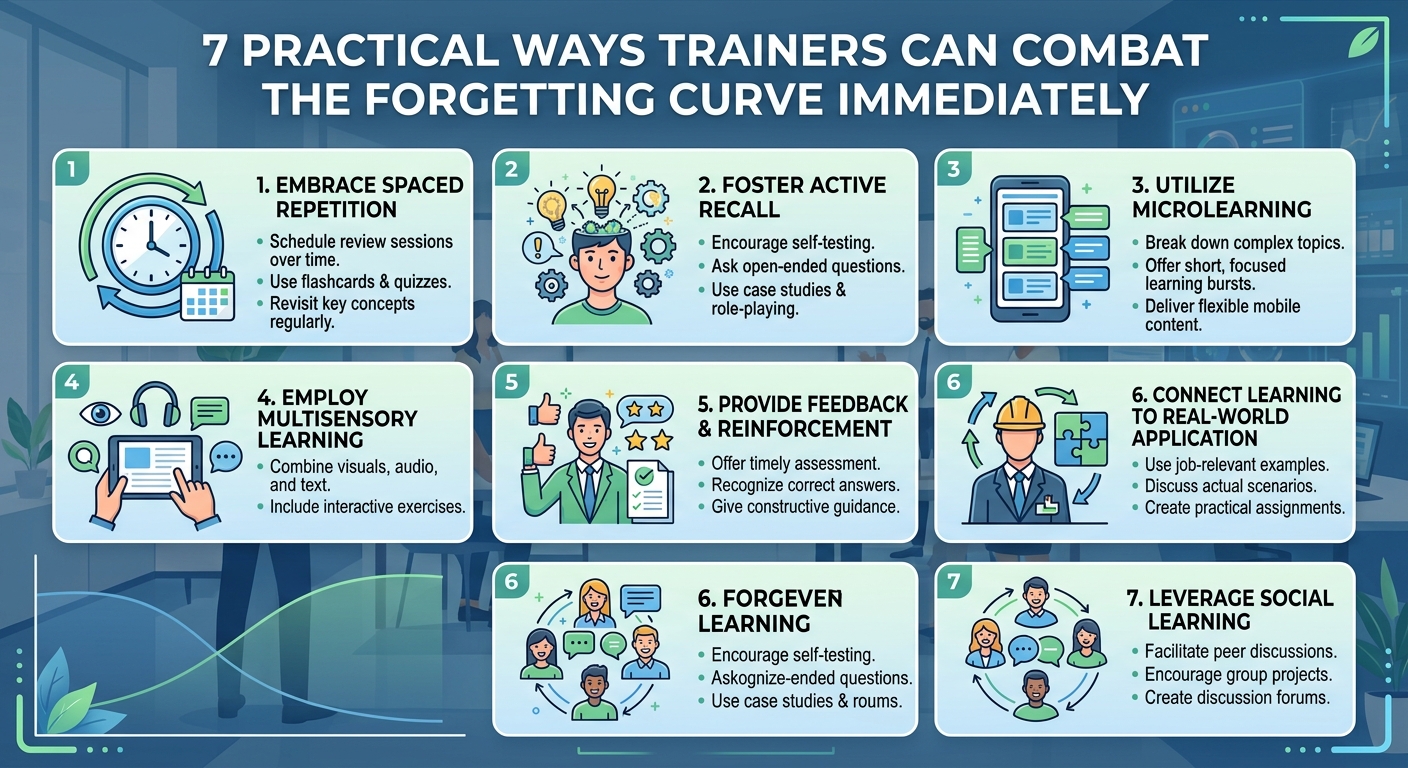
7 Practical Ways Trainers Can Combat the Forgetting Curve Immediately
In the fast-paced world of corporate learning and development, the "forgetting curve" remains a formidable adversary. Hermann Ebbinghaus's century-old research still holds true: without reinforcement, learners can forget up to 90% of what they've learned within a week. For Vice Presidents, Directors, and Senior Managers of L&D, particularly in high-stakes sectors like Compliance, Sales, Banking, Finance, Insurance, Retail, Pharma, Health care, Hospitality, Oil and Gas, and Mining, this challenge isn't just about recall; it translates directly into performance gaps, compliance risks, and lost revenue. Combatting this phenomenon isn't a luxury; it's a strategic imperative.
This article explores seven practical, immediate strategies trainers can implement to flatten the forgetting curve, ensuring that critical knowledge sticks and transforms into lasting competence. We'll also examine how advanced learning management solutions can serve as powerful allies in this ongoing battle.
The Challenge: Battling the Forgetting Curve in Modern L&D
The modern learner is bombarded with information, making the retention of specific training content more challenging than ever. For L&D leaders, the investment in training programs—be it for new product launches, regulatory compliance, sales methodologies, or critical safety protocols—demands a tangible return. If knowledge erodes quickly, that return diminishes. The goal isn't just to deliver information; it's to embed it, making it accessible and actionable when needed. A robust LMS is often the foundational technology that enables these strategies, acting as a central hub for all learning content management system activities.
7 Practical Strategies to Immediately Combat the Forgetting Curve
1. Embrace Microlearning for Bite-Sized Consumption
Traditional long-form courses can overwhelm learners, contributing significantly to information overload and subsequent forgetting. Microlearning LMS platforms offer a powerful antidote by breaking down complex topics into short, focused modules (2-7 minutes). These digestible chunks are easier to consume, understand, and recall. For industries requiring continuous updates, such as Pharma or Finance, microlearning ensures that employees can quickly grasp new policies or product features without disrupting their workflow. It's about delivering just-in-time, relevant information that can be accessed anytime, anywhere, fostering better retention.
2. Leverage Spaced Repetition and Retrieval Practice
Science tells us that revisiting information at increasing intervals and actively recalling it strengthens memory. Trainers can integrate spaced repetition by scheduling automated reminders, short quizzes, or flashcards delivered days or weeks after initial training. Retrieval practice, such as asking learners to explain concepts in their own words or solve problems based on learned material, forces active engagement rather than passive absorption. This can be seamlessly managed through a sophisticated learning management software system designed to automate such reinforcement schedules, significantly boosting retention across all segments, from Retail sales to Oil and Gas safety training.
3. Gamify the Learning Experience
Engagement is a critical component of retention. Gamified LMS environments inject elements like points, badges, leaderboards, and challenges into training. This taps into intrinsic motivation, making learning more enjoyable and memorable. For example, in Sales training, a gamified scenario where reps compete to close virtual deals, earning points for correct product knowledge and objection handling, not only teaches but also reinforces skills in a low-risk, high-engagement format. Gamification encourages repeated interaction with content, directly countering the forgetting curve by making recall fun and rewarding.
4. Personalize Learning with Adaptive Paths
Every learner is unique, with different prior knowledge, learning styles, and paces. One-size-fits-all training often fails to address individual needs, leading to disengagement and poor retention. Adaptive learning tailors the content and pace based on a learner's performance and preferences. An L&D Director might consider, "How can I ensure our extensive compliance training content truly resonates with each individual learner, delivering precisely what they need, exactly when they need it, and in a format that maximizes retention?" The answer lies in data-driven personalization. By implementing Adaptive Learning paths, trainers can guide learners through material most relevant to them, reinforcing weak areas and skipping already mastered concepts, ensuring more efficient and effective learning that sticks.
5. Implement Contextual and Just-in-Time Support
The best time to learn something is often precisely when you need it. Providing access to job aids, checklists, and brief instructional videos at the point of need significantly enhances recall and application. Imagine a sales manager asking, "What's the most effective way to provide on-the-job guidance for our remote field agents, ensuring they access the right information for specific client scenarios or regulatory requirements, regardless of their physical location?" Technologies offering contextual learning through an enterprise learning management system are key. This could be a quick reference guide on a mobile device for a healthcare professional administering medication or a step-by-step video for a hospitality employee troubleshooting equipment. This just-in-time support bridges the gap between formal training and real-world application, making knowledge immediately useful and therefore more memorable.
6. Utilize AI for Content Creation and Curation
Developing engaging and relevant training content can be time-consuming. An L&D VP might wonder, "Beyond just delivering content, how can we intelligently predict which learners are struggling or about to forget critical information, and then proactively offer targeted interventions to reinforce that knowledge?" AI Powered Authoring Tool solutions can dramatically streamline this process by assisting in generating, personalizing, and curating learning materials. AI can analyze vast amounts of data to identify knowledge gaps, suggest content modifications, or even create new microlearning modules on demand. This frees up trainers to focus on facilitation and strategic program design, while ensuring the learning content management system delivers highly relevant and continuously optimized training, a crucial advantage in sectors like Banking and Insurance with frequently updated regulations.
7. Focus on Risk-Based Training
Not all information carries the same weight. By identifying the highest-risk areas of knowledge or skill gaps within an organization, L&D can prioritize training efforts and reinforcement strategies. For instance, in Compliance or Health Care, understanding critical safety protocols or regulatory requirements is paramount. An L&D leader might ask, "How do we ensure our training investments are most effectively addressing the most critical vulnerabilities in our workforce, especially in rapidly evolving regulatory landscapes?" Adopting a Risk-focused Training approach ensures that the most crucial information receives the strongest emphasis and the most frequent reinforcement, directly impacting business continuity and mitigating potential liabilities. This strategic focus ensures maximum impact against the forgetting curve where it matters most.
The Role of a Robust LMS in Retention
Implementing these strategies effectively requires a powerful learning management system (LMS). A modern, cloud based learning management system acts as the backbone for your entire learning ecosystem. It facilitates the delivery of microlearning modules, tracks learner progress for adaptive paths, hosts gamified experiences, and serves as a central repository (LCMS) for all learning content management system assets. For an L&D department managing hundreds or thousands of employees across various industries—from Health care to Mining—a scalable and intuitive learning management system is indispensable. Platforms like MaxLearn LMS provide the comprehensive features necessary to not just deliver training, but to ensure that learning management solutions actively combat the forgetting curve through intelligent design and delivery.
Investing in a sophisticated learning management software that integrates these capabilities empowers L&D professionals to move beyond mere information dissemination to genuine knowledge retention and skill mastery. By strategically applying these seven practical ways, trainers can immediately begin to flatten the forgetting curve, cultivating a more knowledgeable, competent, and compliant workforce prepared for the challenges of today and tomorrow.
.jpg)


