

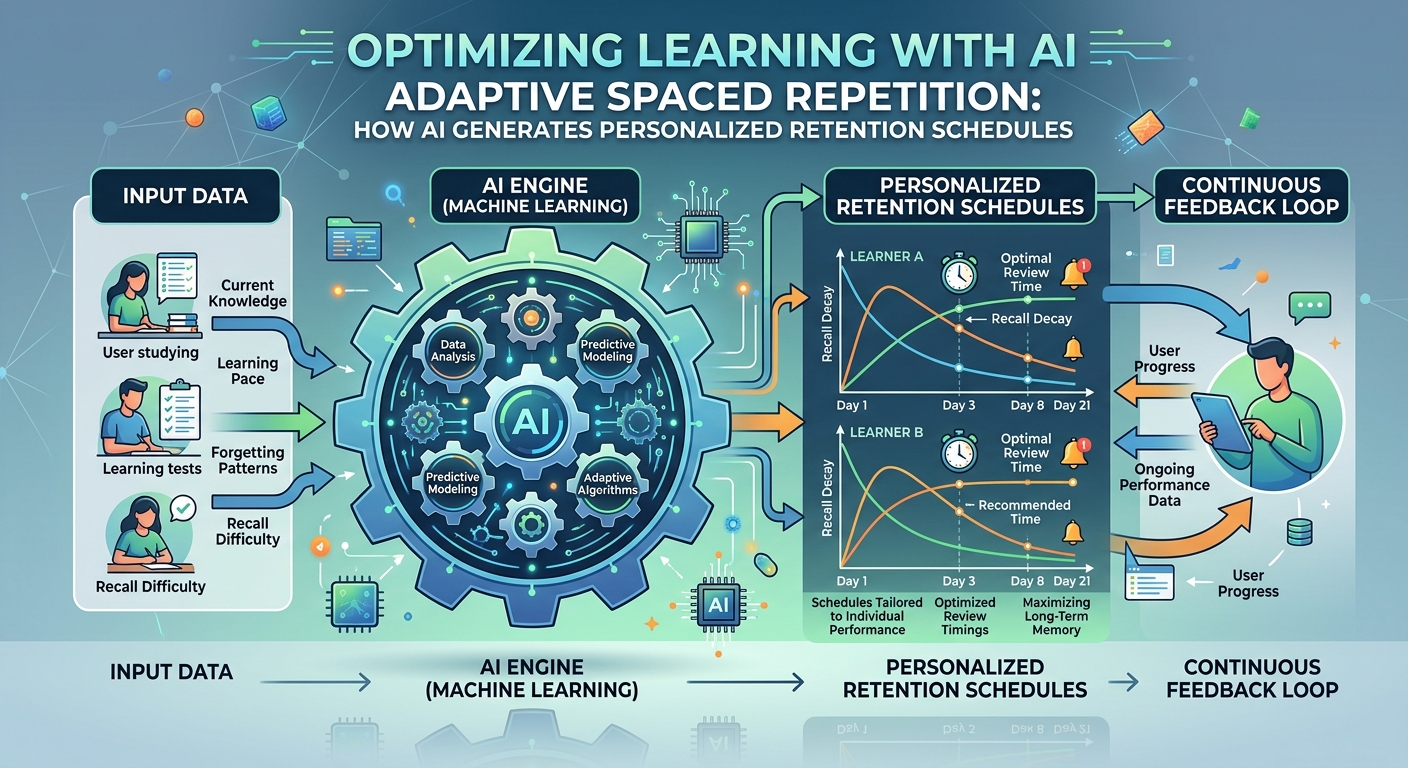
Adaptive Spaced Repetition: How AI Generates Personalized Retention Schedules for L&D
In the fast-evolving landscape of corporate learning, L&D leaders like you face a perennial challenge: ensuring knowledge sticks. Employees are bombarded with information, and the traditional "train-and-forget" model leads to significant knowledge decay. How do you move beyond mere content delivery to true, lasting retention, optimizing your investment in training?
The answer lies in the intelligent application of technology, specifically through Adaptive Spaced Repetition powered by Artificial Intelligence. This isn't just a buzzword; it's a strategic shift that promises to revolutionize how your organization approaches learning, driving unprecedented engagement, proficiency, and return on investment.
The Imperative of Knowledge Retention in Modern Enterprises
Consider the critical need for up-to-date knowledge across your organization. In Compliance, every policy update is vital. For Sales, product knowledge and negotiation tactics are revenue drivers. In Banking and Finance, understanding complex regulations and risk profiles is non-negotiable. Healthcare professionals must stay current with protocols, while Pharma teams need intricate drug knowledge. Even in Retail, Hospitality, Oil and Gas, or Mining, consistent skill application and safety adherence are paramount. The cost of forgotten information can range from missed opportunities to regulatory penalties or even safety incidents.
Traditional learning approaches often fall short. Workshops and lengthy courses provide an initial spike in knowledge, but without reinforcement, the "forgetting curve" quickly takes its toll. The sheer volume of information makes it impossible for individuals to retain everything through rote memorization.
What is Spaced Repetition, and Why Does it Need AI?
Spaced repetition is a learning technique that involves reviewing information at increasing intervals, right before you're about to forget it. It's a scientifically proven method to transfer information from short-term to long-term memory. Historically, this has been managed manually (think flashcards) or through static, pre-set schedules, which lack personalization.
This is where AI enters the equation, transforming a robust learning principle into a dynamic, hyper-personalized retention engine. By leveraging advanced algorithms and machine learning, AI elevates spaced repetition from a helpful technique to a strategic imperative for any modern LMS or learning content management system.
How Does AI Personalize the Retention Schedule?
Many L&D leaders wonder: "How can technology truly understand and adapt to an individual's learning needs?" AI achieves this by continuously analyzing a wealth of data points:
- Learner Performance Data: AI tracks how well an individual performs on assessments, quizzes, and practical exercises. It notes incorrect answers, areas of hesitation, and consistent strengths.
- Interaction Patterns: Beyond just right or wrong, AI observes how learners engage with content – time spent, types of content accessed, and even emotional responses (if gathered through sentiment analysis in specific platforms).
- Confidence Levels: Some systems incorporate self-reported confidence scores or infer confidence from response times.
- Content Difficulty: AI can analyze the intrinsic difficulty of learning modules, categorizing content to predict potential challenge areas.
- Forgetting Curve Prediction: Based on an individual's past performance and the nature of the content, AI algorithms precisely predict when a piece of information is likely to be forgotten. This is the core magic: surfacing content just before recall becomes difficult.
Using this data, AI dynamically adjusts the review intervals for each piece of learning content. If a learner masters a concept quickly, the review interval is extended. If they struggle, the interval is shortened, and the content might be presented in a different format or with additional supporting material. This creates a truly Adaptive Learning pathway for every employee.
The Tangible Benefits for L&D Leaders and Your Organization
Integrating AI-powered adaptive spaced repetition into your learning management system offers a host of strategic advantages:
1. Maximize ROI on Training Investments
By ensuring knowledge retention, you effectively extend the shelf-life of your training programs. Every dollar spent on content development and delivery yields greater, longer-lasting value, transforming your learning management solutions into true performance drivers.
2. Enhance Compliance and Mitigate Risk
For industries heavily regulated like Banking, Finance, Pharma, and Healthcare, continuous and verifiable knowledge of policies, procedures, and regulations is paramount. AI-driven retention ensures critical information is always top-of-mind, significantly reducing the risk of non-compliance. This is particularly effective for Risk-focused Training initiatives.
3. Accelerate Skill Acquisition and Proficiency
Whether it's onboarding new hires, upskilling existing staff, or rolling out new products, AI helps employees achieve proficiency faster and maintain it longer. Sales teams can quickly master new product features, while technical staff can retain complex operational procedures more effectively.
4. Personalized Learning at Scale
One of the long-standing challenges in L&D has been delivering personalized learning without exorbitant costs. An enterprise learning management system integrated with AI provides individualized learning journeys to thousands of employees concurrently, something impossible with traditional methods. This ensures everyone gets exactly what they need, when they need it.
5. Data-Driven Insights for Program Optimization
AI doesn't just deliver learning; it also gathers invaluable data. Your lms learning management system can provide analytics on common forgetting points, content efficacy, and overall knowledge gaps across departments. This allows L&D teams to refine content, identify areas for improved instruction, and make smarter strategic decisions about future training initiatives.
6. Boost Employee Engagement and Satisfaction
Learners appreciate systems that understand and adapt to them. When training feels relevant, timely, and supportive of their individual needs, engagement soars. The integration of Gamified LMS elements can further enhance this engagement, turning learning into an enjoyable and rewarding experience.
Implementing AI-Powered Adaptive Spaced Repetition
So, what does this look like in practice? An advanced cloud based learning management system that incorporates AI for spaced repetition often features:
- Smart Content Delivery: Short, digestible bursts of information (microlearning) that are easy to consume and review.
- Intelligent Quizzing: Questions that adapt based on previous answers, focusing on areas of weakness.
- Automated Scheduling: The system automatically reminds learners when it's time to review specific topics, minimizing administrative overhead.
- Performance Dashboards: For both learners and L&D managers, providing real-time insights into knowledge mastery and retention trends.
Many organizations are now seeking out a MaxLearn LMS or similar advanced learning management software solutions that offer these capabilities. Paired with an AI Powered Authoring Tool, L&D teams can even create adaptive content more efficiently, making the entire ecosystem smarter and more responsive.
The Future is Personalized: Embrace AI for Lasting Learning
The question is no longer "if" AI will transform L&D, but "how quickly" your organization will harness its power. By adopting adaptive spaced repetition driven by AI, L&D leaders can transition from simply delivering content to actively engineering long-term knowledge retention. This strategic move not only optimizes your current training efforts but future-proofs your workforce, ensuring they possess the critical knowledge and skills needed to thrive in an ever-changing business world.
Explore how a cutting-edge LCMS can empower your organization to build a smarter, more knowledgeable, and highly adaptable workforce.
.jpg)


