

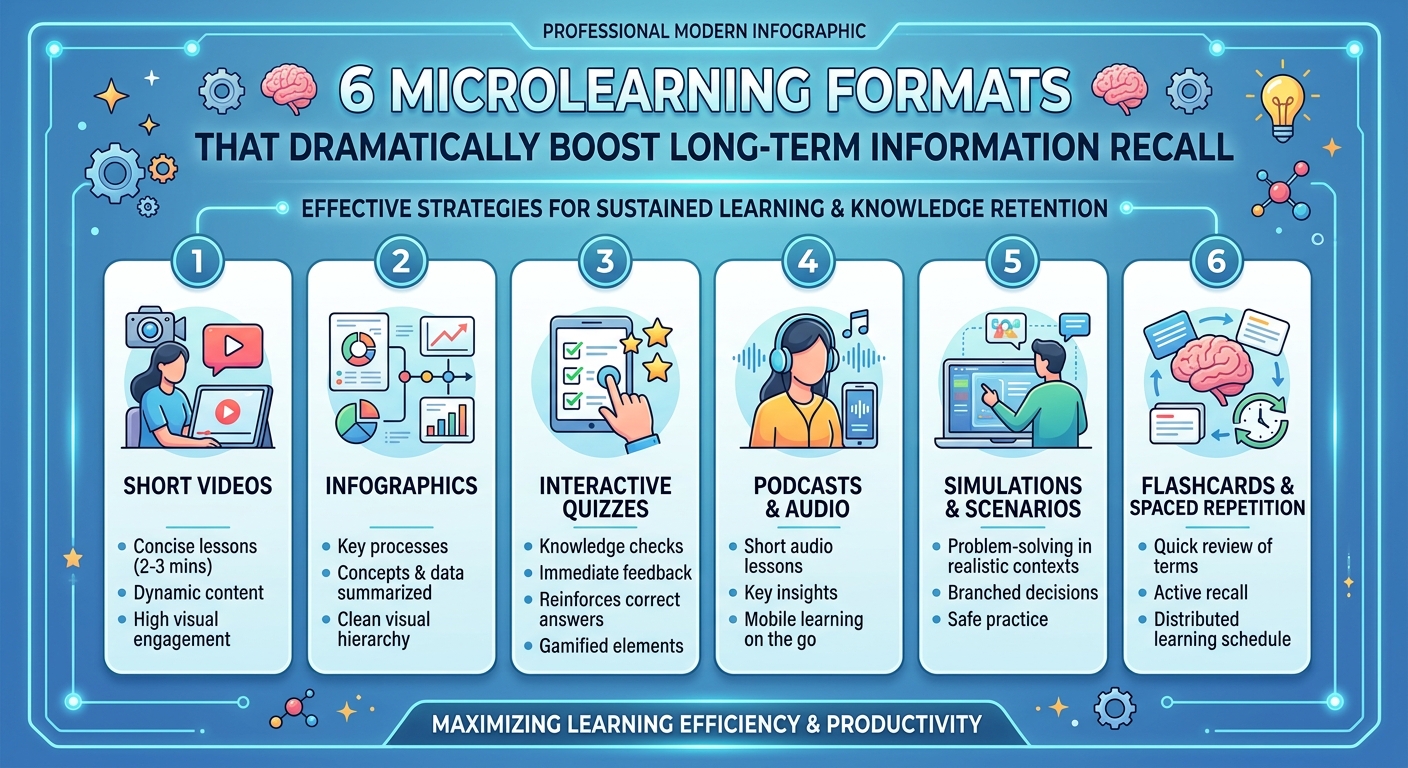
6 Microlearning Formats That Dramatically Boost Long-Term Information Recall
In today's fast-paced corporate environment, the efficacy of employee training directly impacts organizational success. For L&D Vice Presidents, Directors, and Managers, the persistent challenge isn't just delivering content, but ensuring that critical information sticks—especially across diverse industries like Banking, Pharma, Retail, and Oil and Gas. Traditional long-form training often struggles against the brain's inherent limitations, leading to the dreaded "forgetting curve." But what if there was a strategic approach to learning that aligned with how our brains naturally acquire and retain information? This is where microlearning shines, offering powerful solutions for sustained knowledge retention and application.
Many learning professionals often ask: What's the most effective way to combat the forgetting curve? The answer lies in breaking down complex topics into digestible, focused units. Microlearning, defined as short, bite-sized learning activities, is designed to fit into an employee's workflow, making learning accessible, engaging, and remarkably effective for long-term recall. From onboarding new hires in Healthcare to ensuring compliance in Finance, microlearning is transforming how enterprises train their workforce. Let's explore six microlearning formats that can dramatically boost long-term information recall and drive measurable business outcomes.
1. Interactive Quizzes and Assessments
Interactive quizzes and assessments are more than just a way to test knowledge; they are powerful learning tools in themselves. By actively retrieving information, learners strengthen neural pathways, a process known as retrieval practice. This active recall is far more effective than passive review. Imagine sales teams in the Insurance sector needing to quickly recall product features or banking professionals needing to remember specific compliance regulations. Short, scenario-based quizzes—perhaps 2-3 questions long—can be embedded throughout a learning path, reinforcing key concepts immediately after they are introduced.
These formats are particularly effective when delivered through a robust Microlearning LMS. Such a system can track performance, identify knowledge gaps, and even personalize subsequent learning experiences. Is there a strategy that offers both flexibility and measurable impact? Absolutely. Frequent, low-stakes quizzes make learning sticky and provide instant feedback, fostering a continuous learning mindset essential for any enterprise learning management strategy.
2. Short Explainer Videos
Video is a king in microlearning, thanks to its ability to convey complex information visually and audibly in a short timeframe. A 2-5 minute video can explain a process, demonstrate a skill, or clarify a concept more effectively than pages of text. Consider the hospitality industry training new staff on a specific check-in procedure or a manufacturing plant implementing new safety protocols. A concise, professionally produced explainer video captures attention and reduces cognitive load, making the information easier to absorb and recall.
As organizations expand globally, how can consistent, high-quality training be delivered? Videos stored within a learning management system can be accessed anywhere, anytime, ensuring uniformity in training delivery across all locations and departments. When combined with an AI Powered Authoring Tool, creating such impactful video content becomes significantly faster and more efficient, allowing L&D teams to focus on strategy rather than production bottlenecks.
3. Infographics and Visual Summaries
Our brains are wired to process visual information rapidly. Infographics and visual summaries leverage this by presenting complex data, processes, or relationships in a visually appealing and easy-to-digest format. Think of a financial institution needing to communicate changes in investment products, or a pharmaceutical company explaining the side effects of a new drug. A well-designed infographic can condense critical information into a single image, making it highly memorable.
These visual aids serve as excellent job aids and refreshers. Stored in a learning content management system, employees can quickly reference them whenever needed, reinforcing learning without requiring them to sift through extensive documentation. This quick access is crucial for recall, especially when dealing with compliance or operational procedures in high-stakes environments like Mining or Oil and Gas.
4. Interactive Simulations and Scenarios
Learning by doing is arguably the most effective form of retention. Interactive simulations and scenarios allow learners to practice new skills or apply knowledge in a risk-free environment. For instance, a sales professional can practice handling customer objections in a simulated conversation, or a healthcare worker can navigate a patient care scenario. This experiential learning significantly boosts long-term recall by creating practical connections to the information.
A Gamified LMS often incorporates these simulations, adding elements of challenge and reward that further engage learners. By allowing learners to make decisions and see the consequences, these formats transform abstract knowledge into tangible experience. This is especially vital for Risk-focused Training, where understanding the practical application of policies and procedures can prevent costly errors.
5. Gamified Challenges and Micro-Games
Gamification taps into our natural desire for achievement and competition, making learning intrinsically motivating. Short, game-like challenges—think quick puzzles, drag-and-drop exercises, or short decision-making games—can reinforce learning points in an entertaining way. When training retail staff on new POS systems or teaching compliance in the finance sector, gamified elements within a learning management software can transform mundane topics into engaging experiences.
What methods ensure knowledge retention is both fun and effective? By integrating game mechanics into learning, employees are more likely to revisit content, increasing exposure and solidifying recall. A sophisticated cloud based learning management system can host a variety of these micro-games, complete with leaderboards and badges, fostering a healthy competitive spirit that drives engagement and continuous learning.
6. Spaced Repetition Flashcards
Rooted in cognitive science, spaced repetition is a powerful technique for moving information from short-term to long-term memory. Flashcards, when managed by an intelligent system, present information at increasing intervals, right before the learner is about to forget it. This "just-in-time" reinforcement is incredibly effective for recalling specific facts, terminology, or processes, which is crucial in industries like Pharma, where precise recall of drug names and dosages is paramount.
Implementing Adaptive Learning capabilities within an LMS learning management system allows the system to intelligently schedule these flashcard reviews based on individual performance. This personalized approach ensures that learners spend time on what they don't know, optimizing their study time and maximizing recall efficiency. For enterprise learning management, this means less time retraining and more time on productive work.
Beyond the Formats: The Power of a Comprehensive LMS
While these microlearning formats are individually powerful, their true potential is unlocked when integrated within a comprehensive learning management system like MaxLearn LMS. An effective LMS provides the infrastructure to deliver, track, and manage all your microlearning initiatives across various industries. It ensures that content is easily accessible, performance is monitored, and the learning experience is consistent and engaging.
A modern learning management system should offer features that support these microlearning strategies, from an intuitive content management system (LCMS) to advanced analytics that pinpoint areas for improvement. By investing in a robust Microlearning LMS, L&D leaders can ensure that their training programs not only meet compliance requirements but also genuinely empower employees with lasting knowledge and skills.
Conclusion
The quest for effective, long-lasting information recall is a critical priority for L&D leaders across all industries. By strategically adopting these six microlearning formats—interactive quizzes, short explainer videos, infographics, interactive simulations, gamified challenges, and spaced repetition flashcards—organizations can dramatically enhance their training efficacy. These bite-sized approaches align with human cognition, boost engagement, and most importantly, ensure that vital information is not just learned but remembered and applied when it matters most.
To truly harness the power of microlearning and drive superior business outcomes, consider a state-of-the-art MaxLearn LMS. It provides the ideal platform to implement these formats, foster a culture of continuous learning, and ensure your workforce is always equipped with the knowledge needed to excel.
.jpg)


