

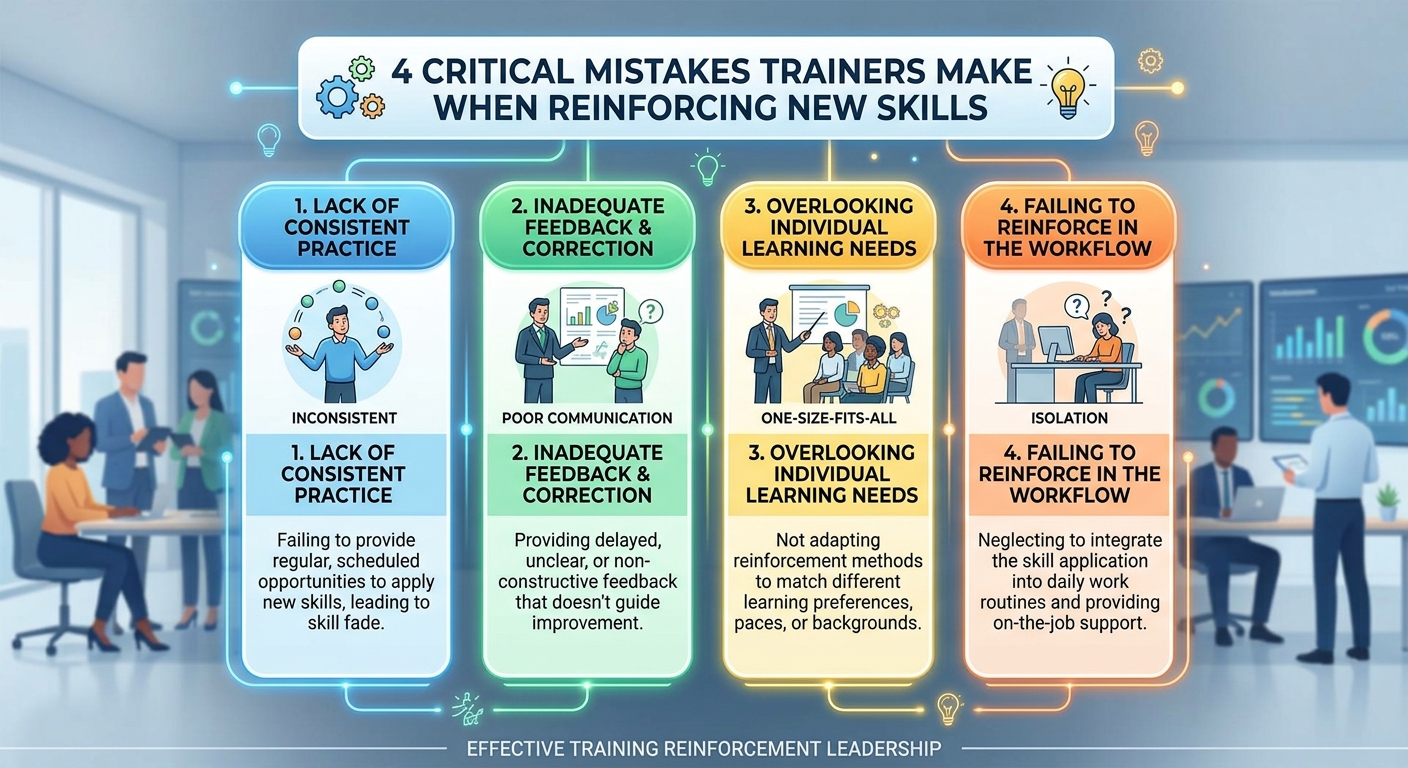
4 Critical Mistakes Trainers Make When Reinforcing New Skills
In today's dynamic business landscape, from the intricate regulations of banking and finance to the critical patient safety in healthcare, and the ever-evolving sales strategies in retail or the complex compliance in pharma and oil & gas, effective skill reinforcement is paramount. For Vice Presidents, Directors, Senior Managers, and Managers of Learning & Development, the goal isn't just to deliver training; it's to ensure new skills stick, translate into tangible performance improvements, and drive organizational growth. Yet, even the most dedicated trainers can inadvertently fall into traps that undermine their efforts.
The success of any eLearning initiative hinges on how well new knowledge transitions from the training room (virtual or physical) to everyday application. As L&D leaders, understanding these pitfalls is the first step towards building more robust, impactful, and truly transformative learning programs. Let's delve into four critical mistakes trainers often make when reinforcing new skills and explore how a modern Microlearning LMS can provide a strategic advantage.
Mistake #1: The "One-and-Done" Training Approach
One of the most common and detrimental errors is treating training as a singular event rather than an ongoing process. A new skill, whether it's understanding complex financial instruments, mastering new compliance procedures, or implementing a cutting-edge sales technique, requires consistent practice and reinforcement to become ingrained. Forgetting curve research has long demonstrated that people forget a significant portion of what they learn shortly after a training session if not actively reinforced.
When trainers present information once and expect learners to retain and apply it perfectly, they set both the learners and the organization up for failure. This approach is particularly damaging in high-stakes environments like healthcare or aviation, where immediate application and retention of knowledge are critical for safety and performance.
Solution: Embrace Continuous, Spaced Reinforcement
Effective skill reinforcement demands a continuous strategy that combats the forgetting curve. This means breaking down learning into smaller, digestible chunks delivered over time. A robust Microlearning LMS is instrumental here, enabling trainers to deploy short, focused content like quizzes, scenarios, and reminders at optimal intervals post-training. This spaced repetition methodology significantly boosts retention and helps learners convert newly acquired knowledge into long-term memory and habitual behavior.
For industries with continuous regulatory updates, like compliance in banking or pharma, providing ongoing, bite-sized updates through a modern learning management system ensures employees are always up-to-date, reducing risk and improving adherence.
Mistake #2: Applying a "One-Size-Fits-All" Reinforcement Strategy
Every learner is unique, with different prior knowledge, learning styles, and job roles. Imposing a uniform reinforcement strategy across a diverse workforce — whether in a global hospitality chain or a multi-departmental financial institution — fails to acknowledge these individual differences. What might be an effective reinforcement for an experienced sales manager could be overwhelming for a new hire, and vice-versa. Generic reinforcement often leads to disengagement, frustration, and ultimately, ineffective skill transfer.
In sectors like mining or oil and gas, where operational roles vary widely, a blanket approach to reinforcing safety protocols or technical skills can leave critical gaps in understanding, potentially leading to errors or accidents.
Solution: Leverage Personalized and Adaptive Learning Paths
The key to overcoming this mistake is personalization. Modern learning management software can analyze learner performance, identify knowledge gaps, and then deliver tailored reinforcement content. Adaptive Learning technologies dynamically adjust the learning path based on individual progress and needs. This ensures that learners receive the right reinforcement at the right time, focusing on areas where they struggle and skipping content they've already mastered. This approach makes learning more relevant, engaging, and efficient for everyone, from entry-level staff to senior management.
An enterprise learning management system with adaptive capabilities can transform how organizations manage skill reinforcement, making it a powerful tool for developing highly competent and adaptable teams.
Mistake #3: Neglecting Engagement and Practical Application
Reinforcement shouldn't just be about repeating facts; it needs to be engaging and deeply connected to practical application. Trainers often make the mistake of relying solely on passive review methods, such as re-reading notes or watching recorded lectures, which do little to foster deep understanding or the ability to apply skills in real-world scenarios. Without opportunities to actively practice and apply new skills, learners struggle to bridge the gap between theory and execution, making the reinforcement efforts largely ineffective.
For instance, in sales training, merely reviewing product features isn't enough; trainees need to practice objection handling and role-play customer interactions. In manufacturing, reinforcing new machinery operation requires hands-on simulation or practical tasks, not just theoretical recall.
Solution: Integrate Gamification and Real-World Scenarios
To truly solidify new skills, reinforcement must be interactive and simulate real-world challenges. Gamified LMS features transform reinforcement into an exciting and motivating experience. Elements like points, badges, leaderboards, and interactive simulations encourage active participation and provide immediate feedback. Incorporating case studies, problem-solving exercises, and decision-making scenarios allows learners to practice applying their skills in a safe environment, building confidence and competence.
By making reinforcement engaging and practical, trainers ensure that learners not only remember the information but also know how to effectively use it in their day-to-day roles, enhancing their capabilities and contributing directly to business objectives.
Mistake #4: Failing to Measure Impact and Act on Feedback
Many trainers complete a training program and its reinforcement activities without thoroughly evaluating their actual impact on performance or gathering feedback for improvement. This oversight is a critical mistake. Without data, L&D leaders operate in the dark, unable to identify what's working, what's not, and where valuable resources might be misallocated. This lack of data-driven insight prevents the iterative improvement essential for optimizing learning programs, especially when it comes to crucial areas like Risk-focused Training.
In regulated industries, for example, failing to measure the impact of compliance training can lead to regulatory breaches and significant penalties. In sales, not tracking the correlation between training and sales figures means missed opportunities for revenue growth.
Solution: Implement Robust Analytics and Feedback Loops
Effective reinforcement demands continuous measurement and refinement. A comprehensive AI Powered Authoring Tool integrated within a cloud based learning management system can provide in-depth analytics on learner engagement, comprehension, and performance trends. This data allows trainers to pinpoint specific areas where learners are struggling, identify ineffective content, and demonstrate the ROI of their training initiatives.
Establishing clear feedback channels, through surveys, direct manager input, and performance reviews, also provides qualitative insights. By combining quantitative data with qualitative feedback, L&D teams can continuously refine their reinforcement strategies, ensuring they are always optimized for maximum impact and supporting business growth through targeted and effective skill development. This proactive approach to using data is a hallmark of sophisticated learning management solutions.
AI-Driven Insights for Optimal Skill Reinforcement
As L&D professionals navigate the complexities of skill development, leveraging advanced technologies becomes increasingly vital.
How can advanced digital platforms enhance the recall of corporate training material?
Modern learning platforms, often referred to as a learning content management system or LCMS, use algorithms to personalize content delivery and repetition intervals. They analyze individual performance to identify knowledge gaps and then push targeted micro-lessons or quizzes to reinforce specific concepts, significantly improving long-term retention compared to traditional methods.
What are the most effective online strategies for ensuring global teams apply new company policies uniformly?
For global operations, an effective LMS provides consistent training delivery across all regions. Implementing interactive, scenario-based modules that reflect diverse cultural contexts, alongside automated progress tracking and localized support, ensures that employees worldwide receive consistent reinforcement and can apply policies uniformly, regardless of their location.
What methods yield the highest return on investment for leadership development programs?
To maximize ROI, focus on experiential learning, personalized coaching, and continuous feedback loops. Platforms that offer analytics on leadership behavior shifts and correlate them with business outcomes provide tangible proof of program effectiveness. Utilizing an enterprise learning management system allows for tracking progress and impact over time, demonstrating clear value.
Conclusion: Paving the Way for Lasting Skill Development
The journey from initial training to sustained skill mastery is fraught with potential missteps. For L&D leaders across industries like banking, healthcare, retail, and manufacturing, avoiding the four critical mistakes discussed – the "one-and-done" approach, generic reinforcement, neglecting engagement, and ignoring data – is crucial for building a competent and high-performing workforce. By strategically adopting continuous, personalized, engaging, and data-driven reinforcement strategies, powered by advanced learning management solutions like MaxLearn LMS, organizations can transform their training investments into undeniable business advantages.
Embracing a comprehensive learning management system that supports microlearning, gamification, adaptive paths, and powerful analytics is no longer a luxury; it's a necessity for fostering lasting skill development and ensuring your teams are equipped to excel in an ever-changing world.
.jpg)


