

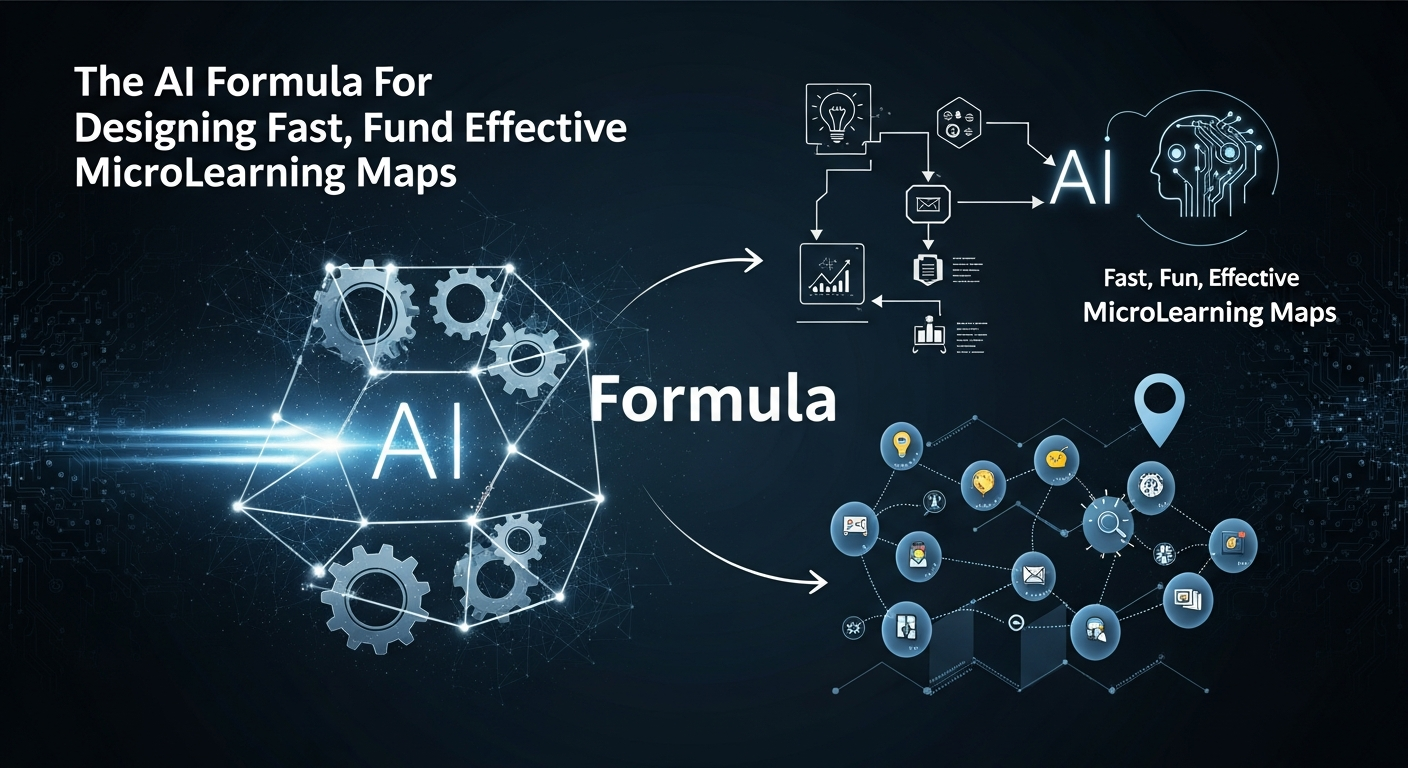
The AI Formula for Designing Fast, Fun, and Effective Microlearning Maps
In today's fast-paced corporate environment, the traditional approach to employee training often falls short. Vice Presidents, Directors, and Senior Managers in Learning & Development are constantly seeking innovative solutions to enhance knowledge retention, boost engagement, and drive measurable performance improvements. Enter microlearning – short, focused bursts of learning designed to fit into an employee's workflow. But what if we could supercharge microlearning with the power of Artificial Intelligence? This article explores the AI formula for creating microlearning maps that are not just fast and fun, but profoundly effective across diverse industries.
Understanding Microlearning's Untapped Potential
Microlearning, by its very nature, is designed for immediate impact. It addresses specific learning objectives, delivering content in digestible formats like short videos, infographics, quizzes, or interactive modules. Its benefits are clear:
- Increased Engagement: Shorter modules combat information overload and maintain attention.
- Better Retention: Spaced repetition and targeted content aid memory recall.
- Flexibility: Learners can access training anytime, anywhere, on any device.
- Cost-Effectiveness: Easier to update and deploy than lengthy courses.
However, scaling microlearning to meet the diverse needs of an entire enterprise, from compliance to sales, requires more than just breaking down content. It demands intelligence, personalization, and adaptability – precisely where AI becomes indispensable.
The AI Advantage in L&D
Artificial Intelligence is no longer a futuristic concept; it's a present-day reality transforming how we learn and develop. For L&D leaders, AI offers an unprecedented opportunity to move beyond one-size-fits-all training to truly personalized and impactful learning experiences.
How AI Transforms Content Creation and Delivery
Consider the challenge of training a global workforce across multiple departments. One might ask, "How can AI identify and address specific knowledge gaps for individual learners, regardless of their role or location?" Or, "What are the critical skills our compliance team needs to master this quarter, and how can AI ensure the training adapts to evolving regulations?"
AI's analytical capabilities allow it to process vast amounts of data – learner performance, job roles, career paths, industry trends, and even employee feedback – to create dynamic learning experiences. It moves beyond simple recommendations, actively shaping the learning journey.
The AI Formula for Microlearning Maps
The synergy between AI and microlearning creates a powerful formula for designing learning maps that are inherently fast, fun, and effective.
Step 1: Data-Driven Personalization
The foundation of effective microlearning is knowing your learner. AI excels at this. By analyzing a learner's past performance, job role, skill gaps, preferred learning styles, and even their current projects, AI can construct a truly personalized learning path. This goes beyond basic segmentation. For instance, in a large financial institution, an AI-driven system can recommend specific modules on anti-money laundering regulations to a new compliance officer, while suggesting advanced risk assessment techniques to a seasoned portfolio manager.
This level of tailoring is the hallmark of Adaptive Learning. It ensures that every learner receives content that is relevant, challenging, and appropriate for their current skill level, maximizing efficiency and engagement. This answers the question, "How can we ensure each employee's learning journey is uniquely tailored to their role and development needs, regardless of their starting point?"
Step 2: Intelligent Content Curation and Creation
Creating engaging microlearning content can be resource-intensive. AI dramatically streamlines this process. An AI Powered Authoring Tool can:
- Suggest Content Topics: Based on performance data and trending industry skills.
- Generate Draft Content: From existing documentation or outlines, speeding up content development.
- Optimize Content for Microlearning: Break down complex topics into bite-sized, digestible modules.
- Translate and Localize: Instantly adapt content for global audiences, ensuring cultural relevance.
- Identify Gaps: Point out where new content is needed based on learner feedback or emerging requirements.
Imagine an L&D team for a global retail chain. They might ask, "How can we rapidly generate culturally sensitive product knowledge training for new hires in different regions, while ensuring consistency in core messaging?" AI provides the engine to answer this with speed and precision.
Step 3: Engaging Learning Paths and Gamification
Once content is personalized and created, AI helps design the learning journey to be not just effective but also enjoyable. This is where Gamified LMS features come into play. AI can:
- Recommend Next Steps: Based on performance and progress, ensuring learners are always on the right track.
- Introduce Challenges: Dynamically adjust difficulty levels to keep learners motivated.
- Facilitate Competition: Create leaderboards, badges, and points systems that genuinely drive engagement.
- Provide Real-time Feedback: Deliver immediate, constructive feedback that helps learners correct mistakes and understand concepts better.
The fun factor isn't just a bonus; it's a critical component of retention. An AI-enhanced platform can ensure that the learning experience feels less like a chore and more like an engaging challenge.
Step 4: Performance Analytics and Iteration
The AI formula doesn't stop at delivery. A crucial element is continuous improvement. AI-driven analytics can provide L&D leaders with deep insights into learner behavior, content effectiveness, and skill proficiency. This answers questions like, "What actions should an L&D leader take when a significant portion of employees struggle with a specific module, and how can AI help predict future training needs?"
AI can:
- Identify Learning Bottlenecks: Pinpoint where learners are struggling.
- Measure ROI: Correlate training completion and performance with business outcomes.
- Predict Future Needs: Anticipate skill gaps based on industry trends and company strategy.
- Recommend Content Updates: Highlight modules that need revision based on performance data.
This iterative loop ensures that microlearning maps are constantly optimized for maximum impact.
Addressing Industry-Specific Needs with AI
The power of the AI microlearning formula resonates across various sectors:
- Compliance: For industries like Banking, Finance, and Insurance, Risk-focused Training is paramount. AI can ensure all employees are up-to-date with the latest regulations, automatically flagging high-risk areas and tailoring modules for specific roles (e.g., AML for front-line staff, data privacy for IT). "How can AI optimize the delivery of compliance training to employees in different regulatory regions, ensuring legal adherence and cultural sensitivity?"
- Sales: In Retail and Sales, AI can provide sales professionals with quick product knowledge updates, objection handling techniques, and competitive analysis, directly impacting their performance. "What are the key learning objectives for our sales team in the upcoming quarter, and how can AI help tailor training to achieve them for different markets?"
- Healthcare & Pharma: AI can deliver critical updates on new drugs, medical procedures, or patient care protocols in digestible micro-modules, ensuring healthcare professionals are always informed without disrupting their busy schedules.
- Hospitality: AI can craft quick training on new service standards, software updates, or cultural etiquette, maintaining high standards across a diverse workforce.
- Oil & Gas / Mining: Safety training is non-negotiable. AI-driven microlearning can deliver crucial safety refreshers, emergency procedures, and equipment operation guides, ensuring critical information is absorbed and retained, minimizing risk in hazardous environments.
The Role of an Advanced Learning Platform
To fully leverage this AI formula, organizations need a robust learning management system. A modern Microlearning LMS serves as the central hub for creating, delivering, and managing these intelligent learning experiences. A comprehensive learning content management system (LCMS) with AI capabilities can be the game-changer.
When considering a learning management software, L&D leaders should look for a cloud based learning management system that offers not just course delivery but also powerful analytics, AI integration for content generation and personalization, and features that support gamification and adaptive learning. An enterprise learning management solution like MaxLearn LMS provides the infrastructure to implement this AI formula, transforming corporate training from a mere necessity into a strategic advantage.
Choosing the right learning management system (LMS) is crucial. A sophisticated lms learning management system not only hosts content but acts as an intelligent partner in skill development.
The future of corporate learning is intelligent, personalized, and efficient. By embracing the AI formula for designing microlearning maps, L&D leaders can create fast, fun, and profoundly effective training programs that empower employees, drive performance, and ensure their organizations remain competitive in an ever-evolving global landscape.
.jpg)


