

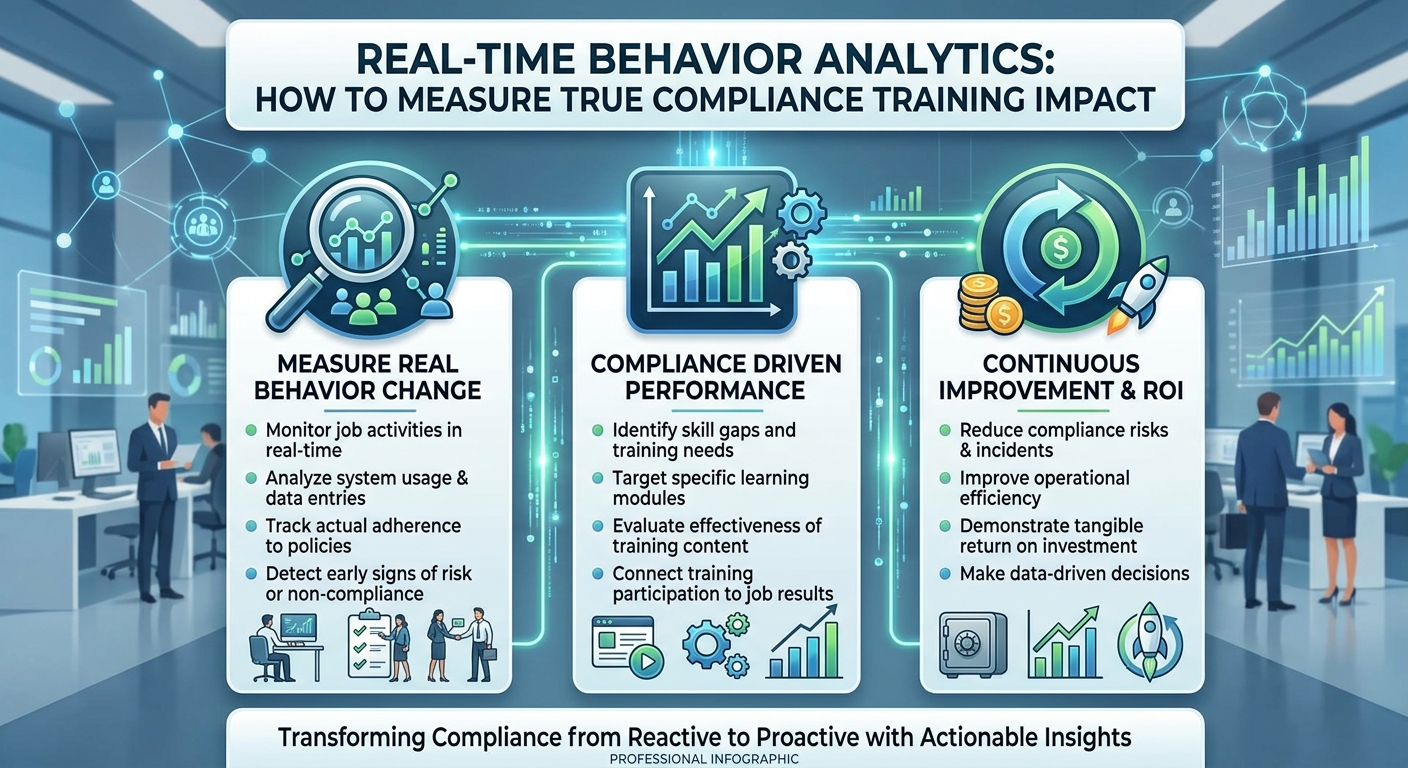
Real-Time Behavior Analytics: How to Measure True Compliance Training Impact
For too long, Learning & Development (L&D) leaders have grappled with a pervasive question: are our compliance training programs truly effective? In an era where regulatory landscapes evolve rapidly and the cost of non-compliance can be catastrophic, merely tracking completion rates or test scores is no longer enough. The challenge isn't just delivering information; it's ensuring that information translates into tangible, compliant employee behavior. This is where real-time behavior analytics emerges as a game-changer, offering a profound shift from passive metrics to proactive, impactful measurement.
Imagine knowing not just if an employee passed a compliance module, but if they apply that knowledge in their daily tasks, make the right decisions in critical moments, and consistently adhere to policies. Real-time behavior analytics provides this level of insight, transforming compliance training from a checkbox exercise into a measurable driver of organizational integrity and risk mitigation. For Vice Presidents, Directors, Senior Managers, and Managers of L&D, understanding and implementing this approach is no longer optional; it's a strategic imperative.
The Evolving Landscape of Compliance Training Measurement
Traditional compliance training often focuses on inputs and outputs: hours spent, modules completed, scores achieved. While these metrics offer a baseline, they fail to answer the ultimate question: has the training genuinely changed behavior and reduced risk? A high score on an anti-money laundering quiz doesn't guarantee an employee will flag a suspicious transaction in a real-world scenario. Similarly, a signed policy acknowledgment doesn't mean policies are consistently followed.
The core problem lies in the disconnect between knowledge acquisition and behavioral application. Without a mechanism to observe and analyze actual employee actions within their operational context, L&D departments operate with a significant blind spot. This gap can lead to ineffective training investments, persistent compliance vulnerabilities, and a reactive approach to risk management.
What is Real-Time Behavior Analytics?
Real-time behavior analytics involves the continuous collection and analysis of data points reflecting how employees interact with systems, make decisions, and perform tasks related to compliance. It moves beyond theoretical knowledge to observable actions. This data can come from various sources:
- Interactions within enterprise software (CRM, ERP, internal platforms)
- Decision-making simulations and Gamified LMS scenarios
- Responses to specific prompts or situations in their workflow
- Error rates or deviations from established procedures
- Application of learned protocols in simulated or actual work environments
By analyzing these streams of data in real-time or near real-time, L&D leaders can gain immediate insights into behavioral patterns, identify areas of non-compliance as they emerge, and understand the practical impact of their training interventions. This approach transforms the Microlearning LMS and LMS from a content delivery system into a powerful behavioral diagnostic tool.
Why Real-Time Matters for Compliance Impact
The immediacy of real-time analytics offers several profound advantages for measuring compliance training impact:
Proactive Risk Mitigation
Instead of discovering non-compliance after an incident, real-time data allows for the identification of behavioral anomalies or emerging risks before they escalate. This enables proactive intervention, whether through targeted learning management solutions or direct feedback.
Pinpointing Training Gaps
By correlating specific behaviors with particular training modules, L&D can precisely identify which parts of their curriculum are effective and which are not translating into desired actions. This allows for data-driven optimization of enterprise learning management content.
Personalized Remediation and Adaptive Learning
Understanding individual employee behavior allows for highly personalized feedback and Adaptive Learning paths. If an employee consistently struggles with a specific type of decision, the cloud based learning management system can automatically recommend relevant learning content management system modules or scenarios.
Demonstrable ROI
With clear links between training, behavior change, and reduced incidents or fines, L&D can robustly demonstrate the return on investment of compliance training programs to senior leadership. This elevates the strategic importance of the learning management software and the L&D function.
Integrating Advanced Intelligence for Deeper Insights
The true power of real-time behavior analytics is unlocked when combined with advanced intelligence. This integration allows L&D leaders to move beyond raw data to actionable insights.
How can we precisely pinpoint the training modules that are failing to translate into desired employee actions?
Advanced analytical algorithms can scan vast datasets of employee interactions and link specific behavioral patterns – such as frequent errors in data entry, incorrect approval processes, or missed red flags – directly back to the training content that was supposed to address them. By identifying correlations between module completion and subsequent non-compliant actions, these systems highlight curriculum weaknesses. This precision allows L&D teams using a modern lms learning management system to target revisions, leveraging an AI Powered Authoring Tool to create more effective content.
Which departments or locations are struggling most with specific compliance policies, and what are the underlying reasons?
By segmenting behavioral data across organizational structures, intelligent systems can reveal geographical or departmental compliance hotspots. Is the sales team in one region consistently deviating from ethical selling practices? Are finance teams in another area failing to properly document transactions? Beyond identification, these systems can analyze contributing factors like workload, system design, or cultural norms, offering a comprehensive view. This helps L&D tailor MaxLearn LMS interventions and Risk-focused Training to specific needs, rather than applying a one-size-fits-all approach.
What specific content or interventions will most effectively improve an individual's compliance behavior?
By creating a detailed profile of each employee’s behavioral strengths and weaknesses, advanced intelligence can recommend highly personalized learning paths. If an employee consistently misclassifies data, the system might suggest a targeted Microlearning LMS module, a simulation focused on data classification, or even peer coaching. This individual-level insight moves training beyond generic requirements to truly impactful, tailored development, maximizing the effectiveness of the entire learning management system.
Real-World Application Across Industries
The need for true compliance measurement spans every sector:
- Banking & Finance: Monitoring transactions for suspicious activity, ensuring adherence to KYC/AML regulations.
- Healthcare: Tracking adherence to patient privacy (HIPAA) protocols, medication administration procedures.
- Pharma: Compliance with clinical trial protocols, ethical marketing practices.
- Retail: Ensuring fair pricing, data privacy (GDPR, CCPA), and ethical sales practices.
- Oil & Gas / Mining: Adherence to safety protocols, environmental regulations, and operational standards.
- Hospitality: Compliance with food safety, guest privacy, and service standards.
- Sales: Ethical sales practices, contract adherence, and regulatory compliance in customer interactions.
In each of these industries, real-time behavior analytics, powered by a robust LCMS, can transform compliance training from a static requirement into a dynamic, protective layer for the organization.
Embracing the Future of Compliance Training
The shift to real-time behavior analytics represents a paradigm change for L&D professionals. It means moving from being reactive custodians of training content to proactive architects of compliant organizational behavior. It requires an investment in modern learning management system platforms that can not only deliver diverse learning content but also integrate with operational systems to gather and analyze behavioral data.
For L&D leaders, the opportunity is clear: elevate compliance training from a necessary evil to a strategic asset. By embracing real-time behavioral insights, you can ensure that every training hour contributes directly to a more compliant, less risky, and ultimately, more successful organization. The true impact of compliance training isn't just about what employees know, but what they consistently do.
.jpg)


